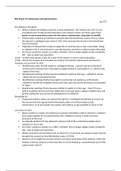
Peds Study Guide Exam 2 (GI, GU, Endocrine, Neuro, Heme/Immune)
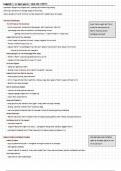
Kim 1. Dehydration – diarrhea and vomiting (from powerpoint) a. Dehydration i. Clinical Manifestations: 1. CRT greater than 3 seconds, dry mucous membranes, absence of tears, sunken fontanels, lethargy, weight loss, rapid weak pulse (1st to respond), low BP (last to respond) ii. Urine output needs to be 1mL/kg per hour for anyone under 30kg. iii. Dehydration Criteria (% of body weight lost) 1. Mild dehydration=5% of total body weight 2. Moderate=10% of total body weight 3. Severe=15% of total body weight iv. Nursing Interventions 1. Assessment should include body weight, skin color, temp & turgor, CRT, presence of thirst sensation, fontanels in infants v. Vomiting: 1. So there is nothing really in the powerpoint or ATI specifically on vomiting….I guess just know that it can cause dehydration and to monitor I&O and F&E status. Can be associated with metabolic alkalosis. vi. TB (chapter 26) 1. Question #: 20 2. ATI book (chapter 22): question 1 2. Inflammatory bowel disease – Ulcerative Colitis and Crohn’s a. Kaur said she’s taking this topic out since it wasn’t in the powerpoint or discussed in lecture. 3. Necrotizing enterocolitis (NEC) (from Powerpoint) a. Acute inflammatory disease of the bowel. Usually occurs 4-10 days after initial feeding. Seen in preterm and high risk infants! b. Due to stasis in the GI tract, decreased blood supply leads to ischemia →bacterial proliferation (HUGE PROBLEM!) c. S/S i. Distended abdomen, bloating, gastric residual that is bile tinged, occult blood in stool, lethargy, poor feeding, pale skin, and bradycardia and hypotension (which are s/s of sepsis!) d. Treatment i. DC the feedings to rest the bowel ii. Gastric tube used to decompress iii. Abx used to treat sepsis iv. Sx may be indicated to remove necrotizing tissue e. Nursing Care i. Monitor VS and gastric residuals ii. Eval stool and abdominal girth iii. Re-establish feeding (breast milk) and monitor tolerance 4. Hirschsprung’s disease (ATI book and powerpoint) a. Lack of ganglionic cells in the segments of the colon resulting in ↓motility and mechanical obstruction. No peristaltic waves in the affected portion of the bowel causing obstruction and distention. b. S/S i. Failure to pass meconium w/i 24-48 hrs after birth ii. Episodes of vomiting bile, poor feeding iii. Abdominal distention/constipation iv. Foul smelling, ribbon like stool! c. Surgical removal of the affected portion is needed. Temporary colostomy may be required d. Nursing Interventions i. High protein, high calorie, low fiber diet ii. Educate parents on colostomy care. e. TB (chapter 26) i. Question #: 6, 7, 8, 9, 38 39 ii. ATI book (chapter 23): question 2 iii. 5. GERD (ATI book and powerpoint) a. Primarily due to an incompetent LES, gastric contents regurg into esophagus. Peak incidence is around 4 mo. old, usually resolves by 1 yr. b. S/S i. Spitting up, forceful vomiting, aspiration may lead to resp. Signs, ulceration and bleeding c. Nursing Management i. Offer small, frequent feedings. ii. Thicken formula with rice cereal iii. Position the child with head elevated after meals. At least an hour at a 30° angle. iv. Can administer antacids before meals or at bedtime. Ranitidine commonly used. v. Nissen fundoplication sx used for patients who have severe cases. vi. TB (chapter 26) 1. Question #: 10, 11, 24, 25, 41, 46, 47. SATA #: 1, 5, 11 2. ATI book (chapter 23): question 5 Mae 6. Appendicitis/Appendectomy (ATI/other version of PPT in portal) a. Etiology/Pathophysiology: 1. Inflammation of the vermiform appendix caused from an obstruction of the lumen of the appendix 2. Obstruction causing inflammation and ischemia → can rupture → peritonitis 3. Average client age is 10 years b. S/S: 1. Abdominal pain in the RLQ 2. Decreased or absent bowel sounds 3. Fever 4. Lethargy 5. Tachycardia 6. Diarrhea or constipation 7. Rapid, shallow breathing 8. Anorexia 9. Possible vomiting 10. “Colicky, cramping, abdominal pain around the umbilicus” c. Lab tests: 1. CBC 2. Urinalysis d. Diagnostic Procedures: 1. Computed tomography scan shows an enlarged diameter of appendix, as well as thickening of the appendiceal wall 2. Including pain: “McBurney’s point” e. Management: 1. Surgery, antibiotics, IV fluids, pain meds with caution, antipyretics, antiemetics f. Nursing care: 1. **Avoid applying heat to the abdomen, enemas or laxatives g. Therapeutic Procedures 1. Appendectomy: treatment for simple or perforated appendicitis 2. Laparoscopic procedure: provides quick recovery for simple appendicitis a. Laparoscopic surgery: removal of the non ruptured appendix b. Laparoscopic or open surgery: removal of the ruptured appendix h. Complications: 1. Peritonitis (inflammation of the peritoneal cavity) i. TB (Chapter 26) i. Question #: 13, 14, 15, 48 and SATA #: 9 7. Cleft lip and palate a. Etiology/Pathophysiology: 1. Lip: visible separation from the upper lip toward the nose 2. Palate: visible or palpable opening of the palate connecting the mouth and the nasal cavity b. Risk Factors: 1. Family history 2. Environmental factors: exposure to teratogens, alcohol, smoking, medications & low folic acid 3. Other syndromes (ATI) c. S/S: 1. Feeding difficulties 2. Speech difficulties 3. Recurrent otitis media (related to altered structure) d. Medical management: 1. Surgical closure 2. Surgery, speech therapy 3. Cleft lip: repair is done b/w 2-3 mo of age 4. Cleft palate: repair is done b/w 6-12 mo of age e. Nursing Interventions: 1. Ensure adequate intake of food and fluids without aspiration 2. Special feeding devices may be used 3. Frequent burping is necessary 4. Assist parents in dealing with the diagnosis f. Procedure nursing care: 1. Pre-op: - assess ability to suck, position the infant upright while cradling the head during feeding, use a wide-based nipple for bottle feeding (only for isolated cleft lip), burp the infant frequently, 2. Post-op: - ABCs, wound care, monitor for bleeding, clear liquid to soft diet, **AVOID having the infant suck on a nipple or pacifier b/c it can damage the surgical site - For cleft lip: apply elbow restraints to keep the infant form injuring the repair site - For cleft palate: change the infant’s position frequently to facilitate drainage and breathing. The infant may be placed on the abdomen in the immediate post-op period. g. TB (Chapter 3, 8) i. Chapter 3 Question #: 18 ii. Chapter 8 Question #: 21, 22, 26 & SATA #: 4 8. Esophageal atresia/Tracheoesophageal fistula
Written for
- Institution
- Peds Study
- Course
- Peds Study
Document information
- Uploaded on
- February 12, 2024
- Number of pages
- 34
- Written in
- 2023/2024
- Type
- Exam (elaborations)
- Contains
- Questions & answers
Subjects
-
kim 1dehydration diarrhea and vomiting