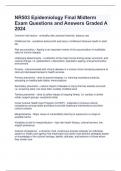
NR503 Epidemiology Final Midterm Exam Questions and Answers Graded A 2024
Common risk factors - unhealthy diet, physical inactivity, tobacco use Childhood risk - conditions before birth and early in childhood influence health in adult life. Risk accumulation - Ageing is an important marker of the accumulation of modifiable risks for chronic disease Underlying determinants - a reflection of the major forces driving social, economic, and cultural change. I.e. globalization, urbanization, population ageing, and general policy environment Poverty - interconnected with chronic disease in a vicious circle increasing exposure to risks and decreased access to health services Primary prevention - aims to prevent disease. I.e. banning hazardous products, educating on healthy/safe habits, immunizations Secondary prevention - reduce impact of disease or injury that has already occurred. I.e. screening tests, low-dose ASA, suitably modified work Tertiary prevention - aims to soften impact of ongoing illness. I.e. cardiac or stroke rehab, support groups, vocational rehab Cross Cultural Health Care Program (CCHCP) - materials to improve cultural competency among health providers to provide healthcare interventions and other cultural variants Marginalization - Major cause of vulnerability referring to exposure to a range of possible harms Variables at risk for marginalization - high risk health literacy, cultural barriers, low english proficiency Cultural competence - a dynamic, fluid, continuous process whereby an individual, system or health care agency find meaningful and useful care delivery strategies based on knowledge of the cultural heritage, beliefs, attitudes, and behavior of those whom they render care Norms & values - soecific practices that guide the actions and decisions of each person in a group based on their culture. Can be learned or shared. Kleinman Explanatory Model - A set of questions that the APN can use in order to assess the culture of a patient. Socioeconomic status - A measure that takes into account three interrelated dimensions: a person's income level, education level, and typ of occupation. Disparities - a higher burden of illness, injury, disability, or mortality experiences by one grup relative to another Minorities - a group of people who because of their physical or cultural characteristics, are singled out from the other in society Food desert - neighborhoods and communities that have limited access to affordable and nutritious foods Social determinants of health - poverty, education level, raciam, income, and poor housisng that effect access to healthcare Social justice theory - the goal that all people will have equal opportunity to healthcare access and quality of healthcare will be the same Data sources utilized to access determinants of health - Healthy People 2020, US Census, US Department of Health and Human Services, Office of Minority Health and Health Disparities Accommodation - To create an environment that accomodates health practice and ritual from other cultures within a plan of care Acculturation - degree to which an individual from one culture has given up the traits of that culture and adopted the traits of the dominant culture in which they now reside Assimilation - the social, economic, and political integration of a cultural group into mainstream society to which it may have emigrated Genetics - place patients at higher risk for certain disease and if family history reveals this a screening tool could be used to determine the likelihood of a person developing the disease Genetic risk assessment - when a patient is determined to have a gene that places them at a higher risk of having a disease such as cancer, diabetes, or cardiovascular disease
Written for
- Institution
-
Chamberlain College Of Nursing
- Course
-
NR503 Epidemiology.
Document information
- Uploaded on
- February 27, 2024
- Number of pages
- 14
- Written in
- 2023/2024
- Type
- Exam (elaborations)
- Contains
- Questions & answers
Subjects
- nr503 epidemiology final
- nr503 epidemiology
- nr503
-
nr503 epidemiology final midterm exam questions
-
nr503 epidemiology final midterm exam

Also available in package deal