CHAPTER 3 Business Continuity and Disaster Recovery questions and answers 2024.
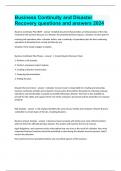
Business Continuity Plan (BCP) Detailed document that provides an initial analysis of the risks involved to the business because of a disaster, the potential business impact, a disaster recovery plan for restoring full operations after a disaster strikes, and a continuity of operations plan for best continuing operations if disrupted from normal activities by any situation, from simple outages to attacks. Business Continuity Plan Phases 1. Create Disaster Recovery Team 2. Perform a risk analysis. 3. Perform a business impact analysis. 4. Creating a disaster recovery plan. 5. Preparing documentation. 6. Testing the plan. Disaster Recovery Team A disaster recovery team is responsible for creating and executing business continuity activities and a disaster recovery plan that outlines the goals for restoring company operations and functionality as quickly as possible following a disaster. The team is also available to provide for the safety and support of the rest of the company's personnel and the protection of company property. Risk Analysis A risk analysis identifies the areas of your facility and computer network that are vulnerable to certain types of threats, including disasters. Business Impact Analysis A business impact analysis will outline your most critical functions and how they'll be affected during a disaster. The analysis will examine the loss of revenue, legal obligations, and customer service interruption that can arise as the result of a disaster. Your most important business functions should be prioritized so that during the disaster recovery process, they'll receive the attention they need to become operational before any noncritical aspects of the business. Types of Disasters: Natural, Human Error, Network / Hacking, Viruses Most important part of Company to get Operational: Basic Communications, Phone, Internet Connection. The Disaster Recovery Plan should include: -Notification lists -Contact information -Networking and facilities Diagrams -Systems Configurations -Backup and restorations procedures -Backup and licensing media Store on-site and off. Test out the Plan. High-Availability The ability to provide uninterrupted service consistently. Examples of Servers that require High-Availability File, E-mail, Networking, Internet, Database and Telecom (PBX). Reliability Factors Mean time to restore (MTTR), Mean time to failure (MTTF), Mean time between failures (MTBF), Recovery time objective (RTO), Recovery point objective (RPO). Mean Time to Restore (MTTR) Mean time to restore is the average time from the moment of a service failure until when the service is restored. For spare parts for a failed server hard drive, your service contract may state that they can provide a new hard drive within 4 hours, but in other cases, this could be 24 to 48 hours. A web hosting company may promise that for any failed website or service, the mean time to restore could be 60 minutes. Mean Time to Failure (MTTF) This is the time that a device is expected to last in regular service. For example, when comparing component prices, one device may have a lower initial price and also a lower MTTF; this could mean that your company spends more in the end on replacing components if the lower-cost device is chosen for implementation. MTTF assumes the component will not be repaired. Mean time between failures (MTBF) This is the average time a specific device is expected to work until it fails. A mathematical formula is used to determine how long a specific product should last based on previous measurements of failure rates. MTBF assumes components will be replaced or repaired upon failure. Recovery time objective (RTO) This is the maximum amount of time that is considered tolerable for a service or certain business function to be unavailable. Organizations use this as a key factor in their ability to provide specific guaranteed service levels. Recovery point objective (RPO) This is the maximum accepted amount of lost data as a result of an outage or disaster. This is defined in terms of time, such as one hour. For example, if a database server fails, up to one hour of data can be considered an acceptable loss. These policies are defined in the business impact analysis of your business continuity and disaster recovery plan. This objective can help define other security policies, such as the backup frequency, to make sure that a data backup occurs at least every hour to preserve the RPO. Redundant Servers A mirror sever that can be used in conjunction with a live server in case the live server goes down, the backup server can take over. Or the live can be swapped with the backup. Clustering For more advanced high-availability purposes, the use of clustering technology enables you to use several servers to perform the services of one. Clustering greatly enhances load balancing, as the resources of all the servers can be used to perform the same task as one server. For fault tolerance purposes,if one system goes down, one of the other servers in the cluster can take over seamlessly without any interruption to the clients. Active / Active Active / Passive Active / Active Clustering Active/active means that both servers in the cluster are up and running and actively responding to requests. In the event one server is unavailable, no drop in availability occurs, as the other server is still actively responding to requests. Active / Passive Clustering In an active/passive arrangement, one server is actively responding to requests, while the other server acts as a live standby. In the event the active server is unavailable, the other passive server can be triggered into becoming the active server and begin responding to requests. Load Balancing Load balancing simply allows administrators to balance the load traversing a network across a number of resources in a distributed manner. Load balancing is often used with websites that receive a large amount of traffic, assuring that the web server is not a single point of failure. Applying the concept of load balancing allows a failover mechanism in the event one server is lost due to mishap or disaster. This can be implemented in several ways, including clustering. Alternative Site Redundancy Hot Site, Warm Site, Cold Site. Hot Site Alternative Site Redundancy , A hot site is a facility that's ready to be operational immediately when the primary site is unavailable. All equipment and networking infrastructure the company requires are already in place and can be activated quickly. Warm Site Alternative Site Redundancy, A warm site is similar to a hot site, but without most of the duplicate servers and computers that would be needed to facilitate an immediate switchover. The warm site is there to provide an immediate facility with some minimal networking in place. In the event of a disaster, a company will transport its own equipment to the new facility, or if the original equipment is destroyed with the facility, new equipment can be purchased and moved there. Cold Site Alternative Site Redundancy, A cold site merely offers an empty facility with some basic features, such as wiring and some environmental protection, but no equipment. This is the least expensive option, but this also means in case a disaster strikes, it might take several weeks before the facility and equipment are ready for operation, as almost all the networking and server infrastructure will need to be built and configured. Fault Tolerance To make a system fault tolerant, it should contain a number of redundant components that will allow it to continue functioning if an equipment failure occurs. RAID Hard drives, Backup Power supply, Power Generator, UPS, Network cards, Data Backups RAID 0 Striping RAID 1 Mirroring Types of Backups Full Backup, Incremental, Differential Planning a backup strategy should contain: The type of data, frequency of backups, amount of data and retention period (time to keep backups). Backups what media? Tape, or Hard drives / NAS Full Backup A full backup includes all files selected on a system. A full backup will clear the archive bit of each file after every backup session to indicate the file has been backed up. Incremental Backup With an incremental backup, only those files that have been modified since the previous full or incremental backup are stored. The archive bit is cleared on those files that are backed up. Incremental backups are much quicker to perform than full backups, and they use up much less space on backup media because you're saving only files that have been changed. The disadvantage of incremental backups is that to restore an entire system, you need to restore the last full backup and every incremental backup since then.
Written for
- Institution
- BUSINESS CONTINUITY AND DISASTER RECOVERY
- Course
- BUSINESS CONTINUITY AND DISASTER RECOVERY
Document information
- Uploaded on
- February 28, 2024
- Number of pages
- 7
- Written in
- 2023/2024
- Type
- Exam (elaborations)
- Contains
- Questions & answers
Subjects
-
chapter 3 business continuity and disaster recover

Also available in package deal