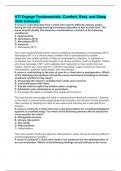
EMT AAOS Section 6 Medical Test Exam with 100% Correct Answers
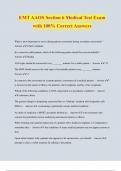
EMT AAOS Section 6 Medical Test Exam with 100% Correct Answers What is most important to assess during patient assessment during secondary assessment? - Answer ️️ -Chief complaint In a conscious adult patient, which of the following pulses should be assessed initially? - Answer ️️ -Radial Vital signs should be reassessed every ________ minutes for a stable patient. - Answer ️️ -15 The EMT should reassess the vital signs of an unstable patient every ________ minutes. - Answer ️️ -5 In contrast to the assessment of a trauma patient, assessment of a medical patient: - Answer ️️ - is focused on the nature of illness, the patient's chief complaint, and his or her symptoms. Which of the following conditions is NOT categorized as a psychiatric condition? - Answer ️️ -substance abuse The greatest danger in displaying a personal bias or "labeling" a patient who frequently calls EMS is: - Answer ️️ -overlooking a potentially serious medical condition. An index of suspicion is MOST accurately defined as: - Answer ️️ -your awareness and concern for potentially serious underlying and unseen injuries or illness. When forming your general impression of a patient with a medical complaint, it is important to remember that: - Answer ️️ -the conditions of many medical patients may not appear serious at first. Upon initial contact with a patient who appears to be unconscious, you should: - Answer ️️ - attempt to elicit a verbal response by talking to the patient. Your primary assessment of an elderly woman reveals that she is conscious and alert, but is experiencing difficulty breathing. She has a history of emphysema, hypertension, and congestive heart failure. As you assess the patient's circulatory status, you should direct your partner to: - Answer ️️ -administer oxygen with the appropriate device. In addition to looking for severe bleeding, assessment of circulation in the conscious patient should involve: - Answer ️️ -checking the radial pulse and noting the color, temperature, and condition of his or her skin. When assessing a patient with a medical complaint, which of the following would MOST likely reveal the cause of his or her problem? - Answer ️️ -history taking Which of the following will MOST reliably allow you to determine the nature of a patient's illness? - Answer ️️ -asking questions related to the chief complaint A 58-year-old man complains of chest discomfort and nausea. He is conscious and alert; his blood pressure is 140/90 mm Hg, his pulse is 104 beats/min, and his respirations are 16 breaths/min. Your partner has applied supplemental oxygen. Prior to assisting the patient with one of his prescribed nitroglycerin tablets, you ask him if he takes medication to treat erectile dysfunction and he tells you that he does. You should: - Answer ️️ -ask him what he takes, how much, and when he last took it. When caring for a patient who takes numerous medications, it is best to: - Answer ️️ -take all of the patient's medications with you to the hospital and document them on your patient care report. The secondary assessment of a medical patient - Answer ️️ -is not practical if the patient is critically ill or your transport time is short. You have just completed your primary assessment of a 48-year-old man with crushing chest pain. The patient has been given 324 mg of aspirin and is receiving high-flow oxygen via nonrebreathing mask. As you begin your secondary assessment, you note that his mental status has deteriorated and he is now bradycardic. You should: - Answer ️️ -prepare the patient for immediate transport. When performing a secondary assessment on a conscious patient with nontraumatic abdominal pain and stable vital signs, you should: - Answer ️️ -focus on his or her chief complaint. It is especially important to assess pulse, sensation, and movement in all extremities as well as pupillary reactions in patients with a suspected ___________ problem. - Answer ️️ -neurologic Which of the following assessment findings is MOST indicative of a cardiovascular problem? - Answer ️️ -jugular venous distention A 33-year-old female presents with lower abdominal quadrant pain. She is conscious and alert, but in moderate pain. While your partner is asking her questions about her medical history, you take her vital signs. When you assess her radial pulse, you are unable to locate it. You should: - Answer ️️ -assess the rate, regularity, and quality of her carotid pulse. End-tidal carbon dioxide (ETCO2) monitoring is clearly indicated for patients who present with: - Answer ️️ -respiratory distress. Reassessment of a patient with a medical complaint should begin by: - Answer ️️ -repeating the primary assessment. The primary prehospital treatment for most medical emergencies: - Answer ️️ -addresses the patient's symptoms more than the actual disease process. Which of the following medications would the EMT LEAST likely administer to a patient with a medical complaint? - Answer ️️ -naloxone (Narcan) When caring for a patient with an altered mental status and signs of circulatory compromise, you should: - Answer ️️ -limit your time at the scene to 10 minutes or less, if possible. The determination of whether a medical patient is a high-priority or low-priority transport is typically made: - Answer ️️ -after the primary assessment has been completed. Which of the following conditions often requires transport to a hospital with specialized capabilities that may not be available at the closest hospital? - Answer ️️ -stroke and heart attack After sizing up the scene of a patient with a possible infectious disease, your next priority should be to: - Answer ️️ -take standard precautions. Typical chief complaints in patients with an infectious disease include: - Answer ️️ -fever, rash, nausea, and difficulty breathing. In addition to obtaining a SAMPLE history and asking questions related to the chief complaint, what else should you inquire about when assessing a patient with a potentially infectious disease? - Answer ️️ -recent trav
Written for
- Institution
- AAOS EMT
- Course
- AAOS EMT
Document information
- Uploaded on
- March 22, 2024
- Number of pages
- 29
- Written in
- 2023/2024
- Type
- Exam (elaborations)
- Contains
- Questions & answers
Subjects
-
emt aaos section 6 medical test exam with 100 cor

Also available in package deal