The Diversity of Eukaryotes-Questions & Answers
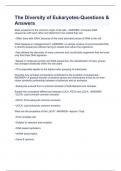
The Diversity of Eukaryotes-Questions & Answers State evidence for the common origin of all cells. -ANSWER-~Compare DNA sequences with each other and determine how related they are. ~Often done with rDNA, because of the most abundant pieces of DNA in the cell. What happens in metagenomics? -ANSWER-~A sample mixture of environmental DNA is directly sequenced without having to isolate and culture the organisms. ~Has allowed the discovery of many unknown and uncultivable organisms that we know only from their DNA signature. ~Based on molecular protein and DNA sequences, the classification of many groups has changed drastically within the last years. ~This especially applies to the higher-order grouping of eukaryotes. Describe how archaea and bacteria contributed to the evolution of eukaryotes. -ANSWER-~A gradual transfer of bacterial genes and membranes driven by an ever-closer symbiotic partnership between a bacterium and an archaeon. ~Eukaryota evolved from a common ancestor of both Bacteria and Archaea. Explain the conceptual differences between LUCA, FECA and LECA. -ANSWER-~LUCA: Last universal common ancestor. ~FECA: First eukaryotic common ancestor. ~LECA: Last eukaryotic common ancestor. What are the properties of the LUCA? -ANSWER-~Approx 3 bya. ~First complete cell. ~Subject to selection and mutation. ~DNA-based replication. ~mRNA transcription. ~Gene & operons.
Written for
- Institution
- The Diversity of Eukaryotes
- Course
- The Diversity of Eukaryotes
Document information
- Uploaded on
- March 26, 2024
- Number of pages
- 5
- Written in
- 2023/2024
- Type
- Exam (elaborations)
- Contains
- Questions & answers
Subjects
- metagenomics
- monophyletic
- phylum
- examples of ciliates
-
the diversity of eukaryotes questions answers
-
the properties of the luca
-
synapomorphies of eukaryotic cells

Also available in package deal