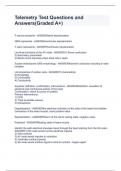
Telemetry Test Questions and Answers(Graded A+)
P waves represent - ANSWERatrial depolarization QRS represents - ANSWERventricular depolarization T wave represents - ANSWERventricular repolarization List three functions of the AV node - ANSWER1) Slows conduction 2) Secondary pacemaker 3) Blocks some impulses when atrial rate is rapid Explain wide/bizarre QRS morphology - ANSWERAberrant conduction resulting in wide complex List properties of cardiac cells - ANSWER1) Automaticity 2) Excitability 3) Contractility 4) Conductivity Asystole: definition, confirmation, interventions - ANSWERDefinition: cessation of electrical and mechanical activity of the heart Confirmation: check for pulse on patient Primary Interventions: 1) CPR 2) Treat reversible causes 3) Epinephrine Depolatization - ANSWERthe electrical activation of the cells of the heart that initiates contraction of the heart muscle, more positive value Repolarization - ANSWERReturn of the cell to resting state, negative value Polarized - ANSWERResting state of heart muscle Identify the path electrical impulses travel through the heart starting from the SA node - ANSWER1) SA node sends out the electrical impulse 2) Atria contract 3) AV node sends impulse to ventricles 4) Ventricles contract (pump) 5) SA node sends another signal to atria to contract - begins again Intrinsic rate of sinus - ANSWER60-100 bpm Intrinsic rate of junctional - ANSWER40-60 bpm Intrinsic rate of Purkinge fiber (ventricular) - ANSWER20-40 bpm How does AV dysfunction lead to 1st degree block? - ANSWERTakes too long for h
Written for
- Institution
- Telemetry
- Course
- Telemetry
Document information
- Uploaded on
- March 28, 2024
- Number of pages
- 4
- Written in
- 2023/2024
- Type
- Exam (elaborations)
- Contains
- Questions & answers
Subjects
- telemetry test stuvia
-
telemetry test questions and answersgraded a
-
p waves represent answeratrial depolarization q
-
explain widebizarre qrs morphology answeraberr

Also available in package deal