Diagnosis and Psychopathology Midterm Exam (Answered) Complete Solution
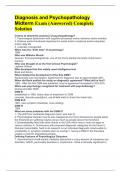
Diagnosis and Psychopathology Midterm Exam (Answered) Complete Solution Criteria to determine presence of psychopathology? 1. Psychological dysfunction with cognitive processes and/or behavior and/or emotion 2. Distress and/or functional impairment in social and/or vocational and/or education and/or daily life 3. Culturally Unexpected When was the "birth date" of psychology? 1886 Who was Wilhelm Wundt German, First psychological lab, one of the first to identify the limits of short-term memory Who was thought of as the first Clinical Psychologist? Lightner Witmer Who developed the first widely used intelligence test Binet and Simon What initiated the development of the first DSM? Assessment was inconsistent. Agreement for diagnosis was at approximately 20%. When did Beck publish his study on diagnostic agreement? What did he find? 1962 - After the first DSM was published, level of agreement increased to 32%-42%. When was psychology recognized for treatment with psychotherapy? During and after WWII DSM III established in 1980, heavy dose of empiricism in DSM concrete, discrete populations, use of field trials to check the check lists. DSM III-R 1987, new symptom checklists, more etiology DSM IV 1994 What are some problems with the DSM-5? 1. The shift from multiracial diagnosis (Axis I and Axis II), 2. Psychological disorder may be less categorical and more dimensional, people below the threshold are suffering maybe just as much as people above the threshold, 3.Generalizability-field trials done mainly in the USA which may or may not apply to various cultures, 4. Controversy with proposed diagnostic categories for the future 5. Rampant comorbidity- hard to do research on an individual diagnostic criteria-adds to unreliability, 6. symptom clusters seem to overlap 7. having a DSM in the first place creates a code for stigmatizing people Defining Features of Psychological Disorders 1. discontrol-lack of self-control, inhibition (discontrol is a key element of substance use disorders, ADHD, personality disorders 2. impairment-- What is clinically significant in regards to impairment? ex: Autism disorder used to be diagnosed only if severe, non-verbal. What's viewed as significant has changed over the years. Note: unclear boundaries are often prevalent in diagnosis (ex: same treatment used to address depressive and anxiety disorders) Who initiated the categorical model, recognizing its gray area? Kraeplin, he began insisting clear distinctions between normality and psychopathology. Theories of dual diagnosis Primary/Secondary Theory-Psychological disorder first, then substance use disorders (SUD). Substance use is attempt at self-medication, SUD related to neurocoginitive deficits related to disorders (ex: schizophrenia symptoms may put someone at a higher risk for SUD). OR SUD is primary and psychological condition is secondary (ex: SUD primary, MDD secondary). cycle of need would drive to MDD-feeling hopeless Bidirectional Causality Model- SU influences psych disorder at the same time psych disorder is influencing SU. cyclic in nature ex: anxiety disorders and dual diagnosis Common Factors Model- ASP disorder common factor to explain disorder and SUD, not a lot of good studies with conclusive factors. DSM-IV-TR 2000 Strengths of categorical system Simplicity Credibility What was the Epidemiological Catchment Area (ECA)? Largest and most comprehensive study of mental disorders ever completed in the United States. The study collected data on the prevalence and incidence of mental disorders in the United States. Characteristics of Dual Diagnosis? Treatment compliance is terrible. Higher rates of homelessness, legal trouble, treatable illnesses. They consume the most health care dollars (despite the fact that they have trouble with treatment compliance). DSM 5 2013 What are some assumptions about the DSM? 1. It identifies/classifies things that are readily distinguishable 2. the accurate diagnosis of disorder is actually important -Dx facilitates choice of a specific treatment that is effective for that disorder 3. substantiates a medical model for psychological disorders which leads to assumption that medical intervention should be prioritized. What is it that makes a discrete illness? 1. There is a reliably observes set of symptomatic criteria 2. criteria can be observed by clinicians 3. Dx are predictable in terms of their course What is important to examine in addition to psychological dysfunction for identifying cases? life impairment, perceived distress, coping styles-adaptive, maladaptive, readiness for treatment--not ready, ready, ambivalent, social support-no, little, moderate, good What are the benefits of discrete, effective treatments? 1. significantly better than no treatment or placebo 2. specific treatments rather than general treatments for all people with psych disorders What are the five advantages of using the SCID 1. increases coverage of diagnoses covered 2. enhances ability to accurately determine whether any Dx is present 3. reduces variability b/t clinicians, therefore leads to increased reliability and diagnosis 4. increase validity 5. very good for trainees-takes guess work out of creating questions Snowballing nature of worry that's practically unstoppable once it starts For example: Anxiety rolls over people with GAD. What is the "All evidence is equally good" fallacy? don't treat anecdotal evidence and empirical evidence the same. What is the "ignorance of statistical logic fallacy?" inferring personality trait from a single of limited sample of behavior. ex: person responding in anger to specific issue has anger management issues--one instance(or 2 or 3) of behavior is not a pattern DSM I 1952 DSM II 1968 DSM-IV 1994 The Barnum Effect common behaviors/experiences are deemed important in diagnostic process. Ex: bereavement and depression. Also of the behaviors shown by those grieving a loss may now be deemed as depression. May be including more ppl in the depressed Dx than we need to. The sick-sick fallacy know of someone that had a disorder and compare the individual to someone who behaves same way and say that they have that dx too. The "me too" fallacy or Uncle George's pancakes fallacy people who are "like us" must not be abnormal and people who are not like us must be abnormal.Ex: pancakes everyday for breakfast is absolutely necessary for an individual or they will break down--which seems abnormal, but justify it by saying "oh, no, my uncle george had pancakes everyday for breakfast and he was fine." The understanding makes it normal fallacy logical explanation for why a person behaves that way--assuming there is a causal explanation Multiple Napoleons Fallacy if patient believes is something that can't be true and acts on that belief. Ex: Client believes he is Napoleon so saying that how he behaves is normal and ok/explainable The soft-hearted, soft-headed fallacy
Written for
- Institution
- Diagnosis and Psychopathology
- Course
- Diagnosis and Psychopathology
Document information
- Uploaded on
- April 9, 2024
- Number of pages
- 20
- Written in
- 2023/2024
- Type
- Exam (elaborations)
- Contains
- Questions & answers
Subjects
-
diagnosis and psychopathology midterm exam answer

Also available in package deal