EXAM 3 NR 324
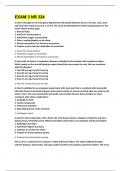
EXAM 3 NR 324 A client is brought to the emergency department with partial thickness burns to his face, neck, arms, and chest after trying to put out a car fire. The nurse should implement which nursing actions for this client? Select all that apply. 1. Restrict fluids. 2. Assess for airway patency. 3. Administer oxygen as prescribed. 4. Place a cooling blanket on the client. 5. Elevate extremities if no fractures are present. 6. Prepare to give oral pain medication as prescribed. 2. Assess for airway patency. 3. Administer oxygen as prescribed. 5. Elevate extremities if no fractures are present. A client with no history of respiratory disease is admitted to the hospital with respiratory failure. Which results on the arterial blood gas report should the nurse expect to note, that are consistent with this disorder? 1. Pao2 58 mm Hg, Paco2 32 mm Hg 2. Pao2 60 mm Hg, Paco2 45 mm Hg 3. Pao2 49 mm Hg, Paco2 52 mm Hg 4. Pao2 73 mm Hg, Paco2 62 mm Hg 3. Pao2 49 mm Hg, Paco2 52 mm Hg A client is admitted to an emergency department with chest pain that is consistent with myocardial infarction based on elevated troponin levels. Heart sounds are normal and vital signs are noted on the client's chart. The nurse should alert the health care provider because these changes are most consistent with which complication? 1. Cardiogenic shock 2. Cardiac tamponade 3. Pulmonary embolism 4. Dissecting thoracic aortic aneurysm 1. Cardiogenic shock A client in sinus bradycardia, with a heart rate of 45 beats/minute, complains of dizziness and has a blood pressure of 82/60 mm Hg. Which prescription should the nurse anticipate will be prescribed? 1. Defibrillate the client. 2. Administer digoxin (Lanoxin). 3. Continue to monitor the client. 4. Prepare for transcutaneous pacing. 4. Prepare for transcutaneous pacing. The nurse in a medical unit is caring for a client with heart failure. The client suddenly develops extreme dyspnea, tachycardia, and lung crackles and the nurse suspects pulmonary edema. The nurse immediately asks another nurse to contact the health care provider and prepares to implement which priority interventions? Select all that apply. 1. Administering oxygen 2. Inserting a Foley catheter 3. Administering furosemide (Lasix) 4. Administering morphine sulfate intravenously 5. Transporting the client to the coronary care unit 6. Placing the client in a low Fowler's side-lying position 1. Administering oxygen 2. Inserting a Foley catheter 3. Administering furosemide (Lasix) 4. Administering morphine sulfate intravenously A client with myocardial infarction suddenly becomes tachycardic, shows signs of air hunger, and begins coughing frothy, pink-tinged sputum. Which finding would the nurse anticipate when auscultating the client's breath sounds? 1. Stridor 2. Crackles 3. Scattered rhonchi 4. Diminished breath sounds 2. Crackles A client with myocardial infarction is developing cardiogenic shock. Because of the risk of myocardial ischemia, what condition should the nurse carefully assess the client for? 1. Bradycardia 2. Ventricular dysrhythmias 3. Rising diastolic blood pressure 4. Falling central venous pressure 2. Ventricular dysrhythmias Which readings obtained from a client's pulmonary artery catheter suggest that the client is in left-sided heart failure? 1. Cardiac output of 5 L/min 2. Right atrial pressure of 9 mm Hg 3. Pulmonary capillary wedge pressure (PCWP) 20 mm Hg 4. Pulmonary artery systolic/diastolic pressures of 24/10 mm Hg 3. Pulmonary capillary wedge pressure (PCWP) 20 mm Hg The nurse is watching the cardiac monitor and notices that the rhythm suddenly changes. There are no P waves, the QRS complexes are wide, and the ventricular rate is regular but more than 140 beats/minute. The nurse determines that the client is experiencing which dysrhythmia? 1. Sinus tachycardia 2. Ventricular fibrillation 3. Ventricular tachycardia 4. Premature ventricular contractions 3. Ventricular tachycardia A client has frequent bursts of ventricular tachycardia on the cardiac monitor. What should the nurse be most concerned about with this dysrhythmia? 1. It can develop into ventricular fibrillation at any time. 2. It is almost impossible to convert to a normal rhythm. 3. It is uncomfortable for the client, giving a sense of impending doom. 4. It produces a high cardiac output that quickly leads to cerebral and myocardial ischemia. 1. It can develop into ventricular fibrillation at any time. A client has developed atrial fibrillation, with a ventricular rate of 150 beats/minute. The nurse should assess the client for which associated signs/symptoms? 1. Flat neck veins 2. Nausea and vomiting 3. Hypotension and dizziness 4. Hypertension and headache 3. Hypotension and dizziness The nurse is watching the cardiac monitor, and a client's rhythm suddenly changes. There are no P waves; instead, there are fibrillatory waves before each QRS complex. How should the nurse correctly interpret the client's heart rhythm? 1. Atrial fibrillation 2. Sinus tachycardia 3. Ventricular fibrillation 4. Ventricular tachycardia 1. Atrial fibrillation The nurse is caring for a client who had a resection of an abdominal aortic aneurysm yesterday. The client has an intravenous infusion at a rate of 150 mL/hour, unchanged for the last 10 hours. The client's urine output for the last 3 hours has been 90, 50, and 28 mL (28 mL most recent). The client's blood urea nitrogen level is 35 mg/dL and the serum creatinine level is 1.8 mg/dL, measured this morning. Which nursing action is the priority? 1. Check the urine specific gravity. 2. Call the health care provider (HCP). 3. Check to see if the client had a sample for a serum albumin level drawn. 4. Put the intravenous (IV) line on a pump so that the infusion rate is sure to stay stable. 2. Call the health care provider (HCP). The nurse notes that a client with sinus rhythm has a premature ventricular contraction that falls on the T wave of the preceding beat. The client's rhythm suddenly changes to one with no P waves, no definable QRS complexes, and coarse wavy lines of varying amplitude. How should the nurse correctly interpret this rhythm?
Written for
- Institution
- NR 324
- Course
- NR 324
Document information
- Uploaded on
- April 11, 2024
- Number of pages
- 7
- Written in
- 2023/2024
- Type
- Exam (elaborations)
- Contains
- Questions & answers
Subjects
-
exam 3 nr 324 a client is brought to the emergency

Also available in package deal