Medicolegal Death Investigation Questions and Answers 100% Solved correctly
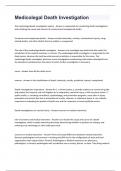
The medicolegal death investigation system - Answer-is responsible for conducting death investigations and certifying the cause and manner of unnatural and unexplained deaths Unnatural and unexplained deaths - Answer-include homicides, suicides, unintentional injuries, drugrelated deaths, and other deaths that are sudden or unexpected The role of the medicolegal death investigator - Answer-is to investigate any death that falls under the jurisdiction of the medical examiner or coroner. The medicolegal death investigator is responsible for the dead person, whereas the local law enforcement jurisdiction is responsible for the scene. The medicolegal death investigator performs scene investigations emphasizing information developed from the decedent and determines the extent to which further investigation is necessary. cause - Answer-how did the death occur manner - Answer-is the classification of death; homicide, suicide, accidental, natural, unexplained Death investigations importance - Answer-for 1. criminal justice; a. provide evidence to convict the guilty and protect the innocent, aid civil litigation as in malpractice, personal injury, or life insurance claims. 2. public health; a. including surveillance, epidemiology, and prevention programs, most often in injury prevention and control but also in prevention of suicide, violence, or substance abuse, b. are critically important in evaluating the quality of health care and the responses to terrorism/bioterrorism. Death investigations are carried out by - Answer-coroners or medical examiners role of coroners and medical examiners - Answer-is to decide the scope and course of a death investigation, which includes examining the body, determining whether to perform an autopsy, and ordering x-ray, toxicology, or other laboratory tests coroners vs medical examiners - Answer-There are broad differences between medical examiners (forensic pathologists) and coroners in training and skills and in the configuration of state and local organizations that support them: Forensic Pathologists or Medical examiners are physicians, pathologists, or forensic pathologists with jurisdiction over a county, district, or state. They bring medicalexpertise to the evaluation of the medical history and physical examination of the deceased. Forensic Pathologists provide unbiased, legally defensible determinations as to cause and manner of death. In times of mass disaster they may aid in victim identification and provide a legal explanation for cause and manner of death, A coroner is an elected or appointed official who usually serves a single county and often is not required to be a physician or to have medical training The major advantages of a statewide medical examiner system - Answer-are the quality of death investigations and forensic pathology services and their independence from population size, county budget variation, and politics the major advantages of the coroner system - Answer-concern autonomy, access to power, and the ability to represent the will of the electorate. As an elected official, a coroner has the power to make decisions and has equal footing with other local elected officials. That places the coroner in a strong position to withstand political pressures imposed by other elected officials and to compete vigorously for the office's budget allocation. Furthermore, due to their English commonlaw origins, coroners also have subpoena and inquest powers. Finally, being an elected official resonates with American political culture, which views elected officials as the best representatives of a community's needs and values autopsy - Answer-primary tool for medicolegal death investigation, performed by forensic pathologists - not coroners (typically), are performed to determine the cause of death, performed when there is suspected criminal activity or litigation is anticipated. the manner of death - Answer-is a legal question Steps for Autopsy - Answer-1. identification of the victim (photographs, DNA, fingerprints, inventory of personal effects, x-ray of the body and dentition) 2. Careful external examination, changes due to rigor mortis, livor mortis, algor mortis, and decomposition are noted 3. Evidence of injury is noted and described by type, location, size, shape, and pattern Internal examination - started with a Y incision from the shoulders to chest, then straight down to the pubis. 4. Organs are examined, described and weighed, samples are taken for further laboratory analysis. Specimens are always saved for a time proscribed by aw and policy. 5. Toxicology is performed 6. Special examinations, genitals, anal and oral orifices7. Organs may be harvested 8. Forensic pathologists may also serve as wound examinations for the living such as patterned injury in child abuse Psychological Autopsy - Answer-used to assist medical examiners in death classifications, particularly when there is some doubt as to whether or not a decedent committed suicide. In cases of suicide, Psychological autopsies are mostly used to gather information about the circumstances of an individual's life, as well as their death, in order to attempt to understand the possible reasons for suicide, ave also been used in some cases to determine the degree of mental illness that existed prior to the death
Written for
- Institution
- Medicolegal Death Investigation
- Course
- Medicolegal Death Investigation
Document information
- Uploaded on
- April 11, 2024
- Number of pages
- 4
- Written in
- 2023/2024
- Type
- Exam (elaborations)
- Contains
- Questions & answers
Subjects
-
medicolegal death investigation

Also available in package deal