UGA History Exemption Test - UPDATED 2022/2023
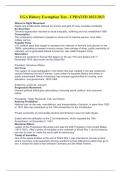
UGA History Exemption Test - UPDATED 2022/2023 Women's Right Movement Rights and entitlements claimed for women and girls of many societies worldwide Ku Klux Klan Terrorist organization devoted to racial inequality, suffering and evil; established 1868 Conscription The compulsory enlistment of people in some sort of national service, most often military service Populist Party U.S. political party that sought to represent the interests of farmers and laborers in the 1890s, advocating increased currency issues, free coinage of silver, public ownership of railroads, and a graduated federal income tax; also called People's Party World War I Global war centered in Europe that began on 28 July 1914 and lasted until 11 November 1918; also known as the Great War President: Woodrow Wilson Jim Crow The system of racial segregation in the South that was created in the late nineteenth century following the end of slavery. Laws written to separate blacks and whites in public areas/meant African Americans had unequal opportunities in housing, work, education, and government; Ended by Lyndon B. Johnson Progressive Movement General political philosophy advocating or favoring social, political, and economic reform Presidents: Teddy Roosevelt, Taft, and Wilson America Prohibition National ban on the sale, manufacture, and transportation of alcohol, in place from 1920 to 1933. Ban was mandated by the 18th Amendment to the Constitution Private ownership of consumable alcohol and drinking it was not made illegal. Ended with the ratification of the 21st Amendment, which repealed the 18th Amendment, on December 5, 1933 Woodrow Wilson Leader of the Progressive Movement and was the 28th President of the United States (). After a policy of neutrality at the outbreak of World War I, he led America into war in order to "make the world safe for democracy" Treaty of Versailles One of the peace treaties at the end of World War I; was intended to provide a place where countries could peacefully discuss solutions to their differences rather than go to war. It ended the state of war between Germany and the Allied Powers. It was signed on 28 June 1919, exactly five years after the assassination of Archduke Franz Ferdinand. Whig Party Party in the Parliament of England, Parliament of Great Britain, and Parliament of the United Kingdom, who contested power with the rival Tories from the 1680s to the 1850s Mugwump Party Republican political activists who bolted from the US Republican Party by supporting Democratic candidate Grover Cleveland in the United States presidential election of 1884 Switched parties because they rejected the financial corruption associated with Republican candidate James G. Blaine. In a close election, they supposedly made the difference in New York state and swung the election to Cleveland New Deal Series of economic programs enacted in the US between 1933 and 1936. They involved presidential executive orders or laws passed by Congress during the first term of FDR Great Depression Economic crisis beginning with the stock market crash in 1929 and continuing through the 1930s; longest and most widespread of its kind of the 20th century President: FDR World War II Global war that was under way by 1939 and ended in 1945. It involved a vast majority of the world's nations, including all of the great powers, eventually forming two opposing military alliances: the Allies and the Axis President: FDR Internment Camps The relocation of about 110,000 Japanese Americans and Japanese who lived along the Pacific coast of the US to camps called "War Relocation Camps," in the wake of Imperial Japan's attack on Pearl Harbor; Americans feared they might be loyal to Japan Axis Powers Alignment of nations that fought in the Second World War against the Allied forces Franklin D. Roosevelt 32nd President of the United States and a central figure in world events during the mid-20th century, leading the United States during a time of worldwide economic depression and total war President during Great Depression and WW2 Victory Gardens Vegetable gardens planted at private residences and public parks in the United States, United Kingdom, Canada and Germany during World War I and World War II to reduce the pressure on the public food supply brought on by the war effort Calvin Coolidge 30th President of the United States Scopes Trial 1925 case in which HS science teacher, John Scopes, was accused of violating Tennessee's Butler Act, which made it unlawful to teach evolution in any state-funded school Father Charles Coughlin Controversial Roman Catholic priest at Royal Oak, Michigan's National Shrine of the Little Flower church Tennessee Valley Authority Federally owned corporation in the US created by congressional charter in May 1933 to provide navigation, flood control, electricity generation, fertilizer manufacturing, and economic development in the Tennessee Valley...built hydroelectric dams to create jobs and bring cheap electricty to south Lend-Lease Act Principal means for providing US military aid to foreign nations during WW2. By allowing the transfer of supplies without compensation to Britain, China, SU, and others, it permitted the US to support its war interests without being overextended in battle Hiroshima The atomic bombings of the cities of this city in Japan was conducted by the US during the final stages of World War II in 1945. These two events are the only use of nuclear weapons in war to date. Harlem Renissance A cultural movement that spanned the 1920s and 1930s Name given to the cultural, social, and artistic explosion that took place in Harlem; known as the "New Negro Movement" The Cold War Often dated from ; was a sustained state of political and military tension between the powers of the Western world, led by the US and its NATO allies, and the communist world, led by the Soviet Union, its satellite states and allies; President: Eisenhower Cuban Missile Crisis A 13-day confrontation between the United States and the Soviet Union over Soviet ballistic missiles deployed in Cuba. It played out on television worldwide and was the closest the Cold War came to escalating into a full-scale nuclear war. Vietnam War Military conflict that occurred in Vietnam, Laos, and Cambodia from November 1955 to the fall of Saigon on April 1975. This war followed the First Indochina War and was fought between North Vietnam, supported by its communist allies, and the government of South Vietnam, supported by the United States and other anti-communist countries Free Speech Movement Student protests which took place during the academic year on the campus of the University of California, Berkeley Civil Rights Movement Worldwide political movement for equality before the law occurring between 1950 and 1980. It took the form of campaigns of civil resistance aimed at achieving change by nonviolent forms of resistance; President: Lyndon B. Johnson Martin Luther King, Jr. American clergyman, activist, and prominent leader in the African-American Civil Rights Movement; Nobel Peace Prize winner National Organization of Women the largest feminist organization in the United States. It was founded in 1966 and has a membership of 500,000 contributing members; unsuccessfully campaigned for an equal rights amendment in the Consitution Richard Nixon 37th President of the United States () after previously serving as a U.S. Representative and a U.S. Senator from California. After successfully ending American fighting in Vietnam and improving international relations with the U.S.S.R. and China, he became the only President to ever resign the office, as a result of the Watergate scandal Watergate Scandal Political scandal that occurred in the United States in the 1970s as a result of the June 1972 break-in at the Democratic National Committee headquarters at the Watergate office complex in Washington, D.C., and the Nixon administration's attempted cover-up of its involvement Communism Revolutionary Socialist movement to create a classless, moneyless, and stateless social order structured upon common ownership of the means of production, as well as a social, political and economic ideology that aims at the establishment of this social order; Derived from Karl Marx Youth Movement Started because of the Civil Rights movement; wondered how the US could fight for another country's freedom when there was racism and discrimination occurring in their own country? The first anti-war protest was "teach-ins". These were meant to educate the public about the war Youth were also protesting the Vietnam War through organized marches and protests. They took a non-violent approach, but some anti-war demonstrations turned violent (ex: March on the Pentagon, Kent State University, and Detroit Riots) Youth Movement-Woodstock lead to the temporary closures of about 500 Universities. One of the most famous anti-war demonstrations. It was known as "Three Days of Peace and Music" Baby Boomers a person who was born during the demographic Post-World War...between the years 1946 and 1964 Containment United States policy using numerous strategies to prevent the spread of communism abroad Brown V. Board of Education Supreme Court case in which the Court declared state laws establishing separate public schools for black and white students unconstitutional Malcolm X African-American Muslim minister and human rights activist John F. Kennedy 35th President of the United States (), the youngest man elected to the office. On November 22, 1963, when he was hardly past his first thousand days in office, he was assassinated in Dallas, Texas, becoming also the youngest President to die Tet Offensive One of the largest military campaigns of the Vietnam War, launched on January 30, 1968 by forces of the Viet Cong and North Vietnamese People's Army of Vietnam against the forces of South Vietnam, the United States, and their allies. It was a campaign of surprise attacks against military and civilian commands and control centers throughout South Vietnam Kent State Shootings Involved the shooting of unarmed college students by the Ohio National Guard on Monday, May 4, 1970. The guardsmen fired 67 rounds over a period of 13 seconds, killing four students and wounding nine others, one of whom suffered permanent paralysis. Some of the students who were shot had been protesting against the American invasion of Cambodia, which President Richard Nixon announced in a television address on April 30. 1961 Freedom Riders were civil rights activists who rode interstate buses into the segregated southern United States in 1961 and following years to test the United States Supreme Court decisions Boynton v. Virginia (1960) and Irene Morgan v. Commonwealth of Virginia (1946).The first Freedom Ride left Washington, D.C. on May 4, 1961, and was scheduled to arrive in New Orleans on May 17 Freedom Riders Civil Rights activists who rode interstate buses into the segregated southern United States in 1961 and following years to challenge the non-enforcement of the US Supreme Court decisions Irene Morgan v. Commonwealth of Virginia (1946) and Boynton v. Virginia (1960), which ruled that segregated public buses were unconstitutional Montgomery Bus Boycott of 1955 a seminal episode in the U.S. civil rights movement, was a political and social protest campaign against the policy of racial segregation on the public transit system of Montgomery, Alabama. The campaign lasted from December 1, 1955, when Rosa Parks, an African American woman, was arrested for refusing to surrender her seat to a white person, to December 20, 1956, when a federal ruling, Browder v. Gayle, took effect, and led to a United States Supreme Court decision that declared the Alabama and Montgomery laws requiring segregated buses to be unconstitutional. Many important figures in the civil rights movement took part in the boycott, including Reverend Martin Luther King, Jr. and Ralph Abernathy. Greensboro Woolroth's Lunch sit-ins
Written for
- Institution
- UGA History
- Course
- UGA History
Document information
- Uploaded on
- April 13, 2024
- Number of pages
- 20
- Written in
- 2023/2024
- Type
- Exam (elaborations)
- Contains
- Questions & answers
Subjects
-
uga history exemption test updated wo

Also available in package deal