100% satisfaction guarantee Immediately available after payment Both online and in PDF No strings attached 4.6 TrustPilot
logo-home
Exam (elaborations)

AS HISTORY 7041/2S

Rating
-
Sold
-
Pages
11
Grade
A+
Uploaded on
16-04-2024
Written in
2023/2024

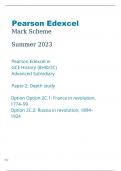
AS HISTORY 7041/2S The Making of Modern Britain, 1951–2007 Component 2S Building a new Britain, 1951–1979 Mark scheme June 2023 Version: 1.0 Final *236A7041/2S/MS* Mark schemes are prepared by the Lead Assessment Writer and considered, together with the relevant questions, by a panel of subject teachers. This mark scheme includes any amendments made at the standardisation events which all associates participate in and is the scheme which was used by them in this examination. The standardisation process ensures that the mark scheme covers the students’ responses to questions and that every associate understands and applies it in the same correct way. As preparation for standardisation each associate analyses a number of students’ scripts. Alternative answers not already covered by the mark scheme are discussed and legislated for. If, after the standardisation process, associates encounter unusual answers which have not been raised they are required to refer these to the Lead Examiner. It must be stressed that a mark scheme is a working document, in many cases further developed and expanded on the basis of students’ reactions to a particular paper. Assumptions about future mark schemes on the basis of one year’s document should be avoided; whilst the guiding principles of assessment remain constant, details will change, depending on the content of a particular examination paper. Further copies of this mark scheme are available from Copyright information AQA retains the copyright on all its publications. However, registered schools/colleges for AQA are permitted to copy material from this booklet for their own internal use, with the following important exception: AQA cannot give permission to schools/colleges to photocopy any material that is acknowledged to a third party even for internal use within the centre. Copyright © 2023 AQA and its licensors. All rights reserved. Level of response marking instructions Level of response mark schemes are broken down into levels, each of which has a descriptor. The descriptor for the level shows the average performance for the level. There are marks in each level. Before you apply the mark scheme to a student’s answer read through the answer and annotate it (as instructed) to show the qualities that are being looked for. You can then apply the mark scheme. Step 1 Determine a level Start at the lowest level of the mark scheme and use it as a ladder to see whether the answer meets the descriptor for that level. The descriptor for the level indicates the different qualities that might be seen in the student’s answer for that level. If it meets the lowest level then go to the next one and decide if it meets this level, and so on, until you have a match between the level descriptor and the answer. With practice and familiarity, you will find that for better answers you will be able to quickly skip through the lower levels of the mark scheme. When assigning a level, you should look at the overall quality of the answer and not look to pick holes in small and specific parts of the answer where the student has not performed quite as well as the rest. If the answer covers different aspects of different levels of the mark scheme you should use a best fit approach for defining the level and then use the variability of the response to help decide the mark within the level, ie if the response is predominantly Level 3 with a small amount of Level 4 material it would be placed in Level 3 but be awarded a mark near the top of the level because of the Level 4 content. Step 2 Determine a mark Once you have assigned a level you need to decide on the mark. The descriptors on how to allocate marks can help with this. The exemplar materials used during standardisation will help. There will be an answer in the standardising materials which will correspond with each level of the mark scheme. This answer will have been awarded a mark by the Lead Examiner. You can compare the student’s answer with the example to determine if it is the same standard, better or worse than the example. You can then use this to allocate a mark for the answer based on the Lead Examiner’s mark on the example. You may well need to read back through the answer as you apply the mark scheme to clarify points and assure yourself that the level and the mark are appropriate. Indicative content in the mark scheme is provided as a guide for examiners. It is not intended to be exhaustive and you must credit other valid points. Students do not have to cover all of the points mentioned in the Indicative content to reach the highest level of the mark scheme. An answer which contains nothing of relevance to the question must be awarded no marks. Section A 0 1 With reference to these sources and your understanding of the historical context, which of these two sources is more valuable in explaining why the Conservatives lost the October 1964 election? [25 marks] Target: AO2 Analyse and evaluate appropriate source material, primary and/or contemporary to the period, within the historical context. Generic Mark Scheme L5: Answers will display a very good understanding of the value of the sources in relation to the issue identified in the question. They will evaluate the sources thoroughly in order to provide a well-substantiated conclusion. The response demonstrates a very good understanding of context. 21–25 L4: Answers will provide a range of relevant well-supported comments on the value of the sources for the issue identified in the question. There will be sufficient comment to provide a supported conclusion but not all comments will be well-substantiated, and judgements will be limited. The response demonstrates a good understanding of context. 16–20 L3: The answer will provide some relevant comments on the value of the sources and there will be some explicit reference to the issue identified in the question. Judgements will however, be partial and/or thinly supported. The response demonstrates an understanding of context. 11-15 L2: The answer will be partial. There may be either some relevant comments on the value of one source in relation to the issue identified in the question or some comment on both, but lacking depth and having little, if any, explicit link to the issue identified in the question. The response demonstrates some understanding of context. 6–10 L1: The answer will either describe source content or offer stock phrases about the value of the source. There may be some comment on the issue identified in the question but it is likely to be limited, unsubstantiated and unconvincing. The response demonstrates limited understanding of context. 1–5 Nothing worthy of credit. 0 Indicative content Note: This content is not prescriptive and students are not obliged to refer to the material contained in this mark scheme. Any legitimate answer will be assessed on its merits according to the generic levels scheme. Students must deploy knowledge of the historical context to show an understanding of the relationship between the sources and the issues raised in the question, when assessing the significance of provenance, the arguments deployed in the sources and the tone and emphasis of the sources. Descriptive answers which fail to do this should be awarded no more than Level 2 at best. Answers should address both the value and the limitations of the sources for the particular question and purpose given. In responding to this question, students may choose to address each source in turn or to adopt a more comparative approach in order to arrive at a judgement. Either approach is equally valid and what follows is indicative of the evaluation which may be relevant. Source A: in assessing the value of this source as an explanation, students may refer to the following: Provenance and tone • the source is of particular value because Brown is a high-ranking cabinet minister speaking on economic affairs, which is his primary responsibility in government; parliamentary speeches are valuable for being in the public domain and in the public record • its limitation is that it presents a one-sided, party political view, but it is, nevertheless, valuable for clearly showing the Labour Party’s interpretation of the economic situation • its tone is highly emotional (he virtually accuses Conservative ministers of lying to the public) and critical, which could be considered both a strength and/or a limitation by students. Content and argument • the content is valuable for showing Brown’s contempt for Conservative economic policies, arguing Labour had inherited a ‘gigantic economic mess’, and for outlining Labour plans; the implication is that mismanagement of the economy was a key reason for the end of Conservative rule • students can develop the context of Brown’s remarks on the state of the economy: the post-war boom had created unprecedented affluence, the so-called ‘never had it so good’ years, but by the early 1960s the underlying economic trends suggested a slowing of growth and productivity • Brown’s reference to the ‘stop-go’ economic cycle can be explored; the application to the Common Market (EEC) is also valid in the context of discussing the underlying weaknesses of the economy. Source B: in assessing the value of this source as an explanation, students may refer to the following: Provenance and tone • the source has value for its relatively objective nature and its wide-ranging brief, garnering the views of a broad cross-section of the ‘top’ people in Britain in the first half of the 1960s; a limitation could be that it focuses on long-term trends not short-term explanations for the Conservatives’ defeat • his book’s bestseller status could be considered to add value, suggesting not only that it was popular but that his analysis was highly regarded • the language (tone) is analytical in style, valuable for being non-partisan and detached from the cut and thrust of political debate. Content and argument • Sampson’s book is valuable for its exploration of attitudes not policies; he argues that the changing nature of British society best explains the end of 13 years of Conservative rule, suggesting that by 1964 the Conservatives were outdated and out of touch with the public • students can develop Sampson’s references to the social and cultural changes that were occurring in the 1950s and early 1960s, fuelled by affluence and television, and the impact of a new generation symbolised by the emergence of the ‘teenager’ and youth culture; references to the anti-establishment attitudes of the period are also valid • the appeal of Labour can also be explored, and how the more relaxed and egalitarian Wilson represented a new technological and cultural era. In arriving at a judgement as to which source might be of greater value, students might consider Source A as having more value because of Brown’s position at the heart of government and because economic matters are always key issues at elections. By 1964, the Conservative government could no longer claim to be delivering ever-increasing prosperity and economic success; the Beeching ‘axe’ and the rejection of Britain’s application to the EEC seemed to sum up the negative economic temper of the times. However, Source B is very persuasive and has the advantage of looking at a wide sweep of social and cultural developments and perhaps of Sampson being more objective, an outsider looking in. Section B 0 2 ‘The liberal reforming legislation, in the years 1964 to 1970, was the result of the Labour government’s determination to modernise Britain.’ Explain why you agree or disagree with this view. [25 marks] Target: AO1 Demonstrate, organise and communicate knowledge and understanding to analyse and evaluate the key features related to the periods studied, making substantiated judgements and exploring concepts, as relevant, of cause, consequence, change, continuity, similarity, difference and significance. Generic Mark Scheme L5: Answers will display a good understanding of the demands of the question. They will be well-organised and effectively communicated. There will be a range of clear and specific supporting information showing a good understanding of key features and issues, together with some conceptual awareness. The answer will be analytical in style with a range of direct comment leading to substantiated judgement. 21–25 L4: Answers will show an understanding of the question and will supply a range of largely accurate information which will show an awareness of some of the key issues and features. The answer will be effectively organised and show adequate communication skills. There will be analytical comment in relation to the question and the answer will display some balance. However, there may be some generalisation and judgements will be limited and only partially substantiated. 16–20 L3: The answer will show some understanding of the full demands of the question and the answer will be adequately organised. There will be appropriate information showing an understanding of some key features and/or issues but the answer may be limited in scope and/or contain inaccuracy and irrelevance. There will be some comment in relation to the question. 11–15 L2: The answer will be descriptive or partial, showing some awareness of the question but a failure to grasp its full demands. There will be some attempt to convey material in an organised way although communication skills may be limited. There will be some appropriate information showing understanding of some key features and/or issues, but the answer may be very limited in scope and/or contain inaccuracy and irrelevance. There will be some, but limited, comment in relation to the question and statements will, for the most part, be unsupported and generalist. 6–10 L1: The question has not been properly understood and the response shows limited organisational and communication skills. The information conveyed is irrelevant or extremely limited. There may be some unsupported, vague or generalist comment. 1–5 Nothing worthy of credit. 0 Indicative content Note: This content is not prescriptive and students are not obliged to refer to the material contained in this mark scheme. Any legitimate answer will be assessed on its merits according to the generic levels scheme. Arguments supporting the view that the liberal reforming legislation, in the years 1964 to 1970, was the result of the Labour government’s determination to modernise Britain might include: • the breadth of legislation passed is evidence of the scale of the government’s determination: capital punishment ended; divorce was made easier; abortion and homosexual relations were legalised; theatrical censorship was abolished; higher education was expanded and the establishment of comprehensive schools was accelerated • the reforms as a whole marked an important stage in the modernising of British social attitudes; Labour deserves great credit for being much more open to liberalising social reforms than previous governments • Roy Jenkins, as Home Secretary, was instrumental in driving through much of the liberal legislation • Wilson also deserves great credit for his determination to set up the Open University, providing degree-level learning to people who had never had the opportunity to attend university, particularly women. Arguments challenging the view that the liberal reforming legislation, in the years 1964 to 1970, was the result of the Labour government’s determination to modernise Britain might include: • liberal reform was never a priority for the government; it did not set out a liberalising agenda on moral issues in its 1964 manifesto; Wilson had little enthusiasm for the broader liberalising agenda, a view shared by Brown and Callaghan • society had already undergone considerable change in the 1950s; the reforms introduced by Labour ‘from the top’ merely reflected changes already happening ‘from below’ • many of the reforms passed came through private members’ bills on ‘free votes’ and not directly from the Labour government • many of the reforms were limited or strictly interpreted, undermining their effectiveness; for example, the requirement that homosexual relations had to be ‘in private’ was interpreted as no one else being in the same building. Despite the lukewarm attitude of some of the Labour leadership towards the liberalising agenda, and the limitations of a number of the reforms, it can be argued that Labour does deserve great credit for modernising Britain. Some of the reforms were groundbreaking and arguably ahead of their time. Without Roy Jenkins’ commitment and his efforts to secure parliamentary time for private members’ bills, it is doubtful that so much would have been achieved. Not everyone welcomed the liberal reforming legislation but, on balance, Labour, and Roy Jenkins in particular, deserve great credit for their determination to make Britain a much more modern society.

Show more Read less
Institution
Course

Content preview

Aqa history


AS
HISTORY
7041/2S
The Making of Modern Britain, 1951–2007
Component 2S Building a new Britain, 1951–1979

Mark scheme
June 2023
Version: 1.0 Final


Aqa history

, *236A7041/2S/MS*

Written for

Course

Document information

Uploaded on
April 16, 2024
Number of pages
11
Written in
2023/2024
Type
Exam (elaborations)
Contains
Questions & answers

Subjects

Get to know the seller

Seller avatar
Reputation scores are based on the amount of documents a seller has sold for a fee and the reviews they have received for those documents. There are three levels: Bronze, Silver and Gold. The better the reputation, the more your can rely on the quality of the sellers work.
margaretmbugua453 Cambridge College
Follow You need to be logged in order to follow users or courses
Sold
35
Member since
1 year
Number of followers
27
Documents
235
Last sold
11 months ago

4.3

7 reviews

5
5
4
1
3
0
2
0
1
1

Trending documents

Recently viewed by you

Why students choose Stuvia

Created by fellow students, verified by reviews

Quality you can trust: written by students who passed their tests and reviewed by others who've used these notes.

Didn't get what you expected? Choose another document

No worries! You can instantly pick a different document that better fits what you're looking for.

Pay as you like, start learning right away

No subscription, no commitments. Pay the way you're used to via credit card and download your PDF document instantly.

Student with book image

“Bought, downloaded, and aced it. It really can be that simple.”

Alisha Student

Frequently asked questions