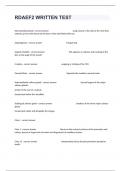
RDAEF2 WRITTEN TEST With Complete Questions And Advanced Answers/2024.
Sternocleidomastoid - correct answer Long muscle in the side of the neck that extends up from the thorax to the base of the skull behind the ear. Ankyloglossia - correct answer Tongue tied Angular Cheilitis - correct answer This appears as redness and cracking of the skin at the angle of the mouth Crepitus - correct answer popping or clicking of the TMJ Parotoid Duct - correct answer Opposite the maxillary second molar Submandibular salivary gland - correct answer Second largest of the major salivary glands; similar to the size of a walnut; located just below the mandible Sublingual salivary gland - correct answer Smallest of the three major salivary gland; located just under and alongside the tongue Class I - correct answer Class 1 - correct answer Decay on the occlusal surfaces of the premolars and molars; buccal or lingual pits of molars and lingual pits of maxillary incisors Class 11 - correct answer Interproximal decay located premolars (posterior teeth) Class 111 - correct answer Interproximal decay located on incisors and cuspids (anterior teeth) Class IV - correct answer Anterior interproximal decay involving the incisal edge Class V - correct answer buccal Decay that occurs at the gingival third, or lingual surface of any tooth Class VI - correct answer lingual Decay on the incisal edges of anterior teeth and/or the cusp tips of posterior teeth caused by wear Regular border - correct answer resembles a symmetrical circle or an oval shape. Irregular border. - correct answer not uniform or has deviations from circular or oval shape. Smooth margin. - correct answer level with the surface of the lesion. Raised margin - correct answer above the level of the surface of the lesion. Papule. - correct answer a solid raised lesion that is usually less than 1 cm in diameter. A papule may be any color Example: an elevated mole Plaque. A - correct answer a superficial raised lesion often formed by the coalescence (joining) of closely grouped papules. is more than 1 cm in diameter; a plaque dif- fers from a nodule in its height; a plaque is flattened, and a nodule is a bump. -Examples: leukoplakia, psoriasis Nodule. - correct answer raised marble-like le- sion detectable by touch, usually 1 cm or more in diameter. It can be felt as a hard mass distinct from the tissue surrounding it. -Examples: wart, basal cell carcinoma, melanoma, en- larged lymph node Vesicle. - correct answer a small blister filled with fluid usually is 1 cm or less in diameter. -Examples: herpes simplex, herpes zoster, chickenpox, and smallpox lesions Pustule. - correct answer a small raised le- sion filled with pus. Examples: acne, boil, abscess Ulcer. - correct answer a craterlike lesion of the skin or mucosa where the top two layers of the skin are lost. . The depth is superficial if it is less than 3 mm. -Examples: aphthous ulcer, chickenpox lesions Primary Bonds - correct answer Strong bonds with electronic attractions; ionic bonds, metallic bonds Secondary Bonds - correct answer Weaker than primary bonds; hydrogen bonds Brittleness - correct answer The hardness; likelihood of breaking or cracking of a material Density - correct answer The measure of the weight of a material compared with its volume Hardness - correct answer The The resistance of a solid to penetration Elasticity - correct a
Written for
- Institution
- RDAEF
- Course
- RDAEF
Document information
- Uploaded on
- May 5, 2024
- Number of pages
- 6
- Written in
- 2023/2024
- Type
- Exam (elaborations)
- Contains
- Questions & answers
Subjects

Also available in package deal