FAU Dr. Brooks - Biological Principles - Unit 3 Comprehensive Study Guide 2024 with complete Solutions
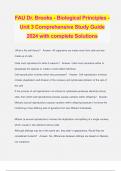
FAU Dr. Brooks - Biological Principles - Unit 3 Comprehensive Study Guide 2024 with complete Solutions What is the cell theory? - Answer- All organisms are made come from cells and are made up of cells Cells must reproduce for what 2 reasons? - Answer- Cells must reproduce either to perpetuate the species or create a multi-celled individual Cell reproduction involves which two processes? - Answer- Cell reproduction involves mitosis (duplication and division of the nucleus) and cytokinesis (division of the rest of the cell) If the process of cell reproduction via mitosis & cytokinesis produces identical (clone) cells, then which cell reproductive process causes variation within offspring? - Answer- Meiosis (sexual reproduction) causes variation within offspring because it involves the combining of two differing sets of genetics from two different individuals. Mitosis (a-sexual reproduction) involves the duplication and splitting of a single nucleus, which results in two identical (clone) cells. Although siblings may be of the same sex, they alter in appearance. Would they be considered mutants? - Answer- No, differences between siblings are based on Meiosis, not mutations. What is the difference between Asexual reproduction and Sexual reproduction? - Answer- Within Asexual reproduction, an organism reproduces asexually (without a partner) which results in offspring being identical (clones). Within Sexual reproduction, an organism requires a partner to produce sexually which results in variation among offspring. What is a big disadvantage to Asexual reproduction? How is it threatening to a population? - Answer- A big disadvantage to Asexual reproduction is that all offspring are identical (clones). With all offspring being identical, there is much more risk of the entire population being susceptible to a virus/infection. What is the ploidy for humans? - Answer- 1n = 23, with 2n = 46 total chromosomes 1n (Haploid = 1 set) 2n (Diploid = 2 set) Does haploid mean half of diploid? - Answer- NO! Haploid (1n) refers to "one set" while Diploid (2n) refers to "two sets" Why must organisms split their chromosomes into one set (Haploid/1n) before reproduction? - Answer- Organisms must split their chromosomes from diploid/2n to haploid/1n so the combining of the sperm and egg can result in the offspring possessing two sets of chromosomes (aka diploid/2n offspring) True/False: Most organisms are nearly indistinguishable within early developmental stages of life. - Answer- TRUE! Evolutionary relationship among organisms shows shared characteristics among all organisms within early embryonic developmental stages. Example: Within early embryonic developmental stage, humans posses slits which later disappear, whereas fish posses the same slits which then turn into gills. What is the term which describes only the duplication of a single nucleus into two identical nuclei? - Answer- Mitosis What is the term of which describes dividing two identical nuclei as well as the remaining cytocontents? - Answer- Cytokinesis What is the difference between Mitosis and Cytokinesis? - Answer- Mitosis is the process of duplicating a single nucleus into two identical nuclei, Cytokinesis is the splitting of those two nuclei into two identical cells. Which occurs first? Mitosis or Cytokinesis? - Answer- Mitosis occurs BEFORE Cytokinesis REMEMBER: Mitosis = Duplication, Cytokinesis = Splitting Is mitosis synonymous with cell division or cell reproduction? - Answer- NO! Mitosis is *technically* only the duplication of a single nucleus, CYTOKINESIS is the process of cell division, hence cytokinesis MUST occur for cell division to occur True/False Cytokinesis is the process of cell division? - Answer- True! Would interphase be considered the "resting" phase of the cell? - Answer- No! Chemical reactions / Cellular respiration / Photosynthesis occurs within interphase, hence interphase is full of function What is produced within the Synthesis Phase? - Answer- Chromosomes are duplicated and DNA is synthesized within the Synthesis Phase of interphase There are two gap phases within interphase, are they before or after the synthesis phase? - Answer- G1 aka First gap phase is BEFORE the synthesis phase while G2 aka Second gap phase is AFTER the synthesis phase Within the S (synthesis) Phase, DNA is in a coiled form called *what*? - Answer- Chromatin What are the three phases of interphase? What is their order? - Answer- G1 (First gap phase) S (synthesis (DNA) phase) G2 (second gap phase) Is DNA produced within interphase? - Answer- Yes, DNA is produced within the Synthesis phase of interphase Which of the three phases is the metabolically active phase of interphase? G1, S, G2 - Answer- For most cells, they will spend most of the metabolically active G1 phase, and will only proceed to the Synthesis & G2 stage if it plans on dividing. What are the 2 base pairing rules for DNA? - Answer- -Adenine bonds with Thymine -Cytosine bonds with Guanine What is the semi-conservative DNA model? What does it mean? - Answer- The semi- conservative DNA model represents the replication of DNA in which the old DNA chain splits in two, and then reconnects with new strands of DNA, creating TWO SETS of: 50% old DNA + 50% new DNA What is the process of ONLY the duplication of the nucleus into two separate nuclei? - Answer- Mitosis What is the process of ONLY separating two nuclei and other extracellular content into two daughter cells? - Answer- Cytokinesis During which phase of the cell cycle are chromosomes duplicated and DNA synthesized? - Answer- S - Synthesis phase (within interphase) What type/form of DNA is within the synthesis phase? - Answer- Chromatin During which metabolically active phase do cells spend most of their time? - Answer- G1 phase of interphase Is it true that some cells of which do not plan on duplicating can remain within the G1 phase? - Answer- TRUE - Cells that don't divide can remain within the G1 stage (also referred to as G0 stage) What occurs within the G2 stage? - Answer- To supply additional structures such as tubulin in the form of microtubules so that we can move things around within the mitotic and cytokinetic stages What are the two histones? What do they appear as? - Answer- The two histones are the: Core - Center, wrapped with DNA which is held by the H1 histone H1 - Clamps DNA to the Core What is a nucleosome? - Answer- Turns of DNA wrapped around a core histone locked in place by an H1 histone. What are nonhistones? - Answer- Nonhistones are proteins such as histones but remain within the chromatin once histones are removed Where are histones located? - Answer- Within the chromatin What is each half of a chromosome called? - Answer- A chromatid Where are chromatids connected? - Answer- The centromere What are two identical chromatids bonded together at the centromere called? - Answer- Two chromatids bonded together is a duplicated Monad chromosome What is the difference between a Monad chromosome and a Dyad chromosome? - Answer- A Monad chromosome is an unduplicated chromosome (contains one chromatid) meanwhile a Dyad chromosome is a duplicated ch
Written for
- Institution
- Brooks Biological Principles
- Course
- Brooks Biological Principles
Document information
- Uploaded on
- May 8, 2024
- Number of pages
- 47
- Written in
- 2023/2024
- Type
- Exam (elaborations)
- Contains
- Questions & answers
Subjects
-
fau dr brooks biological principles unit 3 co

Also available in package deal