CMN 120 Complete Exam Questions With Complete Solutions.
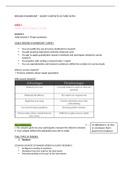
CMN 120 Complete Exam Questions With Complete Solutions. What are the definitions of successful and accidental communication? - correct answer *Successful communication*: behavior sent with intention and behavior interpreted accurately *Accidental communication*: behavior not sent with intention, but behavior is interpreted accurately What is the definition of Interpersonal Communication and Relational Communication? - correct answer *Interpersonal communication*: the exchange of verbal and nonverbal messages between people, regardless of the relationship they share *Relational communication*: focuses on messages exchanged in intimate, or potentially intimate, relationships What are the various ways in which communication competence was defined/explained? - correct answer Competent communication involves *2 separate levels*: - *performative competence* -- surface level; actual performance of verbal and nonverbal behavior - *process competence* -- deeper level; consists of everything we have to know in order to perform PROCESS COMPETENCE COMES *BEFORE* PERFORMATIVE COMPETENCE *5 ways to be a competent communicator*: 1) assign meaning -- what is going on in this situation?(PROCESS) 2) set goals strategically -- what do I want to achieve/how can I make it happen? (PROCESS) 3) take on social roles appropriately (PROCESS) 4) present a valued image of yourself -- how do I want others to view me in this situation? (PROCESS) 5) generate intelligible messages -- language and nonverbal skills (PERFORMATIVE) What is the "cooperation principle" and why is it important to communication competence? - correct answer *Paul Grice's cooperation principle*: receivers assume relevance, and senders guarantee relevance - since the goal of communication is shared meaning -- there must be cooperation and effort from the sender and receiver to reach this goal What are the four conversational maxims and what do each of them mean? - correct answer *Grice's conversational maxims*: - Quantity - providing just the right amount of information, not too much or too little - Quality - truthful, accurate information and evidence - Relevance - staying on topic - Manner - being clear and socially appropriate What makes shared meaning often difficult to achieve? - correct answer Every single individual has a unique set of perceptual filters -- and we use these to filter incoming communication through our own perceptions, experiences, biases, and beliefs What are perceptual filters? - correct answer What we use, individually, to filter incoming communication based on our perceptions, experiences, biases, and beliefs. What are the sources of possible perceptual misinterpretations? - correct answer - *stereotyping*: relying on generalities, ignoring individual differences - *the primacy effect*: we emphasize first impressions over later impressions when forming a perception - *the recency effect*: we emphasize the most recent impression over earlier impressions when forming a perception - *perceptual sets*: we are more likely to perceive only what we want or expect to perceive - *egocentrism*: unable to see any other perspective besides one's own - *positivity/negativity bias*: we tend to focus heavily on a person's positive or negative attributes when forming a perception What affects perceptual accuracy? - correct answer - physiological state (tired, hungry) - psychological state (anxious, angry) - culture (age, ethnicity, sex) - social roles (teacher, mother, police officer) Why is effective listening so important? - correct answer Listening is the active process of making out meaning of another person's spoken message It is a LEARNED SKILL, and requires *concerted and prolonged effort* What are the types of listening? - correct answer - *Informational* -- listening to LEARN from message - *Critical* -- listening to evaluate credibility of message - *Empathic* -- listening to emotionally support and understand someone What are the barriers to effective listening? - correct answer - *Pseudo-listening*: using behaviors that make it seem like you're listening even when you aren't - *Selective listening*: listening to only what you want to hear - *Information overload*: being overwhelmed by the large amount of info we take in each day - *Glazing over*: daydreaming instead of listening
Written for
- Institution
- CMN.
- Course
- CMN.
Document information
- Uploaded on
- May 15, 2024
- Number of pages
- 10
- Written in
- 2023/2024
- Type
- Exam (elaborations)
- Contains
- Questions & answers
Subjects
- cmn
-
cmn 120 complete exam questions with complete so

Also available in package deal