NR449 Evidence-Based Practice Quiz 4 Comprehensive Exam With 100% Guaranteed Answers (a+ graded)
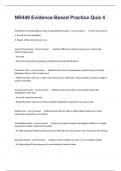
Guidelines for Conducting ALL Types of Quantitative Analysis - correct answer 1. Select tests a priori 2. Run all the tests identified 3. Report all the tests that were run Goals of the Analysis - correct answer - Evaluate differences between groups (ex. control and experimental group) - Sort data - Aid in data reduction by grouping variables into overall classifications Parametric tests - correct answer Statistical tests that are appropriate for data that are normally distributed (that is, fall in a bell curve) - Holds only when interval- or ratio- level measures are collected or when samples are large enough to achieve normality Nonparametric tests - correct answer Statistical tests that make no assumptions about the distribution of the data - If normal cannot be assumed - Distribution free: tests do not rely on specific distribution to generate accurate results Robust tests - correct answer Statistical tests that are able to yield reliable results even if their underlying assumptions are violated Univariable analysis - correct answer Analysis of a single variable in descriptive statistics or a single dependent variable in inferential analysis - Ex. differentiating whether blood pressure is affected more by exercise in the morning or the evening Bivariate analysis - correct answer Analysis of two variables at a time, as in correlation studies - Ex. Determining if blood pressure is associated with sodium intake Multivariate analysis - correct answer The simultaneous analysis of multiple variables - Ex. Determining if blood pressure is different in the morning or evening, and is associated with sodium intake, weight, and stress level Interferential analysis - correct answer Statistical tests to determine if results found in a sample are representative of a larger population Standard error - correct answer The error that arises from the sampling procedure; it is directly affected by variability and indirectly affected by sample size - Differences between samples and populations Point estimate - correct answer A statistic derived from a sample that is used to represent a population parameter - represents a single number Confidence interval - correct answer A range of values that includes, with a specified level of confidence, the actual population parameter - Used to estimate population parameters Effect size - correct answer The size of the differences between experimental and control groups compared to variability; an indication of the clinical importance of a finding - Determine how much of an effect can be expected The researcher must make decisions about the appropriateness of a statistical test based on the following factors: - correct answer - The requirements of the research question - The number of groups to be tested - The level of measurement of the independent and dependent variables - The statistical and mathematical assumptions of the test There are essentially three versions of this test that can be applied to determine differences in mean values: - correct answer 1. The one-sample t test quantifies the difference between a mean value in a sample and a mean value in the larger population. For example, a one- sample t test could test the difference between a hospital's mean length of stay and the national average. 2. The independent-samples t test quantifies the difference between the mean in one group and the mean in another group. An example would be a test to determine if mean lengths of stay were different for rural and urban hospitals. This t test variant could also be used as a test of effectiveness by comparing the mean in an experimental group to the value for a control group. For example, an independent-samples t test would be appropriate to determine if units that relied on standard orders sets had a shorter length of stay than units that did not. 3. The paired-samples t test quantifies the difference between a mean value measured in the same group over time. For example, a paired-sample t test could be used to answer questions about average length of stay before and after a change in Medicare reimbursement. Error Multiple Comparisons - correct answer The increased error associated with conducting multiple comparisons in the same analysis; the 5% allowable error for each test is multiplied by the number of comparisons, resulting in an inflated error rate Factors - correct answer Independent variables in an ANOVA that are measured as categories Levels - correct answer Categories that make up factors in an ANOVA ANOVA - correct answer - One of the most frequently used statistical tests in evidence-based research studies. - It is a staple for testing the effectiveness of interventions because of its versatility and its capacity to produce a tremendous amount of information. - It is effective in studies utilizing experimental and quasi- experimental designs Four Basic Kinds of ANOVA - correct answer 1. Univariate ANOVA - applied to determine if groups differ on a single numerical outcome 2. Repeated-measures ANOVA - used to determine if time is a factor in treatment conditions 3. Analysis of Covariance (ANCOVA) - used to determine if a covariate— commonly an extraneous variable—has an impact on the experiment 4. MANOVA - the multivariate version of ANOVA, is the most complex version of the test Magnitude of effect - correct answer The size of the differences between experimental and control groups; it supports clinical significance of the findings Three principles in mind when interpreting quantitative results as evidence for practice: - correct answer 1. A p value does not measure effect size. The p value refers to the probability of error, and nothing more. It means the results are statistically real, but it provides little information about the meaning of the results. Effect sizes offer more information about the magnitude of response. 2. Effect size is not a measure of import
Written for
- Institution
- NR 449
- Course
- NR 449
Document information
- Uploaded on
- May 18, 2024
- Number of pages
- 8
- Written in
- 2023/2024
- Type
- Exam (elaborations)
- Contains
- Questions & answers
Subjects
-
nr449 evidence based practice quiz 4

Also available in package deal