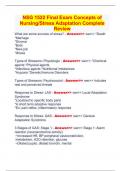
NSG 1522 Final Exam Concepts of
Nursing/Stress Adaptation Complete
Review
What are some sources of stress? - Answer>> wer>> *Death
*Marriage
*Divorce
*Birth
*New job
*Illness
Types of Stressors: Physiologic - Answer>> wer>> *Chemical
agents *Physical agents
*Infectious agents *Nutritional imbalances
*Hypoxia *Genetic/Immune Disorders
Types of Stressors: Psychosocial - Answer>> wer>> Includes
real and perceived threats
Response to Stress: LAS - Answer>> wer>> Local Adaptation
Syndrome
*Localized to specific body parts
*A short term adaptive response
*Ex: pain reflex, inflammatory response
Response to Stress: GAS - Answer>> wer>> General
Adaptation Syndrome
3 Stages of GAS: Stage 1 - Answer>> wer>> Stage 1: Alarm
reaction (neuroendocrine activity)
~Increased HR, BP peripheral vasoconstriction,
metabolism, H2O retention, glucose
~Dilated pupils, dilated bronchi, mental
, alertness
~Fight or flight response (sympathetic nervous
system)
3 Stages of GAS: Stage 2 - Answer>> wer>> Stage 2:
Resistance
~Trying to adapt to the stressor; return to homeostasis
~Vital signs even out; back to normal
~Adrenaline decreases
~If homeostasis occurs --> able to go into recovery stage
3 Stages of GAS: Stage 3 - Answer>> wer>> Stage 3:
Exhaustion
~Occurs if homeostasis is not achieved in resistance
stage
~Decreased BP, Increased HR, respirations
(vasodilation)
~Panic, crisis
~Can have 2 different results
1. Except stressor, seek treatment, rest & recovery
2. Deny stressor = death
Clinical manifestations of stress include: - Answer>> wer>>
*Pupil dilation *Diaphoresis
*HR & CO increase *Pallid skin
*Na & H2O retention *^ rate & depth of resp.
*Decreased urinary output *Dry mouth
*Muscle tension *Increased blood sugar
What is the most common response to stress? - Answer>>
wer>> Anxiety
Types of anxiety: Mild, Moderate, Severe, Panic - Answer>>
wer>> Mild: Butterflies, feels like something is going to happen
Nursing/Stress Adaptation Complete
Review
What are some sources of stress? - Answer>> wer>> *Death
*Marriage
*Divorce
*Birth
*New job
*Illness
Types of Stressors: Physiologic - Answer>> wer>> *Chemical
agents *Physical agents
*Infectious agents *Nutritional imbalances
*Hypoxia *Genetic/Immune Disorders
Types of Stressors: Psychosocial - Answer>> wer>> Includes
real and perceived threats
Response to Stress: LAS - Answer>> wer>> Local Adaptation
Syndrome
*Localized to specific body parts
*A short term adaptive response
*Ex: pain reflex, inflammatory response
Response to Stress: GAS - Answer>> wer>> General
Adaptation Syndrome
3 Stages of GAS: Stage 1 - Answer>> wer>> Stage 1: Alarm
reaction (neuroendocrine activity)
~Increased HR, BP peripheral vasoconstriction,
metabolism, H2O retention, glucose
~Dilated pupils, dilated bronchi, mental
, alertness
~Fight or flight response (sympathetic nervous
system)
3 Stages of GAS: Stage 2 - Answer>> wer>> Stage 2:
Resistance
~Trying to adapt to the stressor; return to homeostasis
~Vital signs even out; back to normal
~Adrenaline decreases
~If homeostasis occurs --> able to go into recovery stage
3 Stages of GAS: Stage 3 - Answer>> wer>> Stage 3:
Exhaustion
~Occurs if homeostasis is not achieved in resistance
stage
~Decreased BP, Increased HR, respirations
(vasodilation)
~Panic, crisis
~Can have 2 different results
1. Except stressor, seek treatment, rest & recovery
2. Deny stressor = death
Clinical manifestations of stress include: - Answer>> wer>>
*Pupil dilation *Diaphoresis
*HR & CO increase *Pallid skin
*Na & H2O retention *^ rate & depth of resp.
*Decreased urinary output *Dry mouth
*Muscle tension *Increased blood sugar
What is the most common response to stress? - Answer>>
wer>> Anxiety
Types of anxiety: Mild, Moderate, Severe, Panic - Answer>>
wer>> Mild: Butterflies, feels like something is going to happen