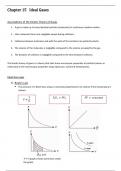
Chapter 15 Ideal Gases
Assumptions of the Kinetic Theory of Gases
1. A gas is made up of many identical particles (molecules) in continuous random motion.
2. Inter-molecular forces are negligible except during collisions.
3. Collisions between molecules and with the walls of the container are perfectly elastic.
4. The volume of the molecules is negligible compared to the volume occupied by the gas.
5. The duration of collisions is negligible compared to the time between collisions.
The kinetic theory of gases is a theory that links these microscopic properties of particles (atoms or
molecules) to the macroscopic properties of gas (pressure, volume & temperature).
Ideal Gas Laws
1) Boyle’s Law
▪ The pressure of a fixed mass of gas is inversely proportional to its volume if the temperature is
costant.
1 𝑃1 𝑉1 = 𝑃𝑉2 𝑃𝑉 = 𝑐𝑜𝑛𝑠𝑡𝑎𝑛𝑡
𝑃∝
𝑉
P-V graphs shows work done under
the graph.
,If a gas is compressed at constant temperature,
i. The volume occupied by the gas decreases.
ii. More particles per unit volume.
iii. More collisions per second of the particles with unit area of the wall.
iv. Temperature is constant, the average speed of molecules does not change.
v. Each collision with the wall involves:
▪ The same change in momentum (as the mass and speed of molecules are the same)
vi. Collision frequency on unit area of the wall is greater.
vii. The rate of change of momentum is greater.
viii. Pressure is greater.
2) Pressure Law
▪ The pressure of a fixed mass of gas is directly proportional to its absolute temperature
(thermodynamic / kelvin temperature) if volume is constant.
𝑃∝𝑇 𝑃1 𝑃2 𝑃
= = 𝑐𝑜𝑛𝑠𝑡𝑎𝑛𝑡
𝑉1 𝑉2 𝑉
Absolute Zero: 0K / -273.15oC
When temperature of a gas with constant volume is increased,
i. Average kinetic energy of molecules increases.
ii. The gas molecules travel faster.
iii. Volume is constant, gas molecules travel the same distance.
iv. Collision frequency increases.
v. Pressure is greater.
, 3) Charles’ Law
▪ The volume of a fixed mass of gas is directly proportional to its absolute temperature if pressure
is constant.
▪ 𝑉∝𝑇 𝑉1 𝑉2 𝑉
= = 𝑐𝑜𝑛𝑠𝑡𝑎𝑛𝑡
𝑇1 𝑇2 𝑇
When gas is heated,
i. Average kinetic energy of molecules increases.
ii. The gas molecules travel faster.
iii. For the pressure to remain constant, the gas expands such that the rate of collision of particle with
the wall of container remains constant.
Combining all 3 Gas Laws
𝑃∝𝑇
𝑇
1 𝑃∝
𝑃∝ 𝑉
𝑉
𝑷𝑽
= 𝒄𝒐𝒏𝒔𝒕𝒂𝒏𝒕
𝑻
Amount of gas
or molecules / mass is
constant
𝑷𝑽 ∝ 𝑻
Assumptions of the Kinetic Theory of Gases
1. A gas is made up of many identical particles (molecules) in continuous random motion.
2. Inter-molecular forces are negligible except during collisions.
3. Collisions between molecules and with the walls of the container are perfectly elastic.
4. The volume of the molecules is negligible compared to the volume occupied by the gas.
5. The duration of collisions is negligible compared to the time between collisions.
The kinetic theory of gases is a theory that links these microscopic properties of particles (atoms or
molecules) to the macroscopic properties of gas (pressure, volume & temperature).
Ideal Gas Laws
1) Boyle’s Law
▪ The pressure of a fixed mass of gas is inversely proportional to its volume if the temperature is
costant.
1 𝑃1 𝑉1 = 𝑃𝑉2 𝑃𝑉 = 𝑐𝑜𝑛𝑠𝑡𝑎𝑛𝑡
𝑃∝
𝑉
P-V graphs shows work done under
the graph.
,If a gas is compressed at constant temperature,
i. The volume occupied by the gas decreases.
ii. More particles per unit volume.
iii. More collisions per second of the particles with unit area of the wall.
iv. Temperature is constant, the average speed of molecules does not change.
v. Each collision with the wall involves:
▪ The same change in momentum (as the mass and speed of molecules are the same)
vi. Collision frequency on unit area of the wall is greater.
vii. The rate of change of momentum is greater.
viii. Pressure is greater.
2) Pressure Law
▪ The pressure of a fixed mass of gas is directly proportional to its absolute temperature
(thermodynamic / kelvin temperature) if volume is constant.
𝑃∝𝑇 𝑃1 𝑃2 𝑃
= = 𝑐𝑜𝑛𝑠𝑡𝑎𝑛𝑡
𝑉1 𝑉2 𝑉
Absolute Zero: 0K / -273.15oC
When temperature of a gas with constant volume is increased,
i. Average kinetic energy of molecules increases.
ii. The gas molecules travel faster.
iii. Volume is constant, gas molecules travel the same distance.
iv. Collision frequency increases.
v. Pressure is greater.
, 3) Charles’ Law
▪ The volume of a fixed mass of gas is directly proportional to its absolute temperature if pressure
is constant.
▪ 𝑉∝𝑇 𝑉1 𝑉2 𝑉
= = 𝑐𝑜𝑛𝑠𝑡𝑎𝑛𝑡
𝑇1 𝑇2 𝑇
When gas is heated,
i. Average kinetic energy of molecules increases.
ii. The gas molecules travel faster.
iii. For the pressure to remain constant, the gas expands such that the rate of collision of particle with
the wall of container remains constant.
Combining all 3 Gas Laws
𝑃∝𝑇
𝑇
1 𝑃∝
𝑃∝ 𝑉
𝑉
𝑷𝑽
= 𝒄𝒐𝒏𝒔𝒕𝒂𝒏𝒕
𝑻
Amount of gas
or molecules / mass is
constant
𝑷𝑽 ∝ 𝑻