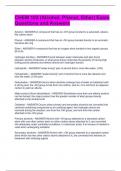
CHEM 102 (Alcohol, Phenol, Ether) Exam
Questions and Answers
Alcohol - ANSWER-A compound that has an -OH group bonded to a saturated, alkane-
like carbon atom
Phenol - ANSWER-A compound that has an -OH group bonded directly to an aromatic,
benzene-like ring
Ether - ANSWER-A compound that has an oxygen atom bonded to two organic groups
(R-O-R)
Hydrogen bonding - ANSWER-Found between water molecules and also found
between alcohol molecules, is what gives these molecules the property of having high
boiling points (alkanes and ethers cannot form hydrogen bonds)
Hydrophilic - ANSWER-"water-loving" part of alcohol that is more like water, (-OH)
Hydrophobic - ANSWER-"water-fearing" part of alcohol that is more like alkanes and
less like water, (CH3 part)
Dehydration - ANSWER-Occurs when alcohols undergo loss of water on treatment with
a strong acid, the -OH group is lost from one carbon, and an -H is lost from an adjacent
carbon to yield an alkene
Major product (from dehydration) - ANSWER-Sometimes more than one alkene product
can be formed, the major product has the greater number of alkyl groups directly
attached to the double bond
Oxidation - ANSWER-Occurs when primary and secondary alcohols are converted into
carbonyl-containing compounds by an oxidizing agent, two hydrogen atoms are
removed during the reaction; one from the -OH group, and one from the carbon
attached to the -OH group
Primary alcohols - ANSWER-Alcohol with -OH group attached to a saturated carbon
atom with one other carbon atom no other carbon atoms attached to it, are converted
into aldehydes under controlled conditions, or carboxylic acids, if an excess of oxidant is
used when undergoing oxidation
Secondary alcohols - ANSWER-Alcohol with ‒OH group attached to a saturated carbon
atom which has two other carbon atoms attached to it, are converted into ketones on
treatment with oxidizing agents
Questions and Answers
Alcohol - ANSWER-A compound that has an -OH group bonded to a saturated, alkane-
like carbon atom
Phenol - ANSWER-A compound that has an -OH group bonded directly to an aromatic,
benzene-like ring
Ether - ANSWER-A compound that has an oxygen atom bonded to two organic groups
(R-O-R)
Hydrogen bonding - ANSWER-Found between water molecules and also found
between alcohol molecules, is what gives these molecules the property of having high
boiling points (alkanes and ethers cannot form hydrogen bonds)
Hydrophilic - ANSWER-"water-loving" part of alcohol that is more like water, (-OH)
Hydrophobic - ANSWER-"water-fearing" part of alcohol that is more like alkanes and
less like water, (CH3 part)
Dehydration - ANSWER-Occurs when alcohols undergo loss of water on treatment with
a strong acid, the -OH group is lost from one carbon, and an -H is lost from an adjacent
carbon to yield an alkene
Major product (from dehydration) - ANSWER-Sometimes more than one alkene product
can be formed, the major product has the greater number of alkyl groups directly
attached to the double bond
Oxidation - ANSWER-Occurs when primary and secondary alcohols are converted into
carbonyl-containing compounds by an oxidizing agent, two hydrogen atoms are
removed during the reaction; one from the -OH group, and one from the carbon
attached to the -OH group
Primary alcohols - ANSWER-Alcohol with -OH group attached to a saturated carbon
atom with one other carbon atom no other carbon atoms attached to it, are converted
into aldehydes under controlled conditions, or carboxylic acids, if an excess of oxidant is
used when undergoing oxidation
Secondary alcohols - ANSWER-Alcohol with ‒OH group attached to a saturated carbon
atom which has two other carbon atoms attached to it, are converted into ketones on
treatment with oxidizing agents