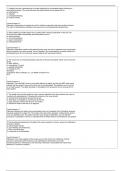
1. A patient has had a splenectomy to control bleeding from a lacerated spleen following an
automobile accident. The nurse will teach the patient about the increased risk for
a. lymphedema.
b. infection.
c. prolonged bleeding.
d. chronic anemia.
Correct Answer: B
Rationale: Splenectomy increases the risk for infection, especially with gram-positive bacteria.
The risks for lymphedema, bleeding, and anemia are not increased after splenectomy.
2. While obtaining a health history from a patient with numerous petechiae on the skin, the
nurse asks the patient specifically about the patient's use of
a. anticonvulsants.
b. oral contraceptives.
c. aspirin medications.
d. antihypertensives.
Correct Answer: C
Rationale: Salicylates interfere with platelet function and can lead to petechiae and ecchymoses.
Anticonvulsants may cause anemia, but not bleeding. Oral contraceptives increase clotting risk.
Antihypertensives do not commonly cause problems with decreased clotting.
3. The nurse who is reviewing laboratory data for an 86-year-old patient will be most concerned
about
a. WBC 3500/µl.
b. hemoglobin 11.8 g/dl.
c. platelets 400,000/µl.
d. hematocrit 37%.
Test Bank
Copyright © 2007 by Mosby, Inc., an affiliate of Elsevier Inc.
30-2
Correct Answer: A
Rationale: The total WBC count is not usually affected by aging, and the low WBC here would
indicate that the patient's immune function may be compromised. The platelet count is normal
for an older patient. The slight decrease in hemoglobin and hematocrit are not unusual for an
older patient.
4. The health care provider performs a bone marrow aspiration from the posterior iliac crest on
a patient with pancytopenia. Following the procedure, the nurse should
a. use half-inch sterile gauze to pack the wound.
b. administer an analgesic to control pain at the site.
c. apply pressure over the site for 5 to 10 minutes.
d. elevate the head of the bed to 30 degrees.
Correct Answer: C
Rationale: Because the patient has pancytopenia and is at increased risk for bleeding, pressure
should be applied for at least 5 to 10 minutes at the site of the aspiration. A Band-Aid is used to
cover the aspiration site. The patient will have pain during the aspiration, but not after the
procedure is completed. There is no indication that the head needs to be elevated for this patient.
5. During physical assessment of a patient, the nurse suspects a chronic, severe iron-deficiency
anemia on finding
a. yellow-tinged sclerae.
b. gum bleeding and tenderness.
c. shiny, smooth tongue.
d. numbness of the extremities.
Correct Answer: C
Rationale: Loss of the papillae of the tongue occurs with chronic iron deficiency. Scleral
jaundice is associated with hemolysis, gum bleeding and tenderness occur with
thrombocytopenia or neutropenia, and extremity numbness is associated with vitamin B12
deficiency or pernicious anemia.
, 6. A patient is found to have leukopenia, anemia, and thrombocytopenia. During the health
history, the nurse asks about the patient's possible exposure to toxic agents when assessing
the patient's
a. self-perception-self-concept pattern.
b. role-relationship pattern.
c. sexuality-reproductive pattern.
d. health promotion-health management pattern.
Correct Answer: B
Rationale: Assessment of the role-relationship pattern includes questioning about occupational
exposure to potentially hazardous materials such as benzene and lead. Information related to
other patterns would be elicited by different questions.
7. When caring for a patient who is receiving heparin, the nurse will monitor
a. thrombin time.
b. normalized ratio (INR).
c. fibrin split products.
d. partial thromboplastin time (PTT).
Correct Answer: D
Rationale: PPT testing is used to determine whether heparin is at a therapeutic level. Thrombin
time and fibrin split factors are useful in diagnosis of problems such as disseminated
intravascular coagulation (DIC). INR is most commonly used to test for therapeutic levels of
Coumadin
8. When evaluating the red cell indices of a patient, the nurse knows that a low mean
corpuscular volume (MCV) indicates
a. small size of the red blood cells (RBCs).
b. inadequate numbers of RBCs.
c. low hemoglobin in the RBCs.
d. hypochromic RBCs.
Correct Answer: A
Rationale: The MCV is low when the RBCs are smaller than normal. Inadequate numbers of
RBCs are an indication of anemia. Low levels of hemoglobin in the RBCs and hypochromic
RBCs result in a low mean corpuscular hemoglobin (MCH).
9. While examining the lymph nodes during physical assessment, the nurse would be most
concerned about
a. firm inguinal nodes in a patient with an infected foot.
b. inability to palpate any superficial lymph nodes.
c. 1-cm mobile and nontender axillary node.
d. 2-cm nonpainful supraclavicular node.
Correct Answer: D
Rationale: Enlarged and nontender nodes are most suggestive of malignancy such as lymphoma.
Firm nodes are an expected finding in an area of infection. The superficial lymph nodes are
usually not palpable in adults, but if they are palpable, they are normally 0.5 to 1 cm and
nontender.
10. When reviewing the CBC for a patient admitted with an elevated temperature and flank pain,
which information will be most important for the nurse to communicate to the health care
provider?
a. Neutrophils 85%
b. Hemoglobin 11.6 g/dl
c. Monocytes 4%
d. Platelets 145,000/µl
Correct Answer: A
Rationale: The elevation in neutrophils indicates that the patient has an acute infection (such as
pyelonephritis) that is causing the temperature elevation and flank pain. The nurse will anticipate
that the health care provider will order a urinalysis for culture and sensitivity and initiate
antibiotic therapy. The monocytes are at a normal level. The slight decreases in hemoglobin and
platelet count would also be reported but will not require any acute treatment.
automobile accident. The nurse will teach the patient about the increased risk for
a. lymphedema.
b. infection.
c. prolonged bleeding.
d. chronic anemia.
Correct Answer: B
Rationale: Splenectomy increases the risk for infection, especially with gram-positive bacteria.
The risks for lymphedema, bleeding, and anemia are not increased after splenectomy.
2. While obtaining a health history from a patient with numerous petechiae on the skin, the
nurse asks the patient specifically about the patient's use of
a. anticonvulsants.
b. oral contraceptives.
c. aspirin medications.
d. antihypertensives.
Correct Answer: C
Rationale: Salicylates interfere with platelet function and can lead to petechiae and ecchymoses.
Anticonvulsants may cause anemia, but not bleeding. Oral contraceptives increase clotting risk.
Antihypertensives do not commonly cause problems with decreased clotting.
3. The nurse who is reviewing laboratory data for an 86-year-old patient will be most concerned
about
a. WBC 3500/µl.
b. hemoglobin 11.8 g/dl.
c. platelets 400,000/µl.
d. hematocrit 37%.
Test Bank
Copyright © 2007 by Mosby, Inc., an affiliate of Elsevier Inc.
30-2
Correct Answer: A
Rationale: The total WBC count is not usually affected by aging, and the low WBC here would
indicate that the patient's immune function may be compromised. The platelet count is normal
for an older patient. The slight decrease in hemoglobin and hematocrit are not unusual for an
older patient.
4. The health care provider performs a bone marrow aspiration from the posterior iliac crest on
a patient with pancytopenia. Following the procedure, the nurse should
a. use half-inch sterile gauze to pack the wound.
b. administer an analgesic to control pain at the site.
c. apply pressure over the site for 5 to 10 minutes.
d. elevate the head of the bed to 30 degrees.
Correct Answer: C
Rationale: Because the patient has pancytopenia and is at increased risk for bleeding, pressure
should be applied for at least 5 to 10 minutes at the site of the aspiration. A Band-Aid is used to
cover the aspiration site. The patient will have pain during the aspiration, but not after the
procedure is completed. There is no indication that the head needs to be elevated for this patient.
5. During physical assessment of a patient, the nurse suspects a chronic, severe iron-deficiency
anemia on finding
a. yellow-tinged sclerae.
b. gum bleeding and tenderness.
c. shiny, smooth tongue.
d. numbness of the extremities.
Correct Answer: C
Rationale: Loss of the papillae of the tongue occurs with chronic iron deficiency. Scleral
jaundice is associated with hemolysis, gum bleeding and tenderness occur with
thrombocytopenia or neutropenia, and extremity numbness is associated with vitamin B12
deficiency or pernicious anemia.
, 6. A patient is found to have leukopenia, anemia, and thrombocytopenia. During the health
history, the nurse asks about the patient's possible exposure to toxic agents when assessing
the patient's
a. self-perception-self-concept pattern.
b. role-relationship pattern.
c. sexuality-reproductive pattern.
d. health promotion-health management pattern.
Correct Answer: B
Rationale: Assessment of the role-relationship pattern includes questioning about occupational
exposure to potentially hazardous materials such as benzene and lead. Information related to
other patterns would be elicited by different questions.
7. When caring for a patient who is receiving heparin, the nurse will monitor
a. thrombin time.
b. normalized ratio (INR).
c. fibrin split products.
d. partial thromboplastin time (PTT).
Correct Answer: D
Rationale: PPT testing is used to determine whether heparin is at a therapeutic level. Thrombin
time and fibrin split factors are useful in diagnosis of problems such as disseminated
intravascular coagulation (DIC). INR is most commonly used to test for therapeutic levels of
Coumadin
8. When evaluating the red cell indices of a patient, the nurse knows that a low mean
corpuscular volume (MCV) indicates
a. small size of the red blood cells (RBCs).
b. inadequate numbers of RBCs.
c. low hemoglobin in the RBCs.
d. hypochromic RBCs.
Correct Answer: A
Rationale: The MCV is low when the RBCs are smaller than normal. Inadequate numbers of
RBCs are an indication of anemia. Low levels of hemoglobin in the RBCs and hypochromic
RBCs result in a low mean corpuscular hemoglobin (MCH).
9. While examining the lymph nodes during physical assessment, the nurse would be most
concerned about
a. firm inguinal nodes in a patient with an infected foot.
b. inability to palpate any superficial lymph nodes.
c. 1-cm mobile and nontender axillary node.
d. 2-cm nonpainful supraclavicular node.
Correct Answer: D
Rationale: Enlarged and nontender nodes are most suggestive of malignancy such as lymphoma.
Firm nodes are an expected finding in an area of infection. The superficial lymph nodes are
usually not palpable in adults, but if they are palpable, they are normally 0.5 to 1 cm and
nontender.
10. When reviewing the CBC for a patient admitted with an elevated temperature and flank pain,
which information will be most important for the nurse to communicate to the health care
provider?
a. Neutrophils 85%
b. Hemoglobin 11.6 g/dl
c. Monocytes 4%
d. Platelets 145,000/µl
Correct Answer: A
Rationale: The elevation in neutrophils indicates that the patient has an acute infection (such as
pyelonephritis) that is causing the temperature elevation and flank pain. The nurse will anticipate
that the health care provider will order a urinalysis for culture and sensitivity and initiate
antibiotic therapy. The monocytes are at a normal level. The slight decreases in hemoglobin and
platelet count would also be reported but will not require any acute treatment.