CBT TEST QUESTIONS AND ANSWERS
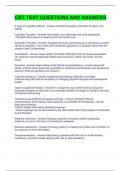
3 Type of Cognitions (Beck) - Answer-Voluntary thoughts, Automatic thought, Core
beliefs
Voluntary Thoughts - Answer--less stable, less influential, and most assessable
-Thoughts that a person is aware of and has control over
Automatic Thoughts - Answer-Thoughts that arise spontaneously in response to specific
stimuli or situations. They reflect the individual's appraisal of a situation rather than the
situation itself. (Judgmental)
Core Beliefs - Answer-Super stable, Incredible Influential, and not always assessable.
Our deepest most fundamental beliefs about ourselves, others, the world, and the
future.
Schemas - Answer-Highly idiosyncratic blends of assumptions or models about self,
others, and the world; goals and expectations; memories and fantasies; and all previous
learning. What all cognitions are rooted in.
Cognitive therapy is - Answer-Insight-focused therapy (reflection and better
understanding self) with an emphasis on changing negative thoughts and maladaptive
beliefs.
Goal of Cognitive Therapy - Answer-To change the way clients think by using their
automatic thoughts to reach the core schemata (beliefs) and begin to introduce the idea
of schema restructuring
Theoretical assumptions of Cognitive therapy - Answer--People's internal
communication (inner dialog, meta cognition) is accessible to introspection, we can
think about thinking.
-Clients' beliefs have highly personal meanings
-These meanings can be discovered by the client rather than being taught or interpreted
by the therapist
Arbitrary inferences - Answer-Drawing a specific conclusion without supporting
evidence, or even in the face of contradictory evidence.
Selective abstraction - Answer-Focusing solely on a detail that is taken out of context, at
the expense of other information.
Overgeneralization - Answer-Abstracting a general rule from one or a few isolated
incidences, and then broadly applying the rule to other situations.
3 Type of Cognitions (Beck) - Answer-Voluntary thoughts, Automatic thought, Core
beliefs
Voluntary Thoughts - Answer--less stable, less influential, and most assessable
-Thoughts that a person is aware of and has control over
Automatic Thoughts - Answer-Thoughts that arise spontaneously in response to specific
stimuli or situations. They reflect the individual's appraisal of a situation rather than the
situation itself. (Judgmental)
Core Beliefs - Answer-Super stable, Incredible Influential, and not always assessable.
Our deepest most fundamental beliefs about ourselves, others, the world, and the
future.
Schemas - Answer-Highly idiosyncratic blends of assumptions or models about self,
others, and the world; goals and expectations; memories and fantasies; and all previous
learning. What all cognitions are rooted in.
Cognitive therapy is - Answer-Insight-focused therapy (reflection and better
understanding self) with an emphasis on changing negative thoughts and maladaptive
beliefs.
Goal of Cognitive Therapy - Answer-To change the way clients think by using their
automatic thoughts to reach the core schemata (beliefs) and begin to introduce the idea
of schema restructuring
Theoretical assumptions of Cognitive therapy - Answer--People's internal
communication (inner dialog, meta cognition) is accessible to introspection, we can
think about thinking.
-Clients' beliefs have highly personal meanings
-These meanings can be discovered by the client rather than being taught or interpreted
by the therapist
Arbitrary inferences - Answer-Drawing a specific conclusion without supporting
evidence, or even in the face of contradictory evidence.
Selective abstraction - Answer-Focusing solely on a detail that is taken out of context, at
the expense of other information.
Overgeneralization - Answer-Abstracting a general rule from one or a few isolated
incidences, and then broadly applying the rule to other situations.