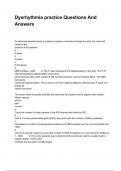
Dysrhythmia practice Questions And Answers
To determine whether there is a delay in impulse conduction through the atria, the nurse will measure the duration of the patients a. P wave. b. Q wave. c. P-R interval. d. QRS complex - ANS a; The P wave represents the depolarization of the atria. The P-R interval represents depolarization of the atria, atrioventricular (AV) node, bundle of His, bundle branches, and the Purkinje fibers. The QRS represents ventricular depolarization. The Q wave is the first negative deflection following the P wave and should be narrow and short The nurse needs to quickly estimate the heart rate for a patient with a regular heart rhythm. Which method will be best to use? a. Count the number of large squares in the R-R interval and divide by 300. b. Print a 1-minute electrocardiogram (ECG) strip and count the number of QRS complexes. c. Calculate the number of small squares between one QRS complex and the next and divide into 1500. d. Use the 3-second markers to count the number of QRS complexes in 6 seconds and multiply by 1 - ANS d; This is the quickest way to determine the ventricular rate for a patient with a regular rhythm. All the other methods are accurate, but take longer A patient has a junctional escape rhythm on the monitor. The nurse will expect the patient to have a heart rate of _____ beats/minute a. 15 to 20 b. 20 to 40 c. 40 to 60 d. 60 to 100 - ANS c; If the sinoatrial (SA) node fails to discharge, the atrioventricular (AV) node will automatically discharge at the normal rate of 40 to 60 beats/minute. The slower rates are typical of the bundle of His and the Purkinje system and may be seen with failure of both the SA and AV node to discharge. The normal SA node rate is 60 to 100 beats/minute The nurse obtains a rhythm strip on a patient who has had a myocardial infarction and makes the following analysis: no visible P waves, P-R interval not measurable, ventricular rate 162, R-R interval regular, and QRS complex wide and distorted, QRS duration 0.18 second. The nurse interprets the patients cardiac rhythm as a. atrial flutter. b. sinus tachycardia. c. ventricular fibrillation. d. ventricular tachycardia - ANS d; The absence of P waves, wide QRS, rate 150 beats/minute, and the regularity of the rhythm indicate ventricular tachycardia. Atrial flutter is usually regular, has a narrow QRS configuration, and has flutter waves present representing atrial activity. Sinus tachycardia has P waves. Ventricular fibrillation is irregular and does not have a consistent QRS duration The nurse notes that a patients cardiac monitor shows that every other beat is earlier than expected, has no visible P wave, and has a QRS complex that is wide and bizarre in shape. How will the nurse document the rhythm? a. Ventricular couplets b. Ventricular bigeminy c. Ventricular R-on-T phenomenon d. Multifocal premature ventricular contractions - ANS b; Ventricular bigeminy describes a rhythm in which every other QRS complex is wide and bizarre looking. Pairs of wide QRS complexes are described as ventricular couplets. There is no indication that the premature ventricular contractions (PVCs) are multifocal or that the R-on-T phenomenon is occurring A patient has a normal cardiac rhythm and a heart rate of 72 beats/minute. The nurse determines that the P-R interval is 0.24 seconds. The most appropriate intervention by the nurse would be to a. notify the health care provider immediately. b. give atropine per agency dysrhythmia protocol. c. prepare the patient for temporary pacemaker insertion. d. document the finding and continue to monitor the patient - ANS d; First-degree atrioventricular (AV) block is asymptomatic and requires ongoing monitoring because it may progress to more serious forms of heart block. The rate is normal, so there is no indication that atropine is needed. Immediate notification of the health care provider about an asymptomatic rhythm is not necessary A patient who was admitted with a myocardial infarction experiences a 45-second episode of ventricular tachycardia, then converts to sinus rhythm with a heart rate of 98 beats/minute. Which of the following actions should the nurse take next ? a. Immediately notify the health care provider. b. Document the rhythm and continue to monitor the patient. c.
Written for
- Institution
- Dysrhythmias
- Course
- Dysrhythmias
Document information
- Uploaded on
- June 10, 2024
- Number of pages
- 13
- Written in
- 2023/2024
- Type
- Exam (elaborations)
- Contains
- Questions & answers
Subjects
-
dysrhythmia practice questions and answers

Also available in package deal