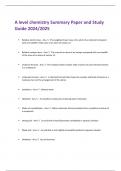
A level chemistry Summary Paper and Study Guide 2024/2025
▪ Relative atomic mass - Ans .The weighted mean mass of an atom of an element compared with one-twelfth of the mass of an atom of carbon-12. ▪ Relative isotopic mass - Ans .The mass of an atom of an isotope compared with one-twelfth of the mass of an atom of carbon-12. ▪ empirical formula - Ans .The simplest whole number ratio of atoms of each element present in a compound ▪ molecular formula - Ans .A chemical formula that shows the number and kinds of atoms in a molecule, but not the arrangement of the atoms. ▪ anhydrous - Ans .without water ▪ Hydrated - Ans .A crystalline compound containing water molecules ▪ Water of crystallisation - Ans .Water molecules that are bonded into a crystalline structure of a compound ▪ strong acid - Ans .an acid that ionises/dissociates completely in aqueous solution ▪ Weak acid - Ans .an acid that is only slightly ionised/dissociated in aqueous solution ▪ Oxidation - Ans .loss of electrons ▪ Reduction - Ans .gain of electrons ▪ Ionic bonding - Ans .The electrostatic attraction between oppositely charged ions ▪ Covalent bonds - Ans .sharing of a pair of electrons ▪ Electronegativity - Ans .the ability of an atom to attract the electrons in a covalent bond ▪ 1st ionisation energy - Ans .energy change when one mole of electrons is removed from one mole of gaseous atoms ▪ Metallic bonding - Ans .the chemical bonding that results from the attraction between metal ions and the surrounding delocalised electrons ▪ Disproportionation - Ans .The oxidation and reduction of the same element in a redox reaction ▪ Activation energy - Ans .the minimum amount of energy required to start a chemical reaction ▪ standard enthalpy of formation - Ans .enthalpy change if 1 mole of compound in standard state were formed directly from its elements ▪ Standard enthalpy of combustion - Ans .the enthalpy change when 1 mole of a substance is completely burned in oxygen under standard conditions. ▪ Standard enthalpy of neutralisation - Ans .The enthalpy change when one mole of water is produced in a neutralisation reaction under standard conditions. ▪ homogeneous catalyst - Ans .a catalyst that is in the same phase as all the reactants and products in a reaction system ▪ heterogeneous catalyst - Ans .A catalyst that is in a different ph
Written for
Document information
- Uploaded on
- June 20, 2024
- Number of pages
- 6
- Written in
- 2023/2024
- Type
- Exam (elaborations)
- Contains
- Questions & answers
Subjects
-
a level chemistry summary paper and study guide 2

Also available in package deal