100% satisfaction guarantee Immediately available after payment Both online and in PDF No strings attached 4.6 TrustPilot
logo-home
Exam (elaborations)

High Yield PULMONOLOGY USMLE STEP 1 NOTES A+ latest

Rating
-
Sold
-
Pages
40
Grade
A+
Uploaded on
21-06-2024
Written in
2023/2024

High Yield PULMONOLOGY USMLE STEP 1 NOTES EMBRYOLOGY The Lung bud which is also called the respiratory diverticulum is the outgrowth of the foregut. This forms during the 4th week of development. Lung Maturation Stages/Periods Pseudoglandular (5-16 weeks) Canalicular (16-26 weeks) Saccular (26 weeks to birth) Alveolar (after birth) Anatomy Bronchi → Hyaline cartilage Bronchioles → No cartilage. Terminal → respiratory Alveoli → Capillaries and gas exchange. Pseudoglandular Period In this period the lung resembles a gland. There is branching to level of terminal bronchioles. No respiratory bronchioles or alveoli are present. Fetal Respiration Fetal breathing movements occur in utero. The baby aspirates amniotic fluid which stimulates lung development and growth of respiratory muscles. Fetal respiration is important for growth during pseudoglandular phase. Canalicular Period In this period the terminal bronchioles divide and form respiratory bronchioles. Respiratory bronchioles divide into alveolar ducts. Survival after birth is possible at the end of this period. The airway lumens become larger. Type II pneumocytes form in this period. This pneumocyte produces surfactant to lower surface tension and keeps alveoli open. Saccular Period Terminal sacs (primitive alveoli) form. Capillaries multiply in contact with alveoli. Alveolar Period At birth, only about ⅓ of alveoli is present. Following birth there is increasing number of respiratory bronchioles and alveoli. There is continued lung development through age 10. Alveolarization: Airspaces are subdivided and new walls will be formed (septa) Bronchopulmonary Dysplasia Occurs in premature infants and is treated in the NICU. Surfactants, oxygen, mechanical ventilation. Oxygen toxicity and lung trauma. Alveolarization does not progress normally. Respiratory problems during infancy. This often improves during childhood. Pulmonary Hypoplasia This is seen in: Oligohydramnios (Potter’s sequence) Congenital diaphragmatic hernia - This is defective formation of pleuroperitoneal membrane - This leads to a hole in the diaphragm and abdominal organs herniate into chest. If there is herniation in utero it will lead to pulmonary hypoplasia. Often fatal. Bronchogenic Cysts Abnormal budding of foregut. Usually found in the mediastinum. Contain clear fluid but air is seen when it is infected. Bronchogenic cysts do not communicate with lungs. Lined by respiratory epithelium (columnar, ciliated). The walls contain cartilage which is a diagnostic criteria. Often asymptomatic. May lead to pneumonia, compression of airway. Pulmonary Vascular Resistance In utero - PVR is high - Canalicular stage: few/no pulmonary capillaries - Later stages: hypoxemia → vasoconstriction - Umbilical venous blood: PaO2 30 mmHg; O2 saturation = 80% - Only about 10% of cardiac output to lungs At birth - PVR falls significantly - 100% cardiac output through lungs ANATOMY Zones Conducting Zone - No gas exchange - Large airways: nose, pharynx, trachea and bronchi - Filters, warms and humidifies air Respiratory Zone - Gas exchange - Respiratory bronchioles, alveolar ducts and alveoli Mucous Secretions produced by respiratory tracts. The secretions are mostly glycoproteins and water. The mucus is secreted by goblet cells in bronchial walls. Protects against particulates, infection. Beating cilia move mucus to epiglottis → swallowed Alveoli Alveoli are small sacs that is responsible for gas exchange. It is surrounded by capillaries. Alveolar Cells: Pneumocytes Type 1 - Most common (97% of cells) - Thin for gas exchange Type 2 - Produce surfactant - Can proliferate to other cells - key for regeneration after injury Club Cells (bronchioles) - Surfactant - Responsible for detoxification Surfactant When you exhale the alveoli shrinks. The alveoli can collapse and this is called atelectasis due to decreased efficiency gas exchange. Surfactant allows alveoli to avoid collapse. Surfactants are secreted by type 2 pneumocytes. Mix of lecithins. Especially dipalmitoylphosphatidylcholine Fetal Lung Maturity Lungs are “mature” when enough surfactant are present. Occurs around 35 weeks. Lecithin-sphingomyelin ratio (L/S ratio) Both produced equally until approx 35 weeks. Ratio 2.0 in amniotic fluid suggests lungs mature Preterm delivery: betamethasone is used to stimulate surfactant production in lungs. Neonatal Respiratory Distress Syndrome Hyaline membrane disease. Can lead to atelectasis. There is severe hypoxemia/↑pCO2 (poor ventilation). Poorly responsive to O2 because lungs are collapsed (alveoli) and intrapulmonary shunting. Risk Factors - Prematurity - Maternal diabetes: high insulin levels decrease surfactant production - Cesarean delivery: lack of vaginal compression stress leads to reduced fetal cortisol and reduction in surfactant There are many complications in NRDS: 1. Bronchopulmonary dysplasia 2. Patent ductus arteriosus (hypoxia keeps shunt open) 3. Retinopathy of prematurity - Oxygen → free radical formation - Neovascularization in the retina - Retinal detachment → blindness Lobes of the Lung Aspiration Right lung is more common site of aspiration. The right bronchus is wider so there is less angle and more vertical path to lung. If patient is upright: Right inferior lobe to lower portion If supine: - Right inferior lobe → superior portion - Right upper lobe → posterior segment Diaphragm Caval Opening - T8 - IVC Esophageal hiatus - T10 - Esophagus, Vagus nerve Aortic Hiatus - T12 - Aorta, thoracic duct, azygos vein The diaphragm is innervated by C3, C4, C5 (phrenic nerve) Diaphragm irritation → “referred” shoulder pain - Classic example is gallbladder disease. - Also lower lung masses - Irritation can cause dyspnea and hiccups Cut nerve → diaphragm elevation, dyspnea. - “Paradoxical movement” → Moves up with inspiration - Can see on fluoroscopy (“sniff test”) Muscles of Quiet Respiration Diaphragm → inspiration Exhalation is passive with normal (“quiet”) breathing Inspiration (neck) - Scalenes → raise ribs - Sternocleidomastoids → raise sternum Exhalations (abdomen) - Rectus muscle - Internal/external obliques - Transverse abdominis - Internal intercostals Use of accessory muscles in respiratory distress

Show more Read less
Institution
Course

Content preview

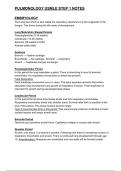
PULMONOLOGY USMLE STEP 1 NOTES

EMBRYOLOGY
The Lung bud which is also called the respiratory diverticulum is the outgrowth of the
foregut. This forms during the 4th week of development.

Lung Maturation Stages/Periods
Pseudoglandular (5-16 weeks)
Canalicular (16-26 weeks)
Saccular (26 weeks to birth)
Alveolar (after birth)

Anatomy
Bronchi → Hyaline cartilage
Bronchioles → No cartilage. Terminal → respiratory
Alveoli → Capillaries and gas exchange.

Pseudoglandular Period
In this period the lung resembles a gland. There is branching to level of terminal
bronchioles. No respiratory bronchioles or alveoli are present.
Fetal Respiration
Fetal breathing movements occur in utero. The baby aspirates amniotic fluid which
stimulates lung development and growth of respiratory muscles. Fetal respiration is
important for growth during pseudoglandular phase.

Canalicular Period
In this period the terminal bronchioles divide and form respiratory bronchioles.
Respiratory bronchioles divide into alveolar ducts. Survival after birth is possible at the
end of this period. The airway lumens become larger.
Type II pneumocytes form in this period. This pneumocyte produces surfactant to lower
surface tension and keeps alveoli open.

Saccular Period
Terminal sacs (primitive alveoli) form. Capillaries multiply in contact with alveoli.

Alveolar Period
At birth, only about ⅓ of alveoli is present. Following birth there is increasing number of
respiratory bronchioles and alveoli. There is continued lung development through age
10. Alveolarization: Airspaces are subdivided and new walls will be formed (septa)

,Bronchopulmonary Dysplasia
Occurs in premature infants and is treated in the NICU. Surfactants, oxygen,
mechanical ventilation. Oxygen toxicity and lung trauma. Alveolarization does not
progress normally. Respiratory problems during infancy. This often improves during
childhood.

Pulmonary Hypoplasia
This is seen in:
Oligohydramnios (Potter’s sequence)
Congenital diaphragmatic hernia
- This is defective formation of pleuroperitoneal membrane
- This leads to a hole in the diaphragm and abdominal organs herniate into chest.
If there is herniation in utero it will lead to pulmonary hypoplasia. Often fatal.

Bronchogenic Cysts
Abnormal budding of foregut. Usually found in the mediastinum. Contain clear fluid but
air is seen when it is infected. Bronchogenic cysts do not communicate with lungs.
Lined by respiratory epithelium (columnar, ciliated). The walls contain cartilage which is
a diagnostic criteria. Often asymptomatic. May lead to pneumonia, compression of
airway.

Pulmonary Vascular Resistance
In utero
- PVR is high
- Canalicular stage: few/no pulmonary capillaries
- Later stages: hypoxemia → vasoconstriction
- Umbilical venous blood: PaO2 30 mmHg; O2 saturation = 80%
- Only about 10% of cardiac output to lungs
At birth
- PVR falls significantly
- 100% cardiac output through lungs


ANATOMY

Zones
Conducting Zone
- No gas exchange
- Large airways: nose, pharynx, trachea and bronchi
- Filters, warms and humidifies air
Respiratory Zone
- Gas exchange
- Respiratory bronchioles, alveolar ducts and alveoli

,Mucous
Secretions produced by respiratory tracts. The secretions are mostly glycoproteins and
water. The mucus is secreted by goblet cells in bronchial walls. Protects against
particulates, infection. Beating cilia move mucus to epiglottis → swallowed

Alveoli

Alveoli are small sacs that is
responsible for gas exchange.
It is surrounded by capillaries.


Alveolar Cells: Pneumocytes
Type 1
- Most common (97% of cells)
- Thin for gas exchange
Type 2
- Produce surfactant
- Can proliferate to other cells - key for regeneration after injury
Club Cells (bronchioles)
- Surfactant
- Responsible for detoxification

Surfactant
When you exhale the alveoli shrinks. The alveoli can collapse and this is called
atelectasis due to decreased efficiency gas exchange.
Surfactant allows alveoli to avoid collapse.

, Surfactants are secreted by type 2 pneumocytes. Mix of lecithins. Especially
dipalmitoylphosphatidylcholine


Fetal Lung Maturity
Lungs are “mature” when enough surfactant are present. Occurs around 35 weeks.
Lecithin-sphingomyelin ratio (L/S ratio)
Both produced equally until approx 35 weeks.
Ratio >2.0 in amniotic fluid suggests lungs mature
Preterm delivery: betamethasone is used to stimulate surfactant production in lungs.

Neonatal Respiratory Distress Syndrome
Hyaline membrane disease. Can lead to atelectasis. There is severe hypoxemia/↑pCO2
(poor ventilation). Poorly responsive to O2 because lungs are collapsed (alveoli) and
intrapulmonary shunting.

Risk Factors
- Prematurity
- Maternal diabetes: high insulin levels decrease surfactant production
- Cesarean delivery: lack of vaginal compression stress leads to reduced fetal
cortisol and reduction in surfactant

There are many complications in NRDS:
1. Bronchopulmonary dysplasia
2. Patent ductus arteriosus (hypoxia keeps shunt open)
3. Retinopathy of prematurity
- Oxygen → free radical formation
- Neovascularization in the retina
- Retinal detachment → blindness

Lobes of the Lung

Written for

Course

Document information

Uploaded on
June 21, 2024
Number of pages
40
Written in
2023/2024
Type
Exam (elaborations)
Contains
Questions & answers

Subjects

$10.49
Get access to the full document:

100% satisfaction guarantee
Immediately available after payment
Both online and in PDF
No strings attached


Also available in package deal

Get to know the seller

Seller avatar
Reputation scores are based on the amount of documents a seller has sold for a fee and the reviews they have received for those documents. There are three levels: Bronze, Silver and Gold. The better the reputation, the more your can rely on the quality of the sellers work.
APluswork Chamberlain College Of Nursng
Follow You need to be logged in order to follow users or courses
Sold
290
Member since
6 year
Number of followers
108
Documents
1523
Last sold
3 days ago
Stuviacommunityhub best high rating notes test bank & Solution manual

Welcome! I am an experienced freelancer offering high-quality academic resources to help you succeed. My materials include detailed notes, guides, test banks, solution manuals, and practice exercises designed to simplify complex topics . I’m committed to helping you improve your grades and GPA. I specialize in subjects like business, IT, nursing, history, poetry, statistics and Accounting finance. Get the *A+* you deserve, with personalized attention to every assignmets.

Read more Read less
3.9

41 reviews

5
24
4
4
3
4
2
3
1
6

Trending documents

Recently viewed by you

Why students choose Stuvia

Created by fellow students, verified by reviews

Quality you can trust: written by students who passed their tests and reviewed by others who've used these notes.

Didn't get what you expected? Choose another document

No worries! You can instantly pick a different document that better fits what you're looking for.

Pay as you like, start learning right away

No subscription, no commitments. Pay the way you're used to via credit card and download your PDF document instantly.

Student with book image

“Bought, downloaded, and aced it. It really can be that simple.”

Alisha Student

Frequently asked questions