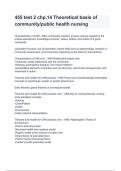
455 test 2 chp.14 Theoretical basis of
community/public health nursing
Characteristics of CHN - ANS--community oriented: process actively shaped by the
unique experiences, knowledge,concerns, values, beliefs, and culture of a given
community.
-population focused: use of population- based skills such as epidemiology, research in
community assessment, and community organizing as the basis for interventions.
Characteristics of CHN cont. - ANS-Relationship based care
-reciprocal, caring relationship with the community
-listening, participatory dialogue, and critical reflection
-sociopolitical elements of practice such as advocacy, community empowerment, and
movement to action.
Theories and models for CHN practice - ANS-Theory:set of systematically interrelated
concepts or hypotheses; explain or predict phenomena
Early theories: grand theories or conceptual models
Theories and models for CHN practice cont. - ANS-Key to nursing theories: nursing
meta paradigm concepts:
-Nursing
-Client/Patient
-Health
-Environment
model: pictorial representation
Theories and models for CHN practice cont. - ANS--Nightingale's Theory of
Environment
-Orem's self-care model
-Neumans health care systems model
-Roger's model of the science of unitary man
-King's theory of goal attainment
-Parse's human becoming theory
-Pender's health promotion model
, -Roys adaptation model
-Salmon's construct for public health nursing
-Minnesota wheel: the public health interventions model
-Public health nursing practice model
-Omaha system
Early Theories were called metaparadigms? - ANS-False: early theories were called
grand theories or conceptual models.
Nightingale's Theory of Environment - ANS--focus on preventive care for populations
-use of observations to validate her hypothesis
-poor environmental conditions are bad for health.
-good environmental conditions reduce disease
-others have added social services and health in addition to environment as conditions
for health.
Orem's self-care model - ANS--communities with collective set of self-care actions and
requirements affecting well-being of the group
-self-care deficit:demand exceeds client abilities related to:
-universal requirements
-developmental requirements
-health deviation requirements
-nursing care supports clients
-specific theories: self-care deficit theory; theory of self-care; theory of nursing system
Neuman's health care systems model - ANS--open systems constantly and reciprocally
interacting with environment
-system>sum of parts
-wellness= parts interacting in harmony with each other and the system's environment
-variables: physiological, sociocultural, developmental
-each system with unique response to stressors and tension-producing stimuli
-system response with boundaries: flexible lie of resistance; normal line of defense;
dynamic flexible line of defense
Roger's model of the science of unitary man - ANS--based on systems theory
-whole is greater than the sum of the parts
-three principles:
1. Life proceeds in one direction along a rhythmic spiral.
2.Energy fields follow a certain wave pattern and organization
community/public health nursing
Characteristics of CHN - ANS--community oriented: process actively shaped by the
unique experiences, knowledge,concerns, values, beliefs, and culture of a given
community.
-population focused: use of population- based skills such as epidemiology, research in
community assessment, and community organizing as the basis for interventions.
Characteristics of CHN cont. - ANS-Relationship based care
-reciprocal, caring relationship with the community
-listening, participatory dialogue, and critical reflection
-sociopolitical elements of practice such as advocacy, community empowerment, and
movement to action.
Theories and models for CHN practice - ANS-Theory:set of systematically interrelated
concepts or hypotheses; explain or predict phenomena
Early theories: grand theories or conceptual models
Theories and models for CHN practice cont. - ANS-Key to nursing theories: nursing
meta paradigm concepts:
-Nursing
-Client/Patient
-Health
-Environment
model: pictorial representation
Theories and models for CHN practice cont. - ANS--Nightingale's Theory of
Environment
-Orem's self-care model
-Neumans health care systems model
-Roger's model of the science of unitary man
-King's theory of goal attainment
-Parse's human becoming theory
-Pender's health promotion model
, -Roys adaptation model
-Salmon's construct for public health nursing
-Minnesota wheel: the public health interventions model
-Public health nursing practice model
-Omaha system
Early Theories were called metaparadigms? - ANS-False: early theories were called
grand theories or conceptual models.
Nightingale's Theory of Environment - ANS--focus on preventive care for populations
-use of observations to validate her hypothesis
-poor environmental conditions are bad for health.
-good environmental conditions reduce disease
-others have added social services and health in addition to environment as conditions
for health.
Orem's self-care model - ANS--communities with collective set of self-care actions and
requirements affecting well-being of the group
-self-care deficit:demand exceeds client abilities related to:
-universal requirements
-developmental requirements
-health deviation requirements
-nursing care supports clients
-specific theories: self-care deficit theory; theory of self-care; theory of nursing system
Neuman's health care systems model - ANS--open systems constantly and reciprocally
interacting with environment
-system>sum of parts
-wellness= parts interacting in harmony with each other and the system's environment
-variables: physiological, sociocultural, developmental
-each system with unique response to stressors and tension-producing stimuli
-system response with boundaries: flexible lie of resistance; normal line of defense;
dynamic flexible line of defense
Roger's model of the science of unitary man - ANS--based on systems theory
-whole is greater than the sum of the parts
-three principles:
1. Life proceeds in one direction along a rhythmic spiral.
2.Energy fields follow a certain wave pattern and organization