BIO 103 Exam 2 Study Questions with Correct Answers
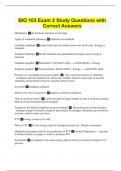
Metabolism all chemical reactions in the body Types of metabolic pathways catabolic and anabolic Catabolic pathways Large molecules are broken down into small ones. Energy is released. Anabolic pathways Small molecules are assembled into large ones. Energy is required Catabolic equation Respiration: C6H12O6 +6O2 —> 6CO2+6H2O + Energy Anabolic equation Photosynthesis: 6CO2+6H2O + Energy —> C6H12O6 +6O2 Process of a competitive enzyme inhibitor - Has a structure similar to substrate - competes with the substrate for active site, inhibitor binds to active site of enzyme, reactants cannot bind to enzyme; reaction doesn't occur Enzymes biological catalysts What is the role of enzymes? speed up chemical reactions How do enzymes work? Lower activation energy needed to start a chemical reaction. Able to do this because they're reusable Process of the NON-competitive enzyme inhibitor - Binds enzyme at other location - changes shape of enzyme; shape of active store is changed, reactants cannot bind to enzyme; reaction does not occur ATP Energy currency for cells Role of ATP It's the energy used for biological activity (ex. Muscle movement) Metabolic processes result in the production of ATP Aerobic Respiration — glucose is broken thanks to oxygen in order to produce ATP Autotrophs an organism that uses energy (light & chem) to converts inorganic C to glucose
Written for
- Institution
- BIO 103
- Course
- BIO 103
Document information
- Uploaded on
- July 3, 2024
- Number of pages
- 5
- Written in
- 2023/2024
- Type
- Exam (elaborations)
- Contains
- Questions & answers
Subjects
-
bio 103 exam 2 study questions with correct answer
-
metabolism all chemical reactions in the body
-
types of metabolic pathways catabolic and anaboli

Also available in package deal