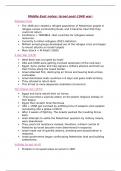
BIOLOGICAL MOLECULES Disaccharides
Condensation reactions – release water molecule
Water
- polar (dipole) - OH group Maltose
- O has greater affinity so a glucose + a glucose
pulls electrons close a 1-4 glycosidic bond
- Slight +ve H, slight -ve O
regions = H bonds (weak)
Sucrose
High specific heat capacity a glucose + fructose
- H bonds absorb lots of energy = stable habitat temp a 1-4 glycosidic bond
- Maintains conditions in cell for enzyme activity
High latent heat of vaporisation Lactose
- Overcome H bonds, cooling = sweat a glucose + galactose
b 1-4 glycosidic bond
Good solvent
- OH groups dissolve = forms solution
Non polar not attract water
- -ve O attract to +ve ions and surrounds Polysaccharides
- Transport substance in blood Compact, insoluble, metabolically inactive
- Medium for chemical reactions
Starch
Freezing 1) Amylose
- Less dense when solid - a glucose chain, a 1-4 glycosidic bonds
- 4 H bonds fixed lattice = further apart - coiled helix = compact, less soluble (OH inside)
- Insulating layer on water (stable)
2) Amylopectin
Cohesion = water molecules attracted to each other - a glucose branched chain, a 1-4 + 1-6 glycosidic
Adhesion = water attracted to polar molecules - branched = fast release, insoluble so good storage
Together capillary action + transport
Surface tension = H bonds support underneath glycogen
- a glucose branched chain, a 1-4 + 1-6 glycosidic
Carbohydrates - insoluble, compact = good storage
Monosaccharides - branched = fast release to ↑ metabolic energy
- Hexose monosaccharide C6H12O6
- Polar + soluble = dissolve, energy source cellulose
- b glucose straight chain, b 1-4 glycosidic bonds
a glucose b glucose - alternate molecules flipped, H bonds between chains
- Insoluble, high tensile strength (support), prevent
burst, permeable
Reducing sugars
(all monosaccharides + most disaccharides)
Benedict’s reagent – blue to brick red
Galactose Fructose 1) place sample in boiling tube
2) add benedict’s reagent (alkaline copper sulphate)
3) heat mixture gently in boiling water bath
reducing sugars will react with copper ions
↑ reducing sugar, ↓blue ions = colour gradient for conc
colorimeter determines conc of glucose solution
Ribose (pentose) Deoxyribose
reagent strips = manufactured,
determine conc of reducing by
colour coded chart
Non reducing sugars (sucrose)
Condensation reactions – release water molecule
Water
- polar (dipole) - OH group Maltose
- O has greater affinity so a glucose + a glucose
pulls electrons close a 1-4 glycosidic bond
- Slight +ve H, slight -ve O
regions = H bonds (weak)
Sucrose
High specific heat capacity a glucose + fructose
- H bonds absorb lots of energy = stable habitat temp a 1-4 glycosidic bond
- Maintains conditions in cell for enzyme activity
High latent heat of vaporisation Lactose
- Overcome H bonds, cooling = sweat a glucose + galactose
b 1-4 glycosidic bond
Good solvent
- OH groups dissolve = forms solution
Non polar not attract water
- -ve O attract to +ve ions and surrounds Polysaccharides
- Transport substance in blood Compact, insoluble, metabolically inactive
- Medium for chemical reactions
Starch
Freezing 1) Amylose
- Less dense when solid - a glucose chain, a 1-4 glycosidic bonds
- 4 H bonds fixed lattice = further apart - coiled helix = compact, less soluble (OH inside)
- Insulating layer on water (stable)
2) Amylopectin
Cohesion = water molecules attracted to each other - a glucose branched chain, a 1-4 + 1-6 glycosidic
Adhesion = water attracted to polar molecules - branched = fast release, insoluble so good storage
Together capillary action + transport
Surface tension = H bonds support underneath glycogen
- a glucose branched chain, a 1-4 + 1-6 glycosidic
Carbohydrates - insoluble, compact = good storage
Monosaccharides - branched = fast release to ↑ metabolic energy
- Hexose monosaccharide C6H12O6
- Polar + soluble = dissolve, energy source cellulose
- b glucose straight chain, b 1-4 glycosidic bonds
a glucose b glucose - alternate molecules flipped, H bonds between chains
- Insoluble, high tensile strength (support), prevent
burst, permeable
Reducing sugars
(all monosaccharides + most disaccharides)
Benedict’s reagent – blue to brick red
Galactose Fructose 1) place sample in boiling tube
2) add benedict’s reagent (alkaline copper sulphate)
3) heat mixture gently in boiling water bath
reducing sugars will react with copper ions
↑ reducing sugar, ↓blue ions = colour gradient for conc
colorimeter determines conc of glucose solution
Ribose (pentose) Deoxyribose
reagent strips = manufactured,
determine conc of reducing by
colour coded chart
Non reducing sugars (sucrose)