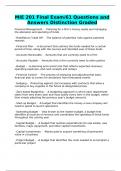
MIE 201 Final Exam/61 Questions and
Answers Distinction Graded
Financial Management - -Planning for a firm's money needs and managing
the allocation and spending of funds
-Risk/Return Trade Off - -The balance of potential risks against potential
rewards
-Financial Plan - -A document that outlines the funds needed for a certain
period of time, along with the sources and intended uses of those funds
-Accounts Receivable - -Amounts that are currently owed to a firm
-Accounts Payable - -Amounts that a firm currently owes to other parties
-Budget - -A planning and control tool that reflects expected revenues,
operating expenses, and cash receipts and outlays
-Financial Control - -The process of analyzing and adjusting that basic
financial plan to correct for deviations from forecasted events
-Hedging - -Protecting against cost increases with contracts that allow a
company to buy supplies in the future at designated prices
-Zero-based Budgeting - -A budgeting approach in which each department
starts from zero every year and must justify every item in the budget, rather
than simply adjusting the previous year's budget amounts
-Start-up Budget - -A budget that identifies the money a new company will
need to spend to launch operations
-Operating Budget - -Also known as the master budget, a budget that
identifies all sources of revenue and coordinates the spending of those funds
throughout the coming year
-Capital Budget - -A budget that outlines expenditures for real estate, new
facilities, major equipment, and other capital investments
-Capital Investments - -Money paid to acquire something of permanent
value in a business
-Project Budget - -A budget that identifies the costs needed to accomplish a
particular project
, -Debt Financing - -Arranging funding by borrowing money
-Equity Financing - -Arranging funding by selling ownership shares in the
company, publicly or privately
-Short-term Financing - -Financing used to cover current expenses (usually
repaid within a year)
-Long-term Financing - -Financing used to cover long-term expenses such
as assets (usually repaid over a period of more than one year)
-Cost of Capital - -The average rate of interest a firm pays on its
combination of debt and equity
-Prime Interest Rate - -The lowest rate of interest that banks charge for
short-term loans to their most creditworthy customers
-Leverage - -The technique of increasing the rate of return of an investment
by financing it with borrowed funds
-Capital Structure - -A firm's mix of debt and equity financing
-Credit Cards - -Essentially creates a short-term loan every time cardholder
makes purchases or gets a cash advance
-Trade Credit - -Allows buyer to make purchases without immediately
paying for them; usually no interest
-Secured Loans - -Lender provides cash using borrower's assets as collateral
in case of default
-Unsecured Loans - -Loans that require a good credit rating but no collateral
-Compensating Balance - -The portion of an unsecured loan that is kept on
deposit at a lending institution to protect the lender and increase the
lender's return
-Line of Credit - -An arrangement in which a financial institution makes
money avaliable for use at any time after the loan has been approved
-Commercial Paper - -Short term promissory notes, or contractual
agreements, to repay a borrowed amount by a specific time with a specified
interest rate
-Factoring - -Obtaining funding by selling accounts receivable
Answers Distinction Graded
Financial Management - -Planning for a firm's money needs and managing
the allocation and spending of funds
-Risk/Return Trade Off - -The balance of potential risks against potential
rewards
-Financial Plan - -A document that outlines the funds needed for a certain
period of time, along with the sources and intended uses of those funds
-Accounts Receivable - -Amounts that are currently owed to a firm
-Accounts Payable - -Amounts that a firm currently owes to other parties
-Budget - -A planning and control tool that reflects expected revenues,
operating expenses, and cash receipts and outlays
-Financial Control - -The process of analyzing and adjusting that basic
financial plan to correct for deviations from forecasted events
-Hedging - -Protecting against cost increases with contracts that allow a
company to buy supplies in the future at designated prices
-Zero-based Budgeting - -A budgeting approach in which each department
starts from zero every year and must justify every item in the budget, rather
than simply adjusting the previous year's budget amounts
-Start-up Budget - -A budget that identifies the money a new company will
need to spend to launch operations
-Operating Budget - -Also known as the master budget, a budget that
identifies all sources of revenue and coordinates the spending of those funds
throughout the coming year
-Capital Budget - -A budget that outlines expenditures for real estate, new
facilities, major equipment, and other capital investments
-Capital Investments - -Money paid to acquire something of permanent
value in a business
-Project Budget - -A budget that identifies the costs needed to accomplish a
particular project
, -Debt Financing - -Arranging funding by borrowing money
-Equity Financing - -Arranging funding by selling ownership shares in the
company, publicly or privately
-Short-term Financing - -Financing used to cover current expenses (usually
repaid within a year)
-Long-term Financing - -Financing used to cover long-term expenses such
as assets (usually repaid over a period of more than one year)
-Cost of Capital - -The average rate of interest a firm pays on its
combination of debt and equity
-Prime Interest Rate - -The lowest rate of interest that banks charge for
short-term loans to their most creditworthy customers
-Leverage - -The technique of increasing the rate of return of an investment
by financing it with borrowed funds
-Capital Structure - -A firm's mix of debt and equity financing
-Credit Cards - -Essentially creates a short-term loan every time cardholder
makes purchases or gets a cash advance
-Trade Credit - -Allows buyer to make purchases without immediately
paying for them; usually no interest
-Secured Loans - -Lender provides cash using borrower's assets as collateral
in case of default
-Unsecured Loans - -Loans that require a good credit rating but no collateral
-Compensating Balance - -The portion of an unsecured loan that is kept on
deposit at a lending institution to protect the lender and increase the
lender's return
-Line of Credit - -An arrangement in which a financial institution makes
money avaliable for use at any time after the loan has been approved
-Commercial Paper - -Short term promissory notes, or contractual
agreements, to repay a borrowed amount by a specific time with a specified
interest rate
-Factoring - -Obtaining funding by selling accounts receivable