©PREP4EXAMS 2024/2025 REAL EXAM DUMPS Tuesday, August 6, 2024 10,57 AM
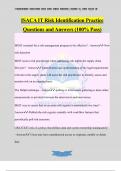
ISACA IT Risk Identification Practice
Questions and Answers (100% Pass)
MOST essential for a risk management program to be effective? - Answer✔️✔️-New
risk detection
BEST assist a risk practitioner when addressing risk within the supply chain
lifecycle? - Answer✔️✔️-Identification and understanding of the legal requirements
relevant to the supply chain will assist the risk practitioner to identify, assess and
monitor risk on an ongoing basis.
The Delphi technique - Answer✔️✔️-polling or information gathering is done either
anonymously or privately between the interviewer and interviewee.
BEST way to ensure that an accurate risk register is maintained over time? -
Answer✔️✔️-Publish the risk register centrally with workflow features that
periodically poll risk assessors.
GREATEST risk of a policy that defines data and system ownership inadequately?
- Answer✔️✔️-Users may have unauthorized access to originate, modify or delete
data
1
, ©PREP4EXAMS 2024/2025 REAL EXAM DUMPS Tuesday, August 6, 2024 10,57 AM
BEST method to ensure the overall effectiveness of a risk management program? -
Answer✔️✔️-Effective risk management requires participation, support and
acceptance by all applicable members of the enterprise, beginning with executives.
Personnel must understand their responsibilities, receive training on how to fulfill
their roles, exercise active judgment and take appropriate action.
MOST significant threat to a project? - Answer✔️✔️-Projects exist to deliver
specific outcomes as stated in requirements. If requirements are misunderstood, a
project can be successful in terms of its internal criteria, scheduling and budget, yet
result in a business failure because the project will not have delivered business
value.
A new data protection regulation directly affects an organization. What information
should the risk practitioner gather to BEST ensure compliance? - Answer✔️✔️-Risk
scenarios should indicate potential effects of noncompliance with the new
regulation and guide management in evaluating whether the cost of compliance
outweighs the cost of noncompliance and if this is in alignment with the
organization's risk tolerance. Understanding the impact of compliance versus
noncompliance will inform which controls are ultimately implemented to achieve
and maintain compliance.
2
ISACA IT Risk Identification Practice
Questions and Answers (100% Pass)
MOST essential for a risk management program to be effective? - Answer✔️✔️-New
risk detection
BEST assist a risk practitioner when addressing risk within the supply chain
lifecycle? - Answer✔️✔️-Identification and understanding of the legal requirements
relevant to the supply chain will assist the risk practitioner to identify, assess and
monitor risk on an ongoing basis.
The Delphi technique - Answer✔️✔️-polling or information gathering is done either
anonymously or privately between the interviewer and interviewee.
BEST way to ensure that an accurate risk register is maintained over time? -
Answer✔️✔️-Publish the risk register centrally with workflow features that
periodically poll risk assessors.
GREATEST risk of a policy that defines data and system ownership inadequately?
- Answer✔️✔️-Users may have unauthorized access to originate, modify or delete
data
1
, ©PREP4EXAMS 2024/2025 REAL EXAM DUMPS Tuesday, August 6, 2024 10,57 AM
BEST method to ensure the overall effectiveness of a risk management program? -
Answer✔️✔️-Effective risk management requires participation, support and
acceptance by all applicable members of the enterprise, beginning with executives.
Personnel must understand their responsibilities, receive training on how to fulfill
their roles, exercise active judgment and take appropriate action.
MOST significant threat to a project? - Answer✔️✔️-Projects exist to deliver
specific outcomes as stated in requirements. If requirements are misunderstood, a
project can be successful in terms of its internal criteria, scheduling and budget, yet
result in a business failure because the project will not have delivered business
value.
A new data protection regulation directly affects an organization. What information
should the risk practitioner gather to BEST ensure compliance? - Answer✔️✔️-Risk
scenarios should indicate potential effects of noncompliance with the new
regulation and guide management in evaluating whether the cost of compliance
outweighs the cost of noncompliance and if this is in alignment with the
organization's risk tolerance. Understanding the impact of compliance versus
noncompliance will inform which controls are ultimately implemented to achieve
and maintain compliance.
2