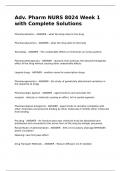
Adv. Pharm NURS 8024 Week 1
with Complete Solutions
Pharmacokinetics - ANSWER - what the body does to the drug
Pharmacodynamics - ANSWER - what the drug does to the body
Toxicology - ANSWER - The undesirable effects of chemicals on living systems
Pharmacotherapeutics - ANSWER - dynamic that achieves the desired therapeutic
effect of the drug without causing other undesirable effects
Legend drugs - ANSWER - another name for prescription drugs
Pharmacogenomics - ANSWER - the study of genetically determined variations in
the response to drugs
Pharmacologic Agonist - ANSWER - agent binds to and activates the
receptor - directly or indirectly causing an effect, full or partial agonists
Pharmacological Antagonist - ANSWER - Agent binds to receptor-completes with
other molecules and prevents binding by other molecules-it inhibits other molecules
from binding
Pro-drug - ANSWER - An inactive percursor chemical-must be abosorbed and
distributed and converted to the active form of the drug by biologic processes.
Rectal Route of administration - ANSWER - 50% of circulatory drainage BYPASSES
portal circulation
Meaning: Less first pass effect
Drug Transport Methods: - ANSWER - Passive diffusion (no E needed)
, Active transport (requires E)
Endocytosis
Passive diffusion (simple diffusion) - ANSWER - no energy needed, related to
concentration gradient across membrane, HIGHER concentration goes to LOWER
concentration
What is ADME? - ANSWER - Absorption
Distribution
Metabolism
Elimination
Absorption - ANSWER - entry of pharmacologic agent into plasma
Distribution - ANSWER - agent leaves the bloodstream and distributes to interstitial
and intracellular fluids
Metablosim - ANSWER - chemical processes that occur to make the drug useful in
the bloodstream--done by the liver, kidney, or other tissue
Ellimination - ANSWER - Leaving the body-via urine, bile, feces, lungs, sweat, breast
milk
2 Major Administration Routes - ANSWER - 1. Enteral -most common, easy, cheap-
BUT drug absorption pathways can be complicated
2. Parenteral-IV, fast, more expensive, once in-cannot get back
Enteral drug administration - ANSWER - oral, sublingual, rectal
drug absorption pathways complicated
**First-pass metabolism can limit the amount of drug that enters systemic
circulation
influenced by food and other drugs
with Complete Solutions
Pharmacokinetics - ANSWER - what the body does to the drug
Pharmacodynamics - ANSWER - what the drug does to the body
Toxicology - ANSWER - The undesirable effects of chemicals on living systems
Pharmacotherapeutics - ANSWER - dynamic that achieves the desired therapeutic
effect of the drug without causing other undesirable effects
Legend drugs - ANSWER - another name for prescription drugs
Pharmacogenomics - ANSWER - the study of genetically determined variations in
the response to drugs
Pharmacologic Agonist - ANSWER - agent binds to and activates the
receptor - directly or indirectly causing an effect, full or partial agonists
Pharmacological Antagonist - ANSWER - Agent binds to receptor-completes with
other molecules and prevents binding by other molecules-it inhibits other molecules
from binding
Pro-drug - ANSWER - An inactive percursor chemical-must be abosorbed and
distributed and converted to the active form of the drug by biologic processes.
Rectal Route of administration - ANSWER - 50% of circulatory drainage BYPASSES
portal circulation
Meaning: Less first pass effect
Drug Transport Methods: - ANSWER - Passive diffusion (no E needed)
, Active transport (requires E)
Endocytosis
Passive diffusion (simple diffusion) - ANSWER - no energy needed, related to
concentration gradient across membrane, HIGHER concentration goes to LOWER
concentration
What is ADME? - ANSWER - Absorption
Distribution
Metabolism
Elimination
Absorption - ANSWER - entry of pharmacologic agent into plasma
Distribution - ANSWER - agent leaves the bloodstream and distributes to interstitial
and intracellular fluids
Metablosim - ANSWER - chemical processes that occur to make the drug useful in
the bloodstream--done by the liver, kidney, or other tissue
Ellimination - ANSWER - Leaving the body-via urine, bile, feces, lungs, sweat, breast
milk
2 Major Administration Routes - ANSWER - 1. Enteral -most common, easy, cheap-
BUT drug absorption pathways can be complicated
2. Parenteral-IV, fast, more expensive, once in-cannot get back
Enteral drug administration - ANSWER - oral, sublingual, rectal
drug absorption pathways complicated
**First-pass metabolism can limit the amount of drug that enters systemic
circulation
influenced by food and other drugs