Performance measurement questions
with answers.
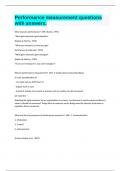
Why measure performance? ANS -(Eccles, 1991)
"What gets measured gets attention"
(Kaplan & Norton, 1992)
"What you measures is what you get"
(Schmenner & Vollmann, 1993)
"What gets measured gets managed"
(Kaplan & Norton, 1996)
"If you can't measure it, you can't manage it"
What is performance measurement? ANS -Is simply about measuring things
It is the quantification of
- An input such as staff hours or
- Output such as cost
- A level of activity of an event or process such as number of calls answered
per operator
Selecting the right measures for an organisation is not easy. Just because it can be measured doesn't
mean it should be measured. Things have to measure versus things need to measure (customer or
regulator driven measures)
What are the four purposes of performance measures? ANS -1. Communication
2. Motivation
3. Control
4. Improvement
(Franco-Santos et al , 2007)
,Describe why performance measurement is useful for communication ANS -• By measuring something
the organisation is saying it is important• Important means for communicating and implementing
organisation strategy • However, by measuring everything, it is implying that nothing is important• A
measure inform employees what may be accountable for
Describe why performance measurement is useful for motivation ANS -• Create the mindset that
influences employees behaviour • It is important to have the right balance of measures
Describe why performance measurement is useful for control ANS -Provide feedback so that action can
be taken to keep process in control
Ensure consistent performance not only within one organisation but across
ecosystem.
Describe why performance measurement is useful for improvement ANS -Provide a powerful means of
driving improvement
Information on how process is ON or OFF Target could learn how to manage
it better.
Linking measures with rewards or penalties
What do we measure? Draw a matrix ANS -Predominantly organisations are using only 2 types of
measures: financial and operational
Also: external data (E)
Development/Forward focus (D)
Financial metrics related to development:
• Training
Staff satisfaction
Staff turnover • Innovation
Financial metrics related to external data:
, Sales Turnover
Total Costs
Value of Stock
Value of raw materials
Non-financial metrics related to external data:
Market Share
Customer Satisfaction
Customer Loyalty
Retention Rates
Non-financial metrics related to development:
Equipment/staff availability
Number of customers/type
On-time delivery
Faults
What is the Balanced Scorecard? ANS -Kaplan and Norton, 1992
The balance scorecard is a framework to measure performance , broadly and widely implemented
worldwide.
HBR - 1993: provides executives with a comprehensive framework that translates a company's strategic
objectives into a coherent set of performance measures.
Four different perspectives of the balance scorecard and at the centre of these perspectives is the vision
and strategy.
Financial Perspective
How should we appear to stakeholders
with answers.
Why measure performance? ANS -(Eccles, 1991)
"What gets measured gets attention"
(Kaplan & Norton, 1992)
"What you measures is what you get"
(Schmenner & Vollmann, 1993)
"What gets measured gets managed"
(Kaplan & Norton, 1996)
"If you can't measure it, you can't manage it"
What is performance measurement? ANS -Is simply about measuring things
It is the quantification of
- An input such as staff hours or
- Output such as cost
- A level of activity of an event or process such as number of calls answered
per operator
Selecting the right measures for an organisation is not easy. Just because it can be measured doesn't
mean it should be measured. Things have to measure versus things need to measure (customer or
regulator driven measures)
What are the four purposes of performance measures? ANS -1. Communication
2. Motivation
3. Control
4. Improvement
(Franco-Santos et al , 2007)
,Describe why performance measurement is useful for communication ANS -• By measuring something
the organisation is saying it is important• Important means for communicating and implementing
organisation strategy • However, by measuring everything, it is implying that nothing is important• A
measure inform employees what may be accountable for
Describe why performance measurement is useful for motivation ANS -• Create the mindset that
influences employees behaviour • It is important to have the right balance of measures
Describe why performance measurement is useful for control ANS -Provide feedback so that action can
be taken to keep process in control
Ensure consistent performance not only within one organisation but across
ecosystem.
Describe why performance measurement is useful for improvement ANS -Provide a powerful means of
driving improvement
Information on how process is ON or OFF Target could learn how to manage
it better.
Linking measures with rewards or penalties
What do we measure? Draw a matrix ANS -Predominantly organisations are using only 2 types of
measures: financial and operational
Also: external data (E)
Development/Forward focus (D)
Financial metrics related to development:
• Training
Staff satisfaction
Staff turnover • Innovation
Financial metrics related to external data:
, Sales Turnover
Total Costs
Value of Stock
Value of raw materials
Non-financial metrics related to external data:
Market Share
Customer Satisfaction
Customer Loyalty
Retention Rates
Non-financial metrics related to development:
Equipment/staff availability
Number of customers/type
On-time delivery
Faults
What is the Balanced Scorecard? ANS -Kaplan and Norton, 1992
The balance scorecard is a framework to measure performance , broadly and widely implemented
worldwide.
HBR - 1993: provides executives with a comprehensive framework that translates a company's strategic
objectives into a coherent set of performance measures.
Four different perspectives of the balance scorecard and at the centre of these perspectives is the vision
and strategy.
Financial Perspective
How should we appear to stakeholders