September 18, 2024
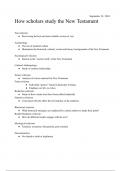
How scholars study the New Testament
Test criticism
● Recovering the best and most reliable version of test
Archaeology
● The use of material culture
● Illuminates the historical, cultural, social and literacy backgrounds of the New Testament
Sociological Criticism
● Interest in the “social world” of the New Testament
Cultural Anthropology
● Study of cultural relationship
Source criticism
● Analysis of source material for New Testament
Form criticism
● Individual “genres” found in particular writings
● Emphasis on Sitz im Leben
Redaction criticism
● Study of how certain texts have been edited (redacted)
Narrative criticism
● Concerned with the affect the text had/has on the audience
Rhetorical criticism
● What rhetorical strategies are employed by certain authors to make their point?
Reader-Response criticism
● How do different readers engage with the text?
Ideological criticism
● Feminist, womanist, liberationist, post-colonial
Deconstruction
● No objective truth or legitimacy
, The New Testament World
What is Archaeology?
● Study of the past as evidenced by human material culture (artifacts, architecture,
art, tools, vessels, etc)
● Focused on what humans can make and manipulate
● NOT: Paleontology (fossil animals & plants) History (text), Treasure Hunting
(Indiana Jones)
● Archeology is a compound of two Greek words: archaios (ancient) and logos
(knowledge)
● In ancient Greece, archeology referred to any general study of the past.
● Today it has a more specialized meaning: a study of the human past through material
remains.
–Archeology is destructive
-we record everything
-Dig in square grids
-measure and record exact location of every artifact or feature
-Records things in three dimensional space (horizontal and vertical location)
Dating Methods
● Radio carbon
● Coins
● inscriptions/written material
● Ancient historical/literary sources
● Ceramics (pottery)
Interpretation in Archeology
● The material culture is mute. Archeologists must make inferences from the remains.
● Not guesswork, but reasoned conclusions based on the convergence of several lines of
evidence. But mistakes can and do get made.
● Ultimately, all archeological interpretation is subject to change based on new evidence.
How scholars study the New Testament
Test criticism
● Recovering the best and most reliable version of test
Archaeology
● The use of material culture
● Illuminates the historical, cultural, social and literacy backgrounds of the New Testament
Sociological Criticism
● Interest in the “social world” of the New Testament
Cultural Anthropology
● Study of cultural relationship
Source criticism
● Analysis of source material for New Testament
Form criticism
● Individual “genres” found in particular writings
● Emphasis on Sitz im Leben
Redaction criticism
● Study of how certain texts have been edited (redacted)
Narrative criticism
● Concerned with the affect the text had/has on the audience
Rhetorical criticism
● What rhetorical strategies are employed by certain authors to make their point?
Reader-Response criticism
● How do different readers engage with the text?
Ideological criticism
● Feminist, womanist, liberationist, post-colonial
Deconstruction
● No objective truth or legitimacy
, The New Testament World
What is Archaeology?
● Study of the past as evidenced by human material culture (artifacts, architecture,
art, tools, vessels, etc)
● Focused on what humans can make and manipulate
● NOT: Paleontology (fossil animals & plants) History (text), Treasure Hunting
(Indiana Jones)
● Archeology is a compound of two Greek words: archaios (ancient) and logos
(knowledge)
● In ancient Greece, archeology referred to any general study of the past.
● Today it has a more specialized meaning: a study of the human past through material
remains.
–Archeology is destructive
-we record everything
-Dig in square grids
-measure and record exact location of every artifact or feature
-Records things in three dimensional space (horizontal and vertical location)
Dating Methods
● Radio carbon
● Coins
● inscriptions/written material
● Ancient historical/literary sources
● Ceramics (pottery)
Interpretation in Archeology
● The material culture is mute. Archeologists must make inferences from the remains.
● Not guesswork, but reasoned conclusions based on the convergence of several lines of
evidence. But mistakes can and do get made.
● Ultimately, all archeological interpretation is subject to change based on new evidence.