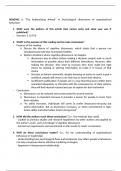
READING 1: “The Rationalizing Animal” in Psychological dimensions of organizational
behaviour
1. WHO were the authors of this article (last names only) and what year was it
published?
- Aronson, E. (1973)
2. WHAT is the purpose of this reading and its main conclusions?
- Purpose of the reading:
o Discuss the theory of cognitive dissonance, which states that a person can
simultaneously hold two inconsistent beliefs.
o Explore situations where cognitive dissonance can happen
dissonance due to effort: before making a decision, people seek as much
information as possible about their different alternatives. However, after
making the decision, they tend to reassure they have made the right
choice by seeking or altering information to make it in favour of that
choice
Decision to behave immorally: despite knowing an action to reach a goal is
unethical, people still chose to act that way to reach their desires.
insufficient justification: if people act in a way that they have neither been
rewarded adequately or threated with the consequences of their actions,
they will find internal reasons/excuses to explain for their behaviour
- Conclusions
o Dissonance can be reduced and counteracted by several motives
o Dissonance is important because it provides a lesson for people to learn from
their mistakes
o “As utility increases, individuals will come to prefer dissonance-arousing but
useful information. But as dissonance increases, or when commitment is high,
future utility and information tend to be ignored”
3. HOW did the authors reach these conclusions? (i.e., the methods they used)
- Looked at previous studies and research hypotheses by other authors and applied to
the author’s work, such as Festinger’s Cognitive Dissonance
- Carried out experiments and commented on the results to reach a conclusion
4. WHY do these conclusions matter? (i.e., for our understanding of organisational
behaviour or leadership)
- Understanding how psychological flaws and tendencies may affect people’s behaviours
can help companies devise effective marketing strategies
- Apparent in interpersonal relationship:
behaviour
1. WHO were the authors of this article (last names only) and what year was it
published?
- Aronson, E. (1973)
2. WHAT is the purpose of this reading and its main conclusions?
- Purpose of the reading:
o Discuss the theory of cognitive dissonance, which states that a person can
simultaneously hold two inconsistent beliefs.
o Explore situations where cognitive dissonance can happen
dissonance due to effort: before making a decision, people seek as much
information as possible about their different alternatives. However, after
making the decision, they tend to reassure they have made the right
choice by seeking or altering information to make it in favour of that
choice
Decision to behave immorally: despite knowing an action to reach a goal is
unethical, people still chose to act that way to reach their desires.
insufficient justification: if people act in a way that they have neither been
rewarded adequately or threated with the consequences of their actions,
they will find internal reasons/excuses to explain for their behaviour
- Conclusions
o Dissonance can be reduced and counteracted by several motives
o Dissonance is important because it provides a lesson for people to learn from
their mistakes
o “As utility increases, individuals will come to prefer dissonance-arousing but
useful information. But as dissonance increases, or when commitment is high,
future utility and information tend to be ignored”
3. HOW did the authors reach these conclusions? (i.e., the methods they used)
- Looked at previous studies and research hypotheses by other authors and applied to
the author’s work, such as Festinger’s Cognitive Dissonance
- Carried out experiments and commented on the results to reach a conclusion
4. WHY do these conclusions matter? (i.e., for our understanding of organisational
behaviour or leadership)
- Understanding how psychological flaws and tendencies may affect people’s behaviours
can help companies devise effective marketing strategies
- Apparent in interpersonal relationship: