PRITE - CHILD PSYCHIATRY QUESTIONS
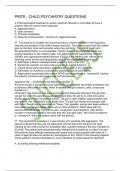
4. Pharmacological treatment in autism spectrum disorder is most likely to have a
positive effect on which of the following?
A. Aggressiveness
B. Gaze aversion
C. Prosodic modulation
D. Gestural communication - Answers-A. Aggressiveness
27. The parents of a toddler are concerned about a recent increase in the frequency,
intensity and duration of the child's temper tantrums. The parents report that the toddler
gets on the floor, kicks and screams when they set limits. The child's health and
developmental history is unremarkable. Family history is significant for mood and
anxiety disorders on the mother's side, and attention-deficit hyperactivity disorder
(ADHD) and oppositional defiant disorder (ODD) on the father's side. Which of the
following would be the most appropriate step for the psychiatrist to take next?
A. Administer a Denver developmental screening test to the child.
B. Explore the parents' concerns about seemingly normal behavior.
C. Inquire about early separations and traumatic events in the child's life.
D. Administer an inventory to assess the parenting style of each parent.
E. Begin parent psychoeducation about ADHD and oppositional d - Answers-B. Explore
the parents' concerns about seemingly normal behavior.
Questions 39 — 42 pertain to the following vignette.
A 9-year-old girl is brought in by her parents for an outpatient psychiatric evaluation due
to behavior difficulties at home. When frustrated, the girl screams, yells, curses and
threatens to
kill herself. This behavior has been occurring more frequently whenever the girl does
not get her way. The parents usually give in and allow the girl to do what she wants.
Similar episodes have occurred at school. The girl is often irritable, argumentative and
provocative. Her schoolwork is on grade level. The girl has friends and interacts well
with them, though she is described as "bossy." Her appetite, energy and sleep patterns
have been normal and stable. There are no other problems. When seen with her
parents and individually, the child is calm, cooperative and interactive. She denies
suicidal or homicidal ideation and says that she "just gets mad." Her mood is euthymic
w - Answers-A. Send the patient home with the parents.
77. The psychiatrist evaluates a 7-year-old boy who presents with aggression. The
parents indicate that they are not particularly worried about the behavior but were
referred by the child's school for evaluation after cognitive testing of the boy revealed an
IQ of 68. The patient was temperamentally inhibited and avoidant as an infant. He was
first noted to have difficulty interacting with peers and a preoccupation with trains at 2
years of age.He does not exhibit any stereotypes or tics. Which of the following aspects
of this patient's clinical presentation is most indicative of autism spectrum disorder?
A. IQ testing showing intellectual disability
,B. Presentation with aggressive symptoms
C. Symptoms present before the age of 3 years
D. Temperamental traits of inhibition and avoidance
E. Lack of parental worry and recognition of symptoms - Answers-C. Symptoms present
before the age of 3 years
84. A 10-year-old child with attention-deficit hyperactivity disorder (ADHD) and a long
history of aggressive outbursts is evaluated by the psychiatrist. Since starting a
moderate dosage of a stimulant medication the ADHD symptoms have improved but the
impulsive aggression has not. In addition to providing behavioral intervention, which of
the following is the best step for the psychiatrist to take next in order to manage both the
child's ADHD and aggression?
A. Continue stimulant and add an atypical antipsychotic
B. Discontinue stimulant and start atypical antipsychotic
C. Maximize dosage of a long-acting stimulant
D. Discontinue stimulant and start divalproex
E. Continue stimulant and add clonidine - Answers-C. Maximize dosage of a long-acting
stimulant
40 Which of the following would be the most appropriate initial diagnostic step by the
physician?
A. Neuroimaging
B. Genetic testing
C. Psychological testing
D. Neurological evaluation
E. Obtain a teacher report - Answers-E. Obtain a teacher report
41. At a follow-up interview, the physician learns that the recent exacerbation of
symptoms appears to be related to increasing parental disagreement about how the
patient's
outbursts should be handled. It would be most appropriate for the physician to next
obtain additional information about parental discipline and:
A. explore reasons for parental differences.
B. reinforce the parent with the best approach.
C. Explain the options for psychiatric interventions.
D. explore the parents' slowness in obtaining care.
E. Elicit the child's opinion about which parent's discipline style works best - Answers-A.
explore reasons for parental differences.
21 A child with an IQ of 68 is most likely to exhibit adjustment issues and struggles
during which of the following developmental stages?
A. Infancy
B. Toddlerhood
C. Preschool
D. School-age
E. Adolescence - Answers-E. Adolescence
, 41 A 9-year-old child has been successfully treated with methylphenidate for attention-
deficit hyperactivity disorder (ADHD) for several years. During the last 2 months, the
medication has not been as effective despite several dose adjustments. It is decided
that
the child needs a different medication. Which of the following would be the best choice?
A. Buspirone
B. Atomoxetine
C. Desipramine
D. Risperidone
E. Mixed amphetamine salts - Answers-E. Mixed amphetamine salts
48. Which of the following is the most widely used comprehensive (broad-band) rating
scale for the assessment of school-aged children due to the availability of age-based
and
gender-based norms?
A. Vineland Adaptive Behavior Scales (VABS-II)
B. Revised Conners' Parent Rating Scale (CPRS-R)
C. Denver Developmental Screening Test (DDST-II)
D. Revised Behavior Problem Checklist (RBPC)
E. Child Behavior Checklist (CBCL) - Answers-E. Child Behavior Checklist (CBCL)
56. Diagnosis of which of the following DSM-IV-TR disorders requires symptoms to be
present in two or more settings?
A. Tourette syndrome
B. Conduct disorder
C. Separation anxiety disorder
D. Oppositional defiant disorder (ODD)
E. Attention-deficit hyperactivity disorder (ADHD) - Answers-E. Attention-deficit
hyperactivity disorder (ADHD)
63. A 5-year-old bilingual child is referred for evaluation and treatment of progressive
refusal to speak in public, especially in school. The child is described as very talkative at
home but is completely silent throughout the entire kindergarten day. Upon completing
the evaluation, the psychiatrist concludes that the child meets criteria for selective
mutism. When meeting with the parents to discuss possible options for intervention, it
would be most appropriate for the psychiatrist to initially recommend:
A. a 2-month course of a intermediate-acting benzodiazepine.
B. individual play therapy to help the child work out Oedipal conflicts.
C. a 6-month course of a selective serotonin reuptake inhibitor (SSRI).
D. family therapy to explore the family dynamics maintaining the symptom.
E. behavioral treatment to increase the child's tolerance for speaking in public. -
Answers-E. behavioral treatment to increase the child's tolerance for speaking in public.
4. Pharmacological treatment in autism spectrum disorder is most likely to have a
positive effect on which of the following?
A. Aggressiveness
B. Gaze aversion
C. Prosodic modulation
D. Gestural communication - Answers-A. Aggressiveness
27. The parents of a toddler are concerned about a recent increase in the frequency,
intensity and duration of the child's temper tantrums. The parents report that the toddler
gets on the floor, kicks and screams when they set limits. The child's health and
developmental history is unremarkable. Family history is significant for mood and
anxiety disorders on the mother's side, and attention-deficit hyperactivity disorder
(ADHD) and oppositional defiant disorder (ODD) on the father's side. Which of the
following would be the most appropriate step for the psychiatrist to take next?
A. Administer a Denver developmental screening test to the child.
B. Explore the parents' concerns about seemingly normal behavior.
C. Inquire about early separations and traumatic events in the child's life.
D. Administer an inventory to assess the parenting style of each parent.
E. Begin parent psychoeducation about ADHD and oppositional d - Answers-B. Explore
the parents' concerns about seemingly normal behavior.
Questions 39 — 42 pertain to the following vignette.
A 9-year-old girl is brought in by her parents for an outpatient psychiatric evaluation due
to behavior difficulties at home. When frustrated, the girl screams, yells, curses and
threatens to
kill herself. This behavior has been occurring more frequently whenever the girl does
not get her way. The parents usually give in and allow the girl to do what she wants.
Similar episodes have occurred at school. The girl is often irritable, argumentative and
provocative. Her schoolwork is on grade level. The girl has friends and interacts well
with them, though she is described as "bossy." Her appetite, energy and sleep patterns
have been normal and stable. There are no other problems. When seen with her
parents and individually, the child is calm, cooperative and interactive. She denies
suicidal or homicidal ideation and says that she "just gets mad." Her mood is euthymic
w - Answers-A. Send the patient home with the parents.
77. The psychiatrist evaluates a 7-year-old boy who presents with aggression. The
parents indicate that they are not particularly worried about the behavior but were
referred by the child's school for evaluation after cognitive testing of the boy revealed an
IQ of 68. The patient was temperamentally inhibited and avoidant as an infant. He was
first noted to have difficulty interacting with peers and a preoccupation with trains at 2
years of age.He does not exhibit any stereotypes or tics. Which of the following aspects
of this patient's clinical presentation is most indicative of autism spectrum disorder?
A. IQ testing showing intellectual disability
,B. Presentation with aggressive symptoms
C. Symptoms present before the age of 3 years
D. Temperamental traits of inhibition and avoidance
E. Lack of parental worry and recognition of symptoms - Answers-C. Symptoms present
before the age of 3 years
84. A 10-year-old child with attention-deficit hyperactivity disorder (ADHD) and a long
history of aggressive outbursts is evaluated by the psychiatrist. Since starting a
moderate dosage of a stimulant medication the ADHD symptoms have improved but the
impulsive aggression has not. In addition to providing behavioral intervention, which of
the following is the best step for the psychiatrist to take next in order to manage both the
child's ADHD and aggression?
A. Continue stimulant and add an atypical antipsychotic
B. Discontinue stimulant and start atypical antipsychotic
C. Maximize dosage of a long-acting stimulant
D. Discontinue stimulant and start divalproex
E. Continue stimulant and add clonidine - Answers-C. Maximize dosage of a long-acting
stimulant
40 Which of the following would be the most appropriate initial diagnostic step by the
physician?
A. Neuroimaging
B. Genetic testing
C. Psychological testing
D. Neurological evaluation
E. Obtain a teacher report - Answers-E. Obtain a teacher report
41. At a follow-up interview, the physician learns that the recent exacerbation of
symptoms appears to be related to increasing parental disagreement about how the
patient's
outbursts should be handled. It would be most appropriate for the physician to next
obtain additional information about parental discipline and:
A. explore reasons for parental differences.
B. reinforce the parent with the best approach.
C. Explain the options for psychiatric interventions.
D. explore the parents' slowness in obtaining care.
E. Elicit the child's opinion about which parent's discipline style works best - Answers-A.
explore reasons for parental differences.
21 A child with an IQ of 68 is most likely to exhibit adjustment issues and struggles
during which of the following developmental stages?
A. Infancy
B. Toddlerhood
C. Preschool
D. School-age
E. Adolescence - Answers-E. Adolescence
, 41 A 9-year-old child has been successfully treated with methylphenidate for attention-
deficit hyperactivity disorder (ADHD) for several years. During the last 2 months, the
medication has not been as effective despite several dose adjustments. It is decided
that
the child needs a different medication. Which of the following would be the best choice?
A. Buspirone
B. Atomoxetine
C. Desipramine
D. Risperidone
E. Mixed amphetamine salts - Answers-E. Mixed amphetamine salts
48. Which of the following is the most widely used comprehensive (broad-band) rating
scale for the assessment of school-aged children due to the availability of age-based
and
gender-based norms?
A. Vineland Adaptive Behavior Scales (VABS-II)
B. Revised Conners' Parent Rating Scale (CPRS-R)
C. Denver Developmental Screening Test (DDST-II)
D. Revised Behavior Problem Checklist (RBPC)
E. Child Behavior Checklist (CBCL) - Answers-E. Child Behavior Checklist (CBCL)
56. Diagnosis of which of the following DSM-IV-TR disorders requires symptoms to be
present in two or more settings?
A. Tourette syndrome
B. Conduct disorder
C. Separation anxiety disorder
D. Oppositional defiant disorder (ODD)
E. Attention-deficit hyperactivity disorder (ADHD) - Answers-E. Attention-deficit
hyperactivity disorder (ADHD)
63. A 5-year-old bilingual child is referred for evaluation and treatment of progressive
refusal to speak in public, especially in school. The child is described as very talkative at
home but is completely silent throughout the entire kindergarten day. Upon completing
the evaluation, the psychiatrist concludes that the child meets criteria for selective
mutism. When meeting with the parents to discuss possible options for intervention, it
would be most appropriate for the psychiatrist to initially recommend:
A. a 2-month course of a intermediate-acting benzodiazepine.
B. individual play therapy to help the child work out Oedipal conflicts.
C. a 6-month course of a selective serotonin reuptake inhibitor (SSRI).
D. family therapy to explore the family dynamics maintaining the symptom.
E. behavioral treatment to increase the child's tolerance for speaking in public. -
Answers-E. behavioral treatment to increase the child's tolerance for speaking in public.