SE 400 Midterm Exam Study Guide
Questions and Answers
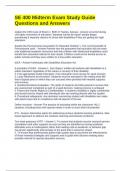
explain the 1954 case of Brown v. BOE of Topeka, Kansas - Answer-occurred during
civil rights movement of education "separate cannot be equal" people began
questioning if separate classes for those with disabilities if they are getting the right
education
Explain the Pennsylvania Association for Retarded Children v. The commonwealth of
Pennsylvania case. - Answer-Parents won the guarantee that education did not mean
only traditional academic instruction and that children with intellectual disabilities could
benefit form education tailored to their needs. Children could not be denied access to
public schools and they were entitles to a free public education
IDEA - Answer-Individuals with Disabilities Education Act
6 principles of IDEA - Answer-1. Zero Reject- entitles all students with disabilities to a
public education regardless of the nature or severity of their disability
2. Free appropriate Public Education- Free education must not pay for sped services
3. Least Restrictive Environment- Students must be educated in the setting most like
that of typical peers in which they can succeed when provided with needed supports
and services
4. Nondiscriminatory Evaluation- The rights of students and their parents to ensure that
any assessment completed as part of a sped decision- making process is unbiased
5. Parent and Family Rights to Confidentiality- A student's disability is highly confidential
and should only be shared with individuals who are working directly with the student
6. Procedural safeguards- Any decisions concerning student with disabilities are made
with parent input and in compliance with all aspects of the law
Define inclusion - Answer-The practice of educating within the classroom *ALL*
students, including those with special needs in order to reach their full potential
RTI - Answer-Alternative option for addressing serious students learning problems- data
based approach to address the students' learning and behavior problems.
Two main purposes of RTI - Answer-1. To ensure that students receive research-proven
remediation and other supports as soon as they are identified as having academic
difficulties even in kindergarten rather than waiting until an academic or behavior gap
has grown significantly and perhaps to the point that it cannot be closed.
2. To ensure that professionals gather high quality data to document the effectiveness
of those remedial strategies and supports and to guide their decision making about
possible referral for special education services.
Questions and Answers
explain the 1954 case of Brown v. BOE of Topeka, Kansas - Answer-occurred during
civil rights movement of education "separate cannot be equal" people began
questioning if separate classes for those with disabilities if they are getting the right
education
Explain the Pennsylvania Association for Retarded Children v. The commonwealth of
Pennsylvania case. - Answer-Parents won the guarantee that education did not mean
only traditional academic instruction and that children with intellectual disabilities could
benefit form education tailored to their needs. Children could not be denied access to
public schools and they were entitles to a free public education
IDEA - Answer-Individuals with Disabilities Education Act
6 principles of IDEA - Answer-1. Zero Reject- entitles all students with disabilities to a
public education regardless of the nature or severity of their disability
2. Free appropriate Public Education- Free education must not pay for sped services
3. Least Restrictive Environment- Students must be educated in the setting most like
that of typical peers in which they can succeed when provided with needed supports
and services
4. Nondiscriminatory Evaluation- The rights of students and their parents to ensure that
any assessment completed as part of a sped decision- making process is unbiased
5. Parent and Family Rights to Confidentiality- A student's disability is highly confidential
and should only be shared with individuals who are working directly with the student
6. Procedural safeguards- Any decisions concerning student with disabilities are made
with parent input and in compliance with all aspects of the law
Define inclusion - Answer-The practice of educating within the classroom *ALL*
students, including those with special needs in order to reach their full potential
RTI - Answer-Alternative option for addressing serious students learning problems- data
based approach to address the students' learning and behavior problems.
Two main purposes of RTI - Answer-1. To ensure that students receive research-proven
remediation and other supports as soon as they are identified as having academic
difficulties even in kindergarten rather than waiting until an academic or behavior gap
has grown significantly and perhaps to the point that it cannot be closed.
2. To ensure that professionals gather high quality data to document the effectiveness
of those remedial strategies and supports and to guide their decision making about
possible referral for special education services.