Introduction to Environmental Governance Verified A+
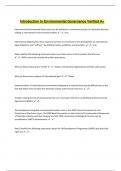
International Environmental Governance can be defined as a continuous process of interactive decision-
making in international environmental matters ✔️✔️true
International Organizations have a general function to contribute to the development on international
legal obligations and "soft law", by drafting treaties, guidelines and principles. ✔️✔️true
Read carefully the following statements about non-state actors in IEG and select the false one:
✔️✔️NGOs cannot be considered as Non-state actors.
Who are the principal actors in IEG? ✔️✔️States, International organizations and Non-state actors.
Who are the primary subjects of International law? ✔️✔️States
Implementation of international environmental obligations at national level may be difficult due to the
fact that States may not have the necessary human and financial resources. ✔️✔️
Treaties relating to environmental protection are commonly referred to as Multilateral Environmental
Agreements (MEAs). ✔️✔️
The development of global environmental treaties such as the 1985 Vienna Convention for the
Protection of the Ozone Layer , the 1989 Basel Convention on the Control of Transboundary Movements
of Hazardous Wastes and their Disposal and the 1992 Convention on Biological Diversity can be
considered as UNEP's achievements. ✔️✔️
Read Carefully the following statements about the UN Development Programme (UNDP) and select the
right one ✔️✔️
International Environmental Governance can be defined as a continuous process of interactive decision-
making in international environmental matters ✔️✔️true
International Organizations have a general function to contribute to the development on international
legal obligations and "soft law", by drafting treaties, guidelines and principles. ✔️✔️true
Read carefully the following statements about non-state actors in IEG and select the false one:
✔️✔️NGOs cannot be considered as Non-state actors.
Who are the principal actors in IEG? ✔️✔️States, International organizations and Non-state actors.
Who are the primary subjects of International law? ✔️✔️States
Implementation of international environmental obligations at national level may be difficult due to the
fact that States may not have the necessary human and financial resources. ✔️✔️
Treaties relating to environmental protection are commonly referred to as Multilateral Environmental
Agreements (MEAs). ✔️✔️
The development of global environmental treaties such as the 1985 Vienna Convention for the
Protection of the Ozone Layer , the 1989 Basel Convention on the Control of Transboundary Movements
of Hazardous Wastes and their Disposal and the 1992 Convention on Biological Diversity can be
considered as UNEP's achievements. ✔️✔️
Read Carefully the following statements about the UN Development Programme (UNDP) and select the
right one ✔️✔️