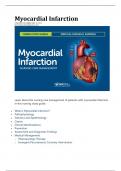
Myocardial Infarction
UPDATED ON FEBRUARY 20, 2021
BY MARIANNE BELLEZA, R.N.
Learn about the nursing care management of patients with myocardial infarction
in this nursing study guide.
• What is Myocardial Infarction?
• Pathophysiology
• Statistics and Epidemiology
• Causes
• Clinical Manifestations
• Prevention
• Assessment and Diagnostic Findings
• Medical Management
o Pharmacologic Therapy
o Emergent Percutaneous Coronary Intervention
, • Nursing Management
o Nursing Assessment
o Diagnosis
o Planning & Goals
o Nursing Priorities
o Nursing Interventions
o Evaluation
o Discharge and Home Care Guidelines
o Documentation Guidelines
• Practice Quiz: Myocardial Infarction
What is Myocardial Infarction?
Myocardial infarction (MI), is used synonymously with coronary occlusion and
heart attack, yet MI is the most preferred term as myocardial ischemia causes
acute coronary syndrome (ACS) that can result in myocardial death.
• In an MI, an area of the myocardium is permanently destroyed
because plaque rupture and subsequent thrombus formation result in
complete occlusion of the artery.
• The spectrum of ACS includes unstable angina, non-ST-segment
elevation MI, and ST-segment elevation MI.
Pathophysiology
In each case of MI, a profound imbalance exists between myocardial oxygen
supply and demand.
• Unstable angina. There is reduced blood flow in a coronary artery, often
due to rupture of an atherosclerotic plaque, but the artery is not
completely occluded.
• Development of infarction. As the cells are deprived of oxygen, ischemia
develops, cellular injury occurs, and lack of oxygen leads to infarction or
death of the cells.
• Schematic Diagram of Myocardial Infarction via Scribd
UPDATED ON FEBRUARY 20, 2021
BY MARIANNE BELLEZA, R.N.
Learn about the nursing care management of patients with myocardial infarction
in this nursing study guide.
• What is Myocardial Infarction?
• Pathophysiology
• Statistics and Epidemiology
• Causes
• Clinical Manifestations
• Prevention
• Assessment and Diagnostic Findings
• Medical Management
o Pharmacologic Therapy
o Emergent Percutaneous Coronary Intervention
, • Nursing Management
o Nursing Assessment
o Diagnosis
o Planning & Goals
o Nursing Priorities
o Nursing Interventions
o Evaluation
o Discharge and Home Care Guidelines
o Documentation Guidelines
• Practice Quiz: Myocardial Infarction
What is Myocardial Infarction?
Myocardial infarction (MI), is used synonymously with coronary occlusion and
heart attack, yet MI is the most preferred term as myocardial ischemia causes
acute coronary syndrome (ACS) that can result in myocardial death.
• In an MI, an area of the myocardium is permanently destroyed
because plaque rupture and subsequent thrombus formation result in
complete occlusion of the artery.
• The spectrum of ACS includes unstable angina, non-ST-segment
elevation MI, and ST-segment elevation MI.
Pathophysiology
In each case of MI, a profound imbalance exists between myocardial oxygen
supply and demand.
• Unstable angina. There is reduced blood flow in a coronary artery, often
due to rupture of an atherosclerotic plaque, but the artery is not
completely occluded.
• Development of infarction. As the cells are deprived of oxygen, ischemia
develops, cellular injury occurs, and lack of oxygen leads to infarction or
death of the cells.
• Schematic Diagram of Myocardial Infarction via Scribd