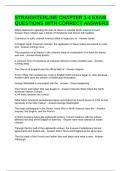
STRAIGHTERLINE CHAPTER 1-4 EXAM
QUESTIONS WITH CORRECT ANSWERS
Which statement regarding the lives of slaves in colonial North America is true? -
Answer-Slave religion was a blend of Christianity and African folk tradition.
Commerce in early colonial America relied in large part on - Answer-barter
In English North American colonies, the application of slave codes was based on color
and - Answer-nothing more.
The proportion of all blacks in the colonies living on a plantation of at least ten slaves
was over - Answer-three-fourths
A common form of resistance of enslaved Africans to their condition was - Answer-
running away
The Church of England was the official faith of - Answer-Virginia
In the 1760s, the revolutionary crisis in English North America began in cities because -
Answer-cities were the centers of intellectual information
George Whitefield is associated with the - Answer-. Great Awakening.
The French and Indian War was fought in - Answer-India,the West Indies,the North
American interior, Europe.
e. All these answers are correct.
What future American revolutionary figure surrendered to French forces in 1754 at Fort
Necessity in the Ohio Valley? - Answer-George Washington
The major participants in the Seven Years' War in North America were the - Answer-
Iroquois, the English, and the French.
In North America during the eighteenth century, French relations with the Indians
differed from that of the English in that they - Answer-were more tolerant of Indian
cultures
Through the first half of the eighteenth century, the Iroquois Confederacy formed
agreements and traded with - Answer-both France and England at the same time.
The first clash of the French and Indian War took place near what is now - Answer-
Pittsburgh
QUESTIONS WITH CORRECT ANSWERS
Which statement regarding the lives of slaves in colonial North America is true? -
Answer-Slave religion was a blend of Christianity and African folk tradition.
Commerce in early colonial America relied in large part on - Answer-barter
In English North American colonies, the application of slave codes was based on color
and - Answer-nothing more.
The proportion of all blacks in the colonies living on a plantation of at least ten slaves
was over - Answer-three-fourths
A common form of resistance of enslaved Africans to their condition was - Answer-
running away
The Church of England was the official faith of - Answer-Virginia
In the 1760s, the revolutionary crisis in English North America began in cities because -
Answer-cities were the centers of intellectual information
George Whitefield is associated with the - Answer-. Great Awakening.
The French and Indian War was fought in - Answer-India,the West Indies,the North
American interior, Europe.
e. All these answers are correct.
What future American revolutionary figure surrendered to French forces in 1754 at Fort
Necessity in the Ohio Valley? - Answer-George Washington
The major participants in the Seven Years' War in North America were the - Answer-
Iroquois, the English, and the French.
In North America during the eighteenth century, French relations with the Indians
differed from that of the English in that they - Answer-were more tolerant of Indian
cultures
Through the first half of the eighteenth century, the Iroquois Confederacy formed
agreements and traded with - Answer-both France and England at the same time.
The first clash of the French and Indian War took place near what is now - Answer-
Pittsburgh