As a consumer when choosing a product or service do you consider the
companies approach to the following:
● What is the core purpose or mission of the company?
● Is the company socially conscious? Is there alignment between their purpose and
their business practice(s)?
● Does the company put their employees and customers first?
● Is the company transparent with their commitment to sustainability?
A sense of purpose is essential for businesses today. - (WEF)
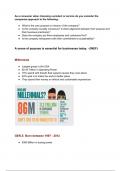
Millennials
● Largest group in the USA
● $2.45 Trillion in Spending Power
● 70% spend with brands that support causes they care about
● 64% goal is to make the world a better place
● They spend their money on ethical and sustainable experiences
GEN Z: Born between 1997 - 2012
● $360 Billion in buying power
, ● Gen Z = 20% of the population
● Save about ⅓ of their income
● 53% work freelance
● Social media impacts buying habits
● More willing to buy secondhand
● 64% will pay for a more sustainable alternative
● 37% want to work for environmentally friendly companies
Companies can do “GOOD” and make a profit
For Profit Companies
● A business that balances purpose and profit, led by people using business as a
force for good.
● The certification framework measures a company’s entire social and
environmental performance
● How a company’s operations and business model impact workers, community,
environment, and customers.
Over 6000 Certified B Corporations in more than 80 countries and over 150 industries
Triple Bottom Line: Why
● Sustainability: Ensures long-term viability of businesses and resources
● Ethical responsibility: Promotes corporate behavior that benefits society and the
environment
, ● Risk management: Helps identify and mitigate potential social and environmental
risks
● Innovation driver: Encourages development of sustainable products and
processes
● Stakeholder value: Creates value for a wider range of stakeholders, not just
shareholders
● Competitive advantage: Can improve brand reputation and customer loyalty
● Regulatory compliance: Helps businesses stay ahead of evolving regulations
● Employee engagement: Can increase employee satisfaction and attract top
talent
● Holistic performance measure: Provides a more complete picture of a company’s
true impact and value
Triple Bottom Line: Stakeholders (Measuring TBL | Stakeholders)
● Local Farmers – training, fair, pay
● Customer – buying a product that has a positive effect on people
● Employees – working for a company making a difference
● Local community – good practice, training, jobs,sustainability
● Government – less governance
● Investor – reliable company, less risky, potentially less return on their investment,
supporting a company that is making a change
Environmental Social Governance (ESG)
● A framework used to assess & measure a company’s business practices and
performance on sustainability and ethical issues.
● Policies, practices and programs
● Investors useESG to evaluate companies on non-financial factors.
● Integrated through business operations and decision-making processes.
companies approach to the following:
● What is the core purpose or mission of the company?
● Is the company socially conscious? Is there alignment between their purpose and
their business practice(s)?
● Does the company put their employees and customers first?
● Is the company transparent with their commitment to sustainability?
A sense of purpose is essential for businesses today. - (WEF)
Millennials
● Largest group in the USA
● $2.45 Trillion in Spending Power
● 70% spend with brands that support causes they care about
● 64% goal is to make the world a better place
● They spend their money on ethical and sustainable experiences
GEN Z: Born between 1997 - 2012
● $360 Billion in buying power
, ● Gen Z = 20% of the population
● Save about ⅓ of their income
● 53% work freelance
● Social media impacts buying habits
● More willing to buy secondhand
● 64% will pay for a more sustainable alternative
● 37% want to work for environmentally friendly companies
Companies can do “GOOD” and make a profit
For Profit Companies
● A business that balances purpose and profit, led by people using business as a
force for good.
● The certification framework measures a company’s entire social and
environmental performance
● How a company’s operations and business model impact workers, community,
environment, and customers.
Over 6000 Certified B Corporations in more than 80 countries and over 150 industries
Triple Bottom Line: Why
● Sustainability: Ensures long-term viability of businesses and resources
● Ethical responsibility: Promotes corporate behavior that benefits society and the
environment
, ● Risk management: Helps identify and mitigate potential social and environmental
risks
● Innovation driver: Encourages development of sustainable products and
processes
● Stakeholder value: Creates value for a wider range of stakeholders, not just
shareholders
● Competitive advantage: Can improve brand reputation and customer loyalty
● Regulatory compliance: Helps businesses stay ahead of evolving regulations
● Employee engagement: Can increase employee satisfaction and attract top
talent
● Holistic performance measure: Provides a more complete picture of a company’s
true impact and value
Triple Bottom Line: Stakeholders (Measuring TBL | Stakeholders)
● Local Farmers – training, fair, pay
● Customer – buying a product that has a positive effect on people
● Employees – working for a company making a difference
● Local community – good practice, training, jobs,sustainability
● Government – less governance
● Investor – reliable company, less risky, potentially less return on their investment,
supporting a company that is making a change
Environmental Social Governance (ESG)
● A framework used to assess & measure a company’s business practices and
performance on sustainability and ethical issues.
● Policies, practices and programs
● Investors useESG to evaluate companies on non-financial factors.
● Integrated through business operations and decision-making processes.