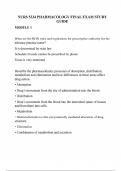
NURS 5334 PHARMACOLOGY FINAL EXAM STUDY GUIDE
What are the BON rules and regulations for prescriptive authority for the advance practice nurse? It is determined by state law Schedule II meds cannot be prescribed by phone Texas is very restricted Describe the pharmacokinetic processes of absorption, distribution, metabolism and elimination and how differences in these areas affect drug action. • Absorption • Drug’s movement from the site of administration into the blood. • Distribution • Drug’s movement from the blood into the interstitial space of tissues and from there into cells. • Metabolism • Biotransformation is the enzymatically mediated alteration of drug structure. • Elimination • Combination of metabolism and excretion • Discuss the impact of food on drug absorption, drug metabolism and on drug toxicity and action—as well as the timing of drug administration. LIFESPAN • Hepatic metabolism and GFR increase during pregnancy, dosages of some drugs may need to be increased. • Rate of albumin to water decreases • Third trimester: Renal blood flow is doubled and renal excretion is accelerated (drugs excreted rapidly) • Tone and mobility of bowel decrease • Prolongation of drug effects Total (½ life increases) Understand stages of development in pregnancy • Conception: through week 2 • Embryonic period: week 3-week 8 a) Gross malformations can be produced by teratogens • Fetal period: week 9-delivery • Understand pregnancy labeling • 3 categories now a) Pregnancy, lactation, male & female reproductive potential • How do you decrease risk in the infant during breastfeeding? • Take meds immediately after breastfeeding, avoid drugs that have long half-lives, choose drugs that tend to be excluded from milk, avoid drugs that are known to be hazardous. • How do pediatric patients differ in their response to medications? • Absorption a) Oral? • Neonates: drug remain in the stomach longer which increases the levels, low acidity can affect the absorption of acid labile drugs b) Parenteral? • Reponses are slow and erratic. • Infancy: absorption is more rapid than in neonates & adults • Best avoided in infants c) Transdermal? • Greater skin permeability which increases topical drug absorption and increases the risk for toxicity • Distribution a) Protein binding 1. Neonates: less protein-binding—increased availability of highly protein bound drugs such as phenytoin, diazepam, and phenobarbital. Reduced dosages needed in these highly bound drugs.
Written for
- Institution
-
University Of Texas - Arlington
- Course
-
NURS 5334
Document information
- Uploaded on
- January 13, 2025
- Number of pages
- 53
- Written in
- 2024/2025
- Type
- Exam (elaborations)
- Contains
- Questions & answers
Subjects
- nurs 5334 pharmacology
-
pharmacology final exam study guide
-
nurs 5334 pharmacology final exam study guide
-
nurs 5334 pharmacology final exam study guide modu

Also available in package deal