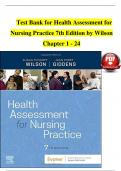
Test Bank for Health Assessment for
Nursing Practice 7th Edition by Wilson
Chapter 1 - 24
,Chapter 01: Introduction to Health Assessment
MULTIPLE CHOICE
1. A patient comes to the emergency department and tells the triage nurse that he
is “having a heart attack.” What is the nurse’s top priority at this time?
a. Determine the patient’s personal data and
insurance coverage.
b. Ask the patient to take a seat in the waiting
room until his name is called.
c. Request that a nurse collect data for a
comprehensive history.
d. Ask a nurse to start a focused assessment
of this patient now.
ANSWER: D
The nurse needs to begin an assessment as soon as possible that is focused on this patient’s
cardiovascular system. The type of health assessment performed by the nurse is also driven
by patient need. Personal data and insurance information will be obtained, but in this
situation, these data can wait until after the patient is assessed. Based also on Maslow’s
hierarchy of needs, physiologic needs take precedence. Rather than asking the patient to
wait, the nurse needs to begin data collection, such as vital signs, immediately to determine
the patient’s health status. Complications can be prevented if an immediate assessment is
made to analyze the patient’s symptoms. A comprehensive history is not indicated in this
situation at this time. Some subjective data will be collected, such as allergies and medical
history related to cardiovascular disease. Eyes, ears, or a complete musculoskeletal or
mental health assessment is not a priority at this time.
DIF: Cognitive Level: Apply REF: Box 1-3 | p. 3
TOP: Nursing Process: Assessment
MSC: NCLEX Patient Needs: Safe and Effective Care Environment: Management of Care:
Establishing Priorities
2. Which situation illustrates a screening assessment?
a. A patient visits an obstetric clinic for the
first time and the nurse conducts a detailed
history and physical examination.
b. A hospital sponsors a health fair at a local
mall and provides cholesterol and blood
pressure checks to mall patrons.
c. The nurse in an urgent care center checks
the vital signs of a patient who is
complaining of leg pain.
, d. A patient newly diagnosed with diabetes
mellitus comes to test his fasting blood
glucose level.
ANSWER: B
A G health G fair G at G a G local G mall G that G provides G cholesterol G and G blood G pressure
G checks G is G an G example G of G a G screening G assessment G focused G on G disease G
detection. G A G detailed G history G and G physical G examination G conducted G during G a G
first-time G visit G to G an G obstetric G clinic G is G an G exampleGof G a G comprehensive G
assessment. G Assessing G a G patient G complaining G of G leg G pain G in G the G triage G area
G of G an G urgent G care G center G is G an G example G of G a G problem-based/focused G
assessment. G A G patient’s G return G appointment G 1 G month G after G today’s G office G
visit G to G report G fasting G blood G glucose G levels G is G an G example G of G an G episodic G or
G follow-up G assessment.
DIF: G G G Cognitive G Level: G Understand REF: G Box G 1-3 G
| G p. G 3GTOP: G Nursing G Process: G Assessment
MSC: G NCLEX G Patient G Needs: G Health G Promotion G and G Maintenance: G Health G Screening
3. For G which G person G is G a G screening G assessment G indicated?
a. The G person G who G had G abdominal G
surgeryGyesterday
b. The G person G who G is G unaware G of G
his G highGserum G glucose G levels
c. The G person G who G is G being G
admitted G to G aGlong-term G care G
facility
d. The G person G who G is G beginning G
rehabilitationGafter G a G knee G replacement
ANSWER: G B
A G screening G assessment G is G performed G for G the G purpose G of G disease G detection.
G In G this G case G thisGperson G may G have G diabetes G mellitus. G A G shift G assessment G
is G most G appropriate G for G the G person G who G is G recovering G in G the G hospital G from
G surgery. G A G comprehensive G assessment G is G performedGduring G admission G to G a G
facility G to G obtain G a G detailed G history G and G complete G physical G examination. G An
G episodic G or G follow-up G assessment G is G performed G after G knee G replacement G toG
evaluate G the G outcome G of G the G procedure.
DIF: G G G Cognitive G Level: G Understand REF: G Box G 1-3 G
| G p. G 3GTOP: G Nursing G Process: G Assessment
MSC: G NCLEX G Patient G Needs: G Safe G and G Effective G Care G Environment: G Management G of
G Care:GEstablishing G Priorities
4. For G which G person G is G a G shift G assessment G indicated?
a. The G person G who G had G abdominal G
surgeryGyesterday
b. The G person G who G is G unaware G of G
his G highGserum G glucose G levels
c. The G person G who G is G being G admitted G
to G a
long-term G care G facility
d. The G person G who G is G beginning G
rehabilitationGafter G a G knee G replacement
ANSWER: G A
A G shift G assessment G is G most G appropriate G for G the G person G who G is G recovering G
in G the G hospital G fromGsurgery. G A G screening G assessment G is G performed G for G the G
purpose G of G disease G detection, G in G this G case G diabetes G mellitus. G A G comprehensive
G assessment G is G performed G during G admission G to G a
, facility G to G obtain G a G detailed G history G and G complete G physical G examination. G
An G episodic G or G follow-up G assessment G is G performed G after G knee G replacement G
to G evaluate G the G outcome G of G theGprocedure.
DIF: G G G Cognitive G Level: G Understand REF: G Box G 1-3 G
| G p. G 4GTOP: G Nursing G Process: G Assessment
MSC: G NCLEX G Patient G Needs: G Safe G and G Effective G Care G Environment: G Management G of
G Care:GEstablishing G Priorities
5. For G which G person G is G a G comprehensive G assessment G indicated?
a. The G person G who G had G abdominal G
surgeryGyesterday
b. The G person G who G is G unaware G of G
his G highGserum G glucose G levels
c. The G person G who G is G being G
admitted G to G aGlong-term G care G
facility
d. The G person G who G is G beginning G
rehabilitationGafter G a G knee G replacement
ANSWER: G C
A G comprehensive G assessment G is Gperformed G during G admission G to G a G facility Gto G obtain G a
detailed G history G and G complete G physical G examination. G A G shift G assessment G is G
most G appropriateGfor G the G person G who G is G recovering G in G the G hospital G from G
surgery. G A G screening G assessment G is G performed G for G the G purpose G of G disease G
detection, G in G this G case G diabetes G mellitus. G An G episodic G or G follow-up G
assessment G is G performed G after G knee G replacement G to G evaluate G the G outcome G of
G the G procedure.
DIF: G G G Cognitive G Level: G Understand REF: G Box G 1-3 G
| G p. G 3GTOP: G Nursing G Process: G Assessment
MSC: G NCLEX G Patient G Needs: G Safe G and G Effective G Care G Environment: G Management G of
G Care:GEstablishing G Priorities
6. For G which G person G is G an G episodic G or G follow-up G assessment G indicated?
a. The G person G who G had G abdominal G
surgeryGyesterday
b. The G person G who G is G unaware G of G
his G highGserum G glucose G levels
c. The G person G who G is G being G admitted G
to G a
long-term G care G facility
d. The G person G who G is G beginning G
rehabilitationGafter G a G knee G replacement
ANSWER: G D
An G episodic G or G follow-up G assessment G is G performed G after G the G knee G
replacement G to G evaluate G the G outcome G of G the G procedure. G A G shift G assessment G
is G most G appropriate G for G the G person G who G isGrecovering G in G the G hospital G from G
surgery. G A G screening G assessment G is G performed G for G the G purpose G of G disease G
detection, G in G this Gcase G diabetes G mellitus. G A G comprehensive G assessment G is G
performed G during G admission G to G a G facility G to G obtain G a G detailed G history G and G
complete G physicalGexamination.
DIF: G G G Cognitive G Level: G Understand REF: G Box G 1-3 G
| G p. G 3GTOP: G Nursing G Process: G Assessment
Nursing Practice 7th Edition by Wilson
Chapter 1 - 24
,Chapter 01: Introduction to Health Assessment
MULTIPLE CHOICE
1. A patient comes to the emergency department and tells the triage nurse that he
is “having a heart attack.” What is the nurse’s top priority at this time?
a. Determine the patient’s personal data and
insurance coverage.
b. Ask the patient to take a seat in the waiting
room until his name is called.
c. Request that a nurse collect data for a
comprehensive history.
d. Ask a nurse to start a focused assessment
of this patient now.
ANSWER: D
The nurse needs to begin an assessment as soon as possible that is focused on this patient’s
cardiovascular system. The type of health assessment performed by the nurse is also driven
by patient need. Personal data and insurance information will be obtained, but in this
situation, these data can wait until after the patient is assessed. Based also on Maslow’s
hierarchy of needs, physiologic needs take precedence. Rather than asking the patient to
wait, the nurse needs to begin data collection, such as vital signs, immediately to determine
the patient’s health status. Complications can be prevented if an immediate assessment is
made to analyze the patient’s symptoms. A comprehensive history is not indicated in this
situation at this time. Some subjective data will be collected, such as allergies and medical
history related to cardiovascular disease. Eyes, ears, or a complete musculoskeletal or
mental health assessment is not a priority at this time.
DIF: Cognitive Level: Apply REF: Box 1-3 | p. 3
TOP: Nursing Process: Assessment
MSC: NCLEX Patient Needs: Safe and Effective Care Environment: Management of Care:
Establishing Priorities
2. Which situation illustrates a screening assessment?
a. A patient visits an obstetric clinic for the
first time and the nurse conducts a detailed
history and physical examination.
b. A hospital sponsors a health fair at a local
mall and provides cholesterol and blood
pressure checks to mall patrons.
c. The nurse in an urgent care center checks
the vital signs of a patient who is
complaining of leg pain.
, d. A patient newly diagnosed with diabetes
mellitus comes to test his fasting blood
glucose level.
ANSWER: B
A G health G fair G at G a G local G mall G that G provides G cholesterol G and G blood G pressure
G checks G is G an G example G of G a G screening G assessment G focused G on G disease G
detection. G A G detailed G history G and G physical G examination G conducted G during G a G
first-time G visit G to G an G obstetric G clinic G is G an G exampleGof G a G comprehensive G
assessment. G Assessing G a G patient G complaining G of G leg G pain G in G the G triage G area
G of G an G urgent G care G center G is G an G example G of G a G problem-based/focused G
assessment. G A G patient’s G return G appointment G 1 G month G after G today’s G office G
visit G to G report G fasting G blood G glucose G levels G is G an G example G of G an G episodic G or
G follow-up G assessment.
DIF: G G G Cognitive G Level: G Understand REF: G Box G 1-3 G
| G p. G 3GTOP: G Nursing G Process: G Assessment
MSC: G NCLEX G Patient G Needs: G Health G Promotion G and G Maintenance: G Health G Screening
3. For G which G person G is G a G screening G assessment G indicated?
a. The G person G who G had G abdominal G
surgeryGyesterday
b. The G person G who G is G unaware G of G
his G highGserum G glucose G levels
c. The G person G who G is G being G
admitted G to G aGlong-term G care G
facility
d. The G person G who G is G beginning G
rehabilitationGafter G a G knee G replacement
ANSWER: G B
A G screening G assessment G is G performed G for G the G purpose G of G disease G detection.
G In G this G case G thisGperson G may G have G diabetes G mellitus. G A G shift G assessment G
is G most G appropriate G for G the G person G who G is G recovering G in G the G hospital G from
G surgery. G A G comprehensive G assessment G is G performedGduring G admission G to G a G
facility G to G obtain G a G detailed G history G and G complete G physical G examination. G An
G episodic G or G follow-up G assessment G is G performed G after G knee G replacement G toG
evaluate G the G outcome G of G the G procedure.
DIF: G G G Cognitive G Level: G Understand REF: G Box G 1-3 G
| G p. G 3GTOP: G Nursing G Process: G Assessment
MSC: G NCLEX G Patient G Needs: G Safe G and G Effective G Care G Environment: G Management G of
G Care:GEstablishing G Priorities
4. For G which G person G is G a G shift G assessment G indicated?
a. The G person G who G had G abdominal G
surgeryGyesterday
b. The G person G who G is G unaware G of G
his G highGserum G glucose G levels
c. The G person G who G is G being G admitted G
to G a
long-term G care G facility
d. The G person G who G is G beginning G
rehabilitationGafter G a G knee G replacement
ANSWER: G A
A G shift G assessment G is G most G appropriate G for G the G person G who G is G recovering G
in G the G hospital G fromGsurgery. G A G screening G assessment G is G performed G for G the G
purpose G of G disease G detection, G in G this G case G diabetes G mellitus. G A G comprehensive
G assessment G is G performed G during G admission G to G a
, facility G to G obtain G a G detailed G history G and G complete G physical G examination. G
An G episodic G or G follow-up G assessment G is G performed G after G knee G replacement G
to G evaluate G the G outcome G of G theGprocedure.
DIF: G G G Cognitive G Level: G Understand REF: G Box G 1-3 G
| G p. G 4GTOP: G Nursing G Process: G Assessment
MSC: G NCLEX G Patient G Needs: G Safe G and G Effective G Care G Environment: G Management G of
G Care:GEstablishing G Priorities
5. For G which G person G is G a G comprehensive G assessment G indicated?
a. The G person G who G had G abdominal G
surgeryGyesterday
b. The G person G who G is G unaware G of G
his G highGserum G glucose G levels
c. The G person G who G is G being G
admitted G to G aGlong-term G care G
facility
d. The G person G who G is G beginning G
rehabilitationGafter G a G knee G replacement
ANSWER: G C
A G comprehensive G assessment G is Gperformed G during G admission G to G a G facility Gto G obtain G a
detailed G history G and G complete G physical G examination. G A G shift G assessment G is G
most G appropriateGfor G the G person G who G is G recovering G in G the G hospital G from G
surgery. G A G screening G assessment G is G performed G for G the G purpose G of G disease G
detection, G in G this G case G diabetes G mellitus. G An G episodic G or G follow-up G
assessment G is G performed G after G knee G replacement G to G evaluate G the G outcome G of
G the G procedure.
DIF: G G G Cognitive G Level: G Understand REF: G Box G 1-3 G
| G p. G 3GTOP: G Nursing G Process: G Assessment
MSC: G NCLEX G Patient G Needs: G Safe G and G Effective G Care G Environment: G Management G of
G Care:GEstablishing G Priorities
6. For G which G person G is G an G episodic G or G follow-up G assessment G indicated?
a. The G person G who G had G abdominal G
surgeryGyesterday
b. The G person G who G is G unaware G of G
his G highGserum G glucose G levels
c. The G person G who G is G being G admitted G
to G a
long-term G care G facility
d. The G person G who G is G beginning G
rehabilitationGafter G a G knee G replacement
ANSWER: G D
An G episodic G or G follow-up G assessment G is G performed G after G the G knee G
replacement G to G evaluate G the G outcome G of G the G procedure. G A G shift G assessment G
is G most G appropriate G for G the G person G who G isGrecovering G in G the G hospital G from G
surgery. G A G screening G assessment G is G performed G for G the G purpose G of G disease G
detection, G in G this Gcase G diabetes G mellitus. G A G comprehensive G assessment G is G
performed G during G admission G to G a G facility G to G obtain G a G detailed G history G and G
complete G physicalGexamination.
DIF: G G G Cognitive G Level: G Understand REF: G Box G 1-3 G
| G p. G 3GTOP: G Nursing G Process: G Assessment