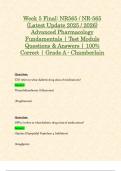
Week 5 Final: NR565 / NR-565
(Latest Update )
Advanced Pharmacology
Fundamentals | Test Module
Questions & Answers | 100%
Correct | Grade A - Chamberlain
Question:
TZD refers to what diabetic drug class of medications?
Answer:
Thiazolidinediones (Glitazones)
(Pioglitazone)
Question:
DPP4-I refers to what diabetic drug class of medications?
Answer:
Gliptins (Dipeptidyl Peptidase-4 Inhibitors)
(Sitagliptin)
,Question:
SGLT2i refers to what diabetic drug class of medications?
Answer:
Sodium-Glucose Cotransporter 2 Inhibitors
(Canagliflozin)
Question:
Which drug class should be considered for diabetes prior to insulin?
Answer:
biguanide, is the drug of choice for initial therapy in most patients with type 2
diabetes
Typically, metformin is started immediately after the diagnosis of type 2
diabetes
thiazolidinedione, a dipeptidyl peptidase-4 (DPP-4) inhibitor, a sodium-
glucose cotransporter 2 (SGLT-2) inhibitor, a glucagon-like peptide-1 (GLP-1)
receptor agonist. A sulfonylurea or basal insulin should be considered if the
patient does not achieve goal with these drugs
, Question:
Ratio of basal insulin to rapid-acting insulin in total daily dose (TDD) of
insulin --(example included)
Answer:
Total daily insulin dose (TDD) calculation includes basal insulin replacement
and bolus insulin replacement. Basal insulin replacement encompasses
approximately 50% of the total daily insulin dose which replaces insulin from
fasting (overnight) and between meals. This dose is usually constant. Bolus
insulin replacement encompasses approximately 50% of the total daily insulin
dose and provides carbohydrate coverage and high blood sugar correction.
The bolus dose for carbohydrate or food coverage is prescribed as an insulin to
carbohydrate ratio, which represents how many grams of carbohydrate are
covered or disposed of by 1 unit of insulin.
For example, the total daily dose (TDD) of insulin can be calculated by taking
the total weight of the patient's weight in kilograms (kg), which is 80 kg (184
pounds) multiplied by 0.6 units equals 48 units. This means 24 units of the
TDD is the basal insulin dose of glargine (Lantus) (50%) and the other 24
units of rapid-acting bolus/mealtime insulin (50%).
Question:
Know the carbohydrate-to insulin ratio when calculating basal insulin
Answer:
The mealtime carbohydrate-to-insulin dose is calculated using the 450 rule
for regular insulin and the 500 rule for rapid-acting insulin; thus 500 is
divided by the TDD insulin, 48 equals 10.4 (this is rounded down to 10). The
carbohydrate-to-insulin ratio is 1:10. If the meal is 60 grams of carbohydrates,
60 is divided by 10, which equals 6 units of rapid-acting insulin for
carbohydrate coverage.
(Latest Update )
Advanced Pharmacology
Fundamentals | Test Module
Questions & Answers | 100%
Correct | Grade A - Chamberlain
Question:
TZD refers to what diabetic drug class of medications?
Answer:
Thiazolidinediones (Glitazones)
(Pioglitazone)
Question:
DPP4-I refers to what diabetic drug class of medications?
Answer:
Gliptins (Dipeptidyl Peptidase-4 Inhibitors)
(Sitagliptin)
,Question:
SGLT2i refers to what diabetic drug class of medications?
Answer:
Sodium-Glucose Cotransporter 2 Inhibitors
(Canagliflozin)
Question:
Which drug class should be considered for diabetes prior to insulin?
Answer:
biguanide, is the drug of choice for initial therapy in most patients with type 2
diabetes
Typically, metformin is started immediately after the diagnosis of type 2
diabetes
thiazolidinedione, a dipeptidyl peptidase-4 (DPP-4) inhibitor, a sodium-
glucose cotransporter 2 (SGLT-2) inhibitor, a glucagon-like peptide-1 (GLP-1)
receptor agonist. A sulfonylurea or basal insulin should be considered if the
patient does not achieve goal with these drugs
, Question:
Ratio of basal insulin to rapid-acting insulin in total daily dose (TDD) of
insulin --(example included)
Answer:
Total daily insulin dose (TDD) calculation includes basal insulin replacement
and bolus insulin replacement. Basal insulin replacement encompasses
approximately 50% of the total daily insulin dose which replaces insulin from
fasting (overnight) and between meals. This dose is usually constant. Bolus
insulin replacement encompasses approximately 50% of the total daily insulin
dose and provides carbohydrate coverage and high blood sugar correction.
The bolus dose for carbohydrate or food coverage is prescribed as an insulin to
carbohydrate ratio, which represents how many grams of carbohydrate are
covered or disposed of by 1 unit of insulin.
For example, the total daily dose (TDD) of insulin can be calculated by taking
the total weight of the patient's weight in kilograms (kg), which is 80 kg (184
pounds) multiplied by 0.6 units equals 48 units. This means 24 units of the
TDD is the basal insulin dose of glargine (Lantus) (50%) and the other 24
units of rapid-acting bolus/mealtime insulin (50%).
Question:
Know the carbohydrate-to insulin ratio when calculating basal insulin
Answer:
The mealtime carbohydrate-to-insulin dose is calculated using the 450 rule
for regular insulin and the 500 rule for rapid-acting insulin; thus 500 is
divided by the TDD insulin, 48 equals 10.4 (this is rounded down to 10). The
carbohydrate-to-insulin ratio is 1:10. If the meal is 60 grams of carbohydrates,
60 is divided by 10, which equals 6 units of rapid-acting insulin for
carbohydrate coverage.