SETI
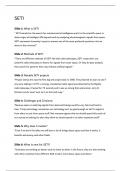
Slide 1: What is SETI
“ SETI stands for: the search for extraterrestrial intelligence and it is the scientific quest to
detect signs of intelligent life beyond earth by analyzing electromagnetic signals from space.
SETI represents humanity’s quest to answer one of the most profound questions: Are we
alone in the universe?’’
Slide 2: Methods of SETI
“There are different methods of SETI like with radio telescopes, SETI researchers use
powerful radio telescopes to listens for signals from outer space. Or they do data analysis:
they search for patterns that may indicate artificial signals.”
Slide 3: Notable SETI projects
“Project Ozma; this was the first big seti project back in 1960. They listened to stars to see if
any were talking. In 1977, a strong, unexplained radio signal was detected by the Big Ear
radio telescope, it lasted for 72 seconds and it was so strong that astronomer Jerry R.
Ehnman wrote ‘wow!’ next to it on the hard copy.”
Slide 4: Challenges and Cristisms
“Because space is really big signals from abnormal beings could be very faint and hard to
hear. Tricky technology: sometimes our technology isn’t as good enough to tell if a signal is
from aliens or just from space stuff. Not everyone agrees that we should spend this much of
our money on looking for alien they think we should spend it on other important stuff.”
Slide 5: Why does it matter?
“Even if we don’t find alien we still learn a lot of things about space and how it works, it
benefits astronomy and other fields.
Slide 6: What is next for SETI?
“Scientists are working on better tools to listen to aliens in the future, they are also working
with other scientists from different field to learn more about space and aliens.”
Slide 1: What is SETI
“ SETI stands for: the search for extraterrestrial intelligence and it is the scientific quest to
detect signs of intelligent life beyond earth by analyzing electromagnetic signals from space.
SETI represents humanity’s quest to answer one of the most profound questions: Are we
alone in the universe?’’
Slide 2: Methods of SETI
“There are different methods of SETI like with radio telescopes, SETI researchers use
powerful radio telescopes to listens for signals from outer space. Or they do data analysis:
they search for patterns that may indicate artificial signals.”
Slide 3: Notable SETI projects
“Project Ozma; this was the first big seti project back in 1960. They listened to stars to see if
any were talking. In 1977, a strong, unexplained radio signal was detected by the Big Ear
radio telescope, it lasted for 72 seconds and it was so strong that astronomer Jerry R.
Ehnman wrote ‘wow!’ next to it on the hard copy.”
Slide 4: Challenges and Cristisms
“Because space is really big signals from abnormal beings could be very faint and hard to
hear. Tricky technology: sometimes our technology isn’t as good enough to tell if a signal is
from aliens or just from space stuff. Not everyone agrees that we should spend this much of
our money on looking for alien they think we should spend it on other important stuff.”
Slide 5: Why does it matter?
“Even if we don’t find alien we still learn a lot of things about space and how it works, it
benefits astronomy and other fields.
Slide 6: What is next for SETI?
“Scientists are working on better tools to listen to aliens in the future, they are also working
with other scientists from different field to learn more about space and aliens.”