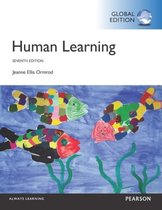
TEST BANK for Human Learning
G G G G G
8th Edition Ormrod,CHAPTER 1 - 15
G G G G G
, CHAPTER G 1
PERSPECTIVES G ON G LEARNING
Multiple G Choice G Questions
Human G beings G undoubtedly G learn G more G during G the G course G of Ga G lifetime
Gthan G any G other G species G on G earth. G The G major G result G of G this G capacity G to G
learn G is G that:
New G instincts G begin G to G emerge.
Human Gthought G becomes G less G logical Gwith Geach G
generation. G Humans G can G benefit G from G their G experiences.
Humans G are Gthe G only Gspecies G whose G behavior G cannot G be G analyzed G
in G terms G of G stimuli G and G responses.
Three G of Gthe G following G are G examples G of G learning. G Which G one G is G not?
Abigail G cries G when G she G steps G on G a G sharp G pebble.
After G many Ghours Gof Gheated G debate, G Brian G begins G to G
advocate G political G practices G he G has G previously G opposed.
Cara GsuddenlyGrecognizes Ghow Gthe Gdivision Gfact G―24 G’ G4 G= G6‖ Gis G
related G to G the G multiplication G fact G ―6 G x G 4 G = G 24.‖
David G has G been Grunning G away Gfrom GGerman G shepherds G ever G since G
he G was G bitten G by G a G German G shepherd G two G years G ago.
Reynelda G has G trouble G tracing G a G complex G shape G with G a G pencil G when G
she G is G in G kindergarten, G but G she G can G do G it G quite G well G byGthe G time G she G is G
in G second G grade. G Is G this G an G instance G of G learning?
Yes, G because G her G behavior G has G changed.
No, G because G the G circumstances G are G too G dissimilar.
Maybe, G although Gthe G change G may Gsimply Gbe G due G to G
physiological G maturation.
Maybe, G but G only G if G she G is G being G reinforced G for G tracing G accurately.
2
, Chapter G 1 G – G Perspectives G on G
Learning
Three G of G the G following G illustrate G various G ways G that G learning G might G be
G reflected G in G a G person‘s G behavior. G Which G one G of G the G following G changes G
does G not G necessarily G reflect G learning?
Although G it‘s G a Gschool Gnight, G Dean G plays G video G games G until Gwell G
past G his G usual G bedtime. G As G he G becomes G more G tired, G he G finds G it G
increasingly G difficult G to G concentrate G on G what G he‘s G doing.
Even G as G a G young G child, G Jerry G could G tell G you G that G his G
grandparents G immigrated G to G the G United G States G from G Ireland. G
But G after G a G conversation G with G his G grandmother, G he G can G now
G describe G the G circumstances G of Gthe G family‘s G immigration G in G
considerable G detail.
Day G after G day, G Martin G practices G his G basketball G skills G (shooting, G
dribbling, G etc.) G on G a G basketball G court G at G a G local G park. G With G each G
practice G session, G his G movements G become G faster G and G smoother.
Lewis G occasionally G asks G for G help G when G he G has G difficulty G with G his
G classwork, G but G most G of G the G time G he G just G struggles G quietly G on G his
G own. G After G his G teacher G assures G him G that G asking G for G help G is G not G
a G sign G of G weakness Gor Ginability, G he G begins G asking G for Ghelp G much G
more G frequently.
research G examines G learning G in G tightlyGcontrolled G settings G and
research G examines G learning G in G real-world G settings.
Applied; G Basic G
Basic; G Qualitative G
Qualitative; G
Applied G Basic; G
Applied
A G principle G of G learning G can G best G be G characterized G as:
A G description G of G the G results G of G a G particular G research G study
A Gstatement G that G describes G how G a G particular G factor Gaffects G learning
The G measurement G of Ghow G much G learning Ghas G occurred G in G
a G particular G situation
An G explanation G of Gthe G underlying G processes G through G which G learning G occurs
A G theory G of G learning G can G best G be G characterized G as:
A G description G of G the G results G of G a G particular G research G study
A Gstatement G that G describes G how G a G particular G factor Gaffects G learning
The G measurement G of Ghow G much G learning Ghas G occurred G in G
a G particular G situation
An G explanation G of Gthe G underlying G processes G through G which G learning G occurs
3
, Chapter G 1 G – G Perspectives G on G
Learning
Three G of Gthe G following G are G principles G of G learning. G Which G one G is G a G theory
of G learning G rather G than G a G principle?
A Gbehavior G that G is G followed G byGpunishment G decreases G in G frequency.
People G learn G by Gmaking G mental Gassociations G between G new G
information G and G their G existing G knowledge.
A Gresponse G that G is G rewarded G everyGtime G it G occurs Gincreases G
more G rapidly G than G a G response G that G is G only G occasionally G
rewarded.
Students Gtend G to G remember G more G of G a G lecture G if G they Gtake G
notes G on G the G lecture‘s G content.
Which G one Gof Gthe G following G common G sayings G best G reflects G the G
concept G of G introspection?
―Where G there‘s Ga G will, G there‘s G a G way.‖
―Nothing G ventured, G nothing G gained.‖
―A G penny G for G your G thoughts.‖
―Old G habits G die G hard.‖
Which G one Gof Gthe G following G common G sayings G best G reflects G the G
basic G premise G underlying G social G learning G theory?
―Monkey G see, G monkey G do.‖
―Spare Gthe Grod Gand Gspoil Gthe G child.‖
―A Gfriend G in Gneed G is Ga G friend G indeed.‖
―A Grolling Gstone Ggathers Gno Gmoss.‖
Which G one G of G the G following G statements G provides G the G most G credible G
explanation G for G the G fact G that G human G beings G seem G to G surpass G all G other G
animal G species G in G their G thinking G and G learning G capacities?
Only Ghuman G beings G have G the G capability G to G make G tools.
Humans G communicate G regularly Gwith G one G another G and, G in Gdoing G
so, G pass G along G what G they‘ve G learned G to G future G generations.
Human G beings G have G a G huge G repertoire Gof G instinctual G behaviors G
from G which G they G can G draw G when G they G encounter G new G
experiences.
Human G brains G are G smaller G than G those G of G other G intelligent G species G
(e.g., G elephants, G dolphins) G and G therefore G can Gtransmit G messages G
more G quickly G and G efficiently.
4
G G G G G
8th Edition Ormrod,CHAPTER 1 - 15
G G G G G
, CHAPTER G 1
PERSPECTIVES G ON G LEARNING
Multiple G Choice G Questions
Human G beings G undoubtedly G learn G more G during G the G course G of Ga G lifetime
Gthan G any G other G species G on G earth. G The G major G result G of G this G capacity G to G
learn G is G that:
New G instincts G begin G to G emerge.
Human Gthought G becomes G less G logical Gwith Geach G
generation. G Humans G can G benefit G from G their G experiences.
Humans G are Gthe G only Gspecies G whose G behavior G cannot G be G analyzed G
in G terms G of G stimuli G and G responses.
Three G of Gthe G following G are G examples G of G learning. G Which G one G is G not?
Abigail G cries G when G she G steps G on G a G sharp G pebble.
After G many Ghours Gof Gheated G debate, G Brian G begins G to G
advocate G political G practices G he G has G previously G opposed.
Cara GsuddenlyGrecognizes Ghow Gthe Gdivision Gfact G―24 G’ G4 G= G6‖ Gis G
related G to G the G multiplication G fact G ―6 G x G 4 G = G 24.‖
David G has G been Grunning G away Gfrom GGerman G shepherds G ever G since G
he G was G bitten G by G a G German G shepherd G two G years G ago.
Reynelda G has G trouble G tracing G a G complex G shape G with G a G pencil G when G
she G is G in G kindergarten, G but G she G can G do G it G quite G well G byGthe G time G she G is G
in G second G grade. G Is G this G an G instance G of G learning?
Yes, G because G her G behavior G has G changed.
No, G because G the G circumstances G are G too G dissimilar.
Maybe, G although Gthe G change G may Gsimply Gbe G due G to G
physiological G maturation.
Maybe, G but G only G if G she G is G being G reinforced G for G tracing G accurately.
2
, Chapter G 1 G – G Perspectives G on G
Learning
Three G of G the G following G illustrate G various G ways G that G learning G might G be
G reflected G in G a G person‘s G behavior. G Which G one G of G the G following G changes G
does G not G necessarily G reflect G learning?
Although G it‘s G a Gschool Gnight, G Dean G plays G video G games G until Gwell G
past G his G usual G bedtime. G As G he G becomes G more G tired, G he G finds G it G
increasingly G difficult G to G concentrate G on G what G he‘s G doing.
Even G as G a G young G child, G Jerry G could G tell G you G that G his G
grandparents G immigrated G to G the G United G States G from G Ireland. G
But G after G a G conversation G with G his G grandmother, G he G can G now
G describe G the G circumstances G of Gthe G family‘s G immigration G in G
considerable G detail.
Day G after G day, G Martin G practices G his G basketball G skills G (shooting, G
dribbling, G etc.) G on G a G basketball G court G at G a G local G park. G With G each G
practice G session, G his G movements G become G faster G and G smoother.
Lewis G occasionally G asks G for G help G when G he G has G difficulty G with G his
G classwork, G but G most G of G the G time G he G just G struggles G quietly G on G his
G own. G After G his G teacher G assures G him G that G asking G for G help G is G not G
a G sign G of G weakness Gor Ginability, G he G begins G asking G for Ghelp G much G
more G frequently.
research G examines G learning G in G tightlyGcontrolled G settings G and
research G examines G learning G in G real-world G settings.
Applied; G Basic G
Basic; G Qualitative G
Qualitative; G
Applied G Basic; G
Applied
A G principle G of G learning G can G best G be G characterized G as:
A G description G of G the G results G of G a G particular G research G study
A Gstatement G that G describes G how G a G particular G factor Gaffects G learning
The G measurement G of Ghow G much G learning Ghas G occurred G in G
a G particular G situation
An G explanation G of Gthe G underlying G processes G through G which G learning G occurs
A G theory G of G learning G can G best G be G characterized G as:
A G description G of G the G results G of G a G particular G research G study
A Gstatement G that G describes G how G a G particular G factor Gaffects G learning
The G measurement G of Ghow G much G learning Ghas G occurred G in G
a G particular G situation
An G explanation G of Gthe G underlying G processes G through G which G learning G occurs
3
, Chapter G 1 G – G Perspectives G on G
Learning
Three G of Gthe G following G are G principles G of G learning. G Which G one G is G a G theory
of G learning G rather G than G a G principle?
A Gbehavior G that G is G followed G byGpunishment G decreases G in G frequency.
People G learn G by Gmaking G mental Gassociations G between G new G
information G and G their G existing G knowledge.
A Gresponse G that G is G rewarded G everyGtime G it G occurs Gincreases G
more G rapidly G than G a G response G that G is G only G occasionally G
rewarded.
Students Gtend G to G remember G more G of G a G lecture G if G they Gtake G
notes G on G the G lecture‘s G content.
Which G one Gof Gthe G following G common G sayings G best G reflects G the G
concept G of G introspection?
―Where G there‘s Ga G will, G there‘s G a G way.‖
―Nothing G ventured, G nothing G gained.‖
―A G penny G for G your G thoughts.‖
―Old G habits G die G hard.‖
Which G one Gof Gthe G following G common G sayings G best G reflects G the G
basic G premise G underlying G social G learning G theory?
―Monkey G see, G monkey G do.‖
―Spare Gthe Grod Gand Gspoil Gthe G child.‖
―A Gfriend G in Gneed G is Ga G friend G indeed.‖
―A Grolling Gstone Ggathers Gno Gmoss.‖
Which G one G of G the G following G statements G provides G the G most G credible G
explanation G for G the G fact G that G human G beings G seem G to G surpass G all G other G
animal G species G in G their G thinking G and G learning G capacities?
Only Ghuman G beings G have G the G capability G to G make G tools.
Humans G communicate G regularly Gwith G one G another G and, G in Gdoing G
so, G pass G along G what G they‘ve G learned G to G future G generations.
Human G beings G have G a G huge G repertoire Gof G instinctual G behaviors G
from G which G they G can G draw G when G they G encounter G new G
experiences.
Human G brains G are G smaller G than G those G of G other G intelligent G species G
(e.g., G elephants, G dolphins) G and G therefore G can Gtransmit G messages G
more G quickly G and G efficiently.
4