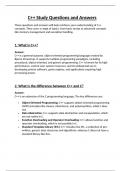
C++ Study Questions and Answers
These questions and answers will help reinforce your understanding of C++
concepts. They cover a range of topics, from basic syntax to advanced concepts
like memory management and exception handling.
1. What is C++?
Answer:
C++ is a general-purpose, object-oriented programming language created by
Bjarne Stroustrup. It supports multiple programming paradigms, including
procedural, object-oriented, and generic programming. C++ is known for its high
performance, control over system resources, and its widespread use in
developing system software, game engines, and applications requiring high
processing power.
2. What is the difference between C++ and C?
Answer:
C++ is an extension of the C programming language. The key differences are:
Object-Oriented Programming: C++ supports object-oriented programming
(OOP) principles like classes, inheritance, and polymorphism, while C does
not.
Data Abstraction: C++ supports data abstraction and encapsulation, which
are not native in C.
Function Overloading and Operator Overloading: C++ allows function and
operator overloading, which is not possible in C.
Standard Template Library (STL): C++ includes the STL, a collection of pre-
written, generic data structures and algorithms, whereas C does not have a
standard library like this.
, 3. What is the use of the main() function in C++?
Answer:
The main() function is the entry point of every C++ program. When the program is
executed, the execution starts from the main() function. It returns an integer to
the operating system, typically 0 to indicate successful execution, and non-zero
values to indicate errors.
4. Explain the difference between ++i and i++ in C++.
Answer:
++i (Pre-increment): The variable i is incremented first, then the value of i is
used in the expression.
i++ (Post-increment): The value of i is used in the expression first, then i is
incremented.
Example:
int i = 5;
int a = ++i; // i becomes 6, then a is assigned 6
int b = i++; // b is assigned 6, then i becomes 7
5. What are pointers in C++?
Answer:
A pointer is a variable that stores the memory address of another variable.
Pointers are used for dynamic memory allocation and for accessing data in arrays
and linked structures.
Example:
int a = 10;
int* ptr = &a; // ptr holds the address of variable 'a'
These questions and answers will help reinforce your understanding of C++
concepts. They cover a range of topics, from basic syntax to advanced concepts
like memory management and exception handling.
1. What is C++?
Answer:
C++ is a general-purpose, object-oriented programming language created by
Bjarne Stroustrup. It supports multiple programming paradigms, including
procedural, object-oriented, and generic programming. C++ is known for its high
performance, control over system resources, and its widespread use in
developing system software, game engines, and applications requiring high
processing power.
2. What is the difference between C++ and C?
Answer:
C++ is an extension of the C programming language. The key differences are:
Object-Oriented Programming: C++ supports object-oriented programming
(OOP) principles like classes, inheritance, and polymorphism, while C does
not.
Data Abstraction: C++ supports data abstraction and encapsulation, which
are not native in C.
Function Overloading and Operator Overloading: C++ allows function and
operator overloading, which is not possible in C.
Standard Template Library (STL): C++ includes the STL, a collection of pre-
written, generic data structures and algorithms, whereas C does not have a
standard library like this.
, 3. What is the use of the main() function in C++?
Answer:
The main() function is the entry point of every C++ program. When the program is
executed, the execution starts from the main() function. It returns an integer to
the operating system, typically 0 to indicate successful execution, and non-zero
values to indicate errors.
4. Explain the difference between ++i and i++ in C++.
Answer:
++i (Pre-increment): The variable i is incremented first, then the value of i is
used in the expression.
i++ (Post-increment): The value of i is used in the expression first, then i is
incremented.
Example:
int i = 5;
int a = ++i; // i becomes 6, then a is assigned 6
int b = i++; // b is assigned 6, then i becomes 7
5. What are pointers in C++?
Answer:
A pointer is a variable that stores the memory address of another variable.
Pointers are used for dynamic memory allocation and for accessing data in arrays
and linked structures.
Example:
int a = 10;
int* ptr = &a; // ptr holds the address of variable 'a'