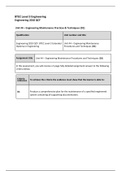
BTEC Level 3 Engineering
Engineering 2010 QCF
Unit 44 – Engineering Maintenance Practices & Techniques (D1)
Qualification Unit number and title
Engineering 2010 QCF: BTEC Level 3 Extended Unit 44 – Engineering Maintenance
Diploma in Engineering Procedures and Techniques (D1)
Assignment title Unit 44 – Engineering Maintenance Procedures and Techniques (D1)
In this assessment, you will receive a 5 page fully detailed assignment answer to the following
criteria below.
Criteria To achieve the criteria the evidence must show that the learner is able to:
reference
D1 Produce a comprehensive plan for the maintenance of a specified engineered
system containing all supporting documentation.
, BTEC Level 3 Engineering
Unit 44 – Engineering Maintenance Procedures and Techniques (D1)
D1: Produce a comprehensive plan for the maintenance of a specified
engineered system containing all supporting documentation.
Comprehensive Maintenance Plan for Lathe Machines
To determine the appropriate maintenance plan, a risk evaluation should be done by the
maintenance engineer, who will find the following:
• Maintenance advice of the equipment maker, who understands the equipment 's
architecture and components and has a good understanding of the parts are most
susceptible to deterioration; they can also propose an acceptable repair schedule for
the machine.
• Awareness of how much the equipment is used will also provide an indication of the
degree and duration of maintenance needed. Heavily used equipment would suffer
from rapid wear and tear and require more frequent maintenance than a rarely used
machine.
• User knowledge and experience accumulated over time is also essential to determine
which equipment or part would fail and/or require more frequent maintenance.
• In determining the nature and frequency of the maintenance, the risk to health and
safety from equipment failure is also crucial. The more regular and thorough
maintenance is needed the higher the risk.
The maintenance engineer must determine the best management plan out of the four basic
maintenance types / strategies that are briefly listed below:
1. Reactive (Breakdown) Maintenance, which means the machine runs until it breaks down.
This isn't a proper lathe machine maintenance strategy. This technique would shorten the life
of the equipment and lead to more frequent system maintenance and secondary failures. The
engineering company's production will be affected as no-one knows when the lathe machines
will break.
2. Preventive Maintenance Is performed at "predetermined intervals" or "as prescribed." The
schedules for the maintenance are planned according to the need. This maintenance strategy
has many benefits over a reactive maintenance strategy; since it reduces the chances of
equipment failure or degradation and prolongs the life of the machines. Therefore, that is the
preferred lathe machines repair technique.
3. Predictive Maintenance Is combined with analyses, measurements, and routine testing to
forecast product decay and determine when maintenance is needed. Therefore, it is
important to prolong the usable life of a part (which may have been prematurely substituted
if proactive maintenance approach is used), while also maintaining protection and
manufacturing performance in the engineering business.
4. Condition Based Maintenance Is based on continuous monitoring of the performance of
the equipment by means of "on-line detection system." Maintenance often happens as "any
signs send the warning" that the system deteriorates, the risk of failure decreases.
Engineering 2010 QCF
Unit 44 – Engineering Maintenance Practices & Techniques (D1)
Qualification Unit number and title
Engineering 2010 QCF: BTEC Level 3 Extended Unit 44 – Engineering Maintenance
Diploma in Engineering Procedures and Techniques (D1)
Assignment title Unit 44 – Engineering Maintenance Procedures and Techniques (D1)
In this assessment, you will receive a 5 page fully detailed assignment answer to the following
criteria below.
Criteria To achieve the criteria the evidence must show that the learner is able to:
reference
D1 Produce a comprehensive plan for the maintenance of a specified engineered
system containing all supporting documentation.
, BTEC Level 3 Engineering
Unit 44 – Engineering Maintenance Procedures and Techniques (D1)
D1: Produce a comprehensive plan for the maintenance of a specified
engineered system containing all supporting documentation.
Comprehensive Maintenance Plan for Lathe Machines
To determine the appropriate maintenance plan, a risk evaluation should be done by the
maintenance engineer, who will find the following:
• Maintenance advice of the equipment maker, who understands the equipment 's
architecture and components and has a good understanding of the parts are most
susceptible to deterioration; they can also propose an acceptable repair schedule for
the machine.
• Awareness of how much the equipment is used will also provide an indication of the
degree and duration of maintenance needed. Heavily used equipment would suffer
from rapid wear and tear and require more frequent maintenance than a rarely used
machine.
• User knowledge and experience accumulated over time is also essential to determine
which equipment or part would fail and/or require more frequent maintenance.
• In determining the nature and frequency of the maintenance, the risk to health and
safety from equipment failure is also crucial. The more regular and thorough
maintenance is needed the higher the risk.
The maintenance engineer must determine the best management plan out of the four basic
maintenance types / strategies that are briefly listed below:
1. Reactive (Breakdown) Maintenance, which means the machine runs until it breaks down.
This isn't a proper lathe machine maintenance strategy. This technique would shorten the life
of the equipment and lead to more frequent system maintenance and secondary failures. The
engineering company's production will be affected as no-one knows when the lathe machines
will break.
2. Preventive Maintenance Is performed at "predetermined intervals" or "as prescribed." The
schedules for the maintenance are planned according to the need. This maintenance strategy
has many benefits over a reactive maintenance strategy; since it reduces the chances of
equipment failure or degradation and prolongs the life of the machines. Therefore, that is the
preferred lathe machines repair technique.
3. Predictive Maintenance Is combined with analyses, measurements, and routine testing to
forecast product decay and determine when maintenance is needed. Therefore, it is
important to prolong the usable life of a part (which may have been prematurely substituted
if proactive maintenance approach is used), while also maintaining protection and
manufacturing performance in the engineering business.
4. Condition Based Maintenance Is based on continuous monitoring of the performance of
the equipment by means of "on-line detection system." Maintenance often happens as "any
signs send the warning" that the system deteriorates, the risk of failure decreases.