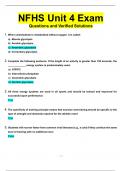
NFHS Unit 4 Exam
Questions and Verified Solutions
1. When carbohydrate is metabolized without oxygen, it is called:
a) Muscle glycolysis
b) Aerobic glycolysis
c) Anaerobic glycolysis
d) Involuntary glycolysis
2. Complete the following sentence. If the length of an activity is greater than 150 seconds, the
_____________ energy system is predominately used.
a) ATP/PC
b) Intercellular phosphate
c) Anaerobic glycolysis
d) Aerobic glycolysis
3. All three energy systems are used in all sports and should be trained and improved for
successful sport performance
True
4. The specificity of training principle means that exercise and training should be specific to the
type of strength and demands required for the athletic event
True
5. Students will recover faster from common viral illnesses (e.g., a cold) if they continue the same
level of training with no additional rest.:
False
, 6. Research has shown that humans improve their task performance through the application of
stress followed by:
a) Aerobic activity
b) Sedentary activity
c) Carbohydrates
d) Relief of stress
7. An extended period of poor performance in training or competition is a potential marker of
overtraining
True
8. Dividing the pre-season into three, 4-week blocks of time is referred to as "periodization." Each
4-week block should begin with:
a) A hard week followed by an easy week and another hard week.
b) A hard week followed by a week off.
c) An easy week, followed by medium/hard week, followed by the hardest week.
d) An easy week followed by a medium week and another easy week
9. The "Use it or lose it!" principle (reversibility) states that if training is stopped, a student's
strength, fitness and body composition will return to pre-training levels very quickly - within
two weeks
True
10. Based on the specificity and reversibility principle, training during the off-season should:
a) Be similar to training during the competitive season, i.e., students should compete year-
round.
b) Focus on improving anaerobic systems.
c) Focus primarily on tactics and techniques related to the sport.
d) Focus on general strength and conditioning in activities similar to the sport-
11. When a student can no longer execute a movement or technique at her current level of skill,
it generally means that she is fatigued.:
Questions and Verified Solutions
1. When carbohydrate is metabolized without oxygen, it is called:
a) Muscle glycolysis
b) Aerobic glycolysis
c) Anaerobic glycolysis
d) Involuntary glycolysis
2. Complete the following sentence. If the length of an activity is greater than 150 seconds, the
_____________ energy system is predominately used.
a) ATP/PC
b) Intercellular phosphate
c) Anaerobic glycolysis
d) Aerobic glycolysis
3. All three energy systems are used in all sports and should be trained and improved for
successful sport performance
True
4. The specificity of training principle means that exercise and training should be specific to the
type of strength and demands required for the athletic event
True
5. Students will recover faster from common viral illnesses (e.g., a cold) if they continue the same
level of training with no additional rest.:
False
, 6. Research has shown that humans improve their task performance through the application of
stress followed by:
a) Aerobic activity
b) Sedentary activity
c) Carbohydrates
d) Relief of stress
7. An extended period of poor performance in training or competition is a potential marker of
overtraining
True
8. Dividing the pre-season into three, 4-week blocks of time is referred to as "periodization." Each
4-week block should begin with:
a) A hard week followed by an easy week and another hard week.
b) A hard week followed by a week off.
c) An easy week, followed by medium/hard week, followed by the hardest week.
d) An easy week followed by a medium week and another easy week
9. The "Use it or lose it!" principle (reversibility) states that if training is stopped, a student's
strength, fitness and body composition will return to pre-training levels very quickly - within
two weeks
True
10. Based on the specificity and reversibility principle, training during the off-season should:
a) Be similar to training during the competitive season, i.e., students should compete year-
round.
b) Focus on improving anaerobic systems.
c) Focus primarily on tactics and techniques related to the sport.
d) Focus on general strength and conditioning in activities similar to the sport-
11. When a student can no longer execute a movement or technique at her current level of skill,
it generally means that she is fatigued.: