1|Page
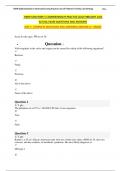
NUR 265 EXAM 1 NEWEST 2025 ACTUAL EXAM
COMPLETE 200 QUESTIONS AND CORRECT
DETAILED ANSWERS (VERIFIED ANSWERS)
|ALREADY GRADED A+||BRAND NEW!!
A nurse teaches a client who experiences occasional premature
atrial contractions (PACs) accompanied by palpitations that
resolve spontaneously without treatment. Which statement
should the nurse include in this client's teaching?
a.
"Minimize or abstain from caffeine."
b.
"Lie on your side until the attack subsides."
c.
"Use your oxygen when you experience PACs."
d.
"Take amiodarone (Cordarone) daily to prevent PACs." -
ANSWER-ANS: A
PACs usually have no hemodynamic consequences. For a client
experiencing infrequent PACs, the nurse should explore possible
lifestyle causes, such as excessive caffeine intake and stress.
Lying on the side will not prevent or resolve PACs. Oxygen is
not necessary. Although medications may be needed to control
,2|Page
symptomatic dysrhythmias, for infrequent PACs, the client first
should try lifestyle changes to control them.
A nurse cares for a client who is on a cardiac monitor. The
monitor displayed the rhythm shown below:
VTACH
Which action should the nurse take first?
a.
Assess airway, breathing, and level of consciousness.
b.
Administer an amiodarone bolus followed by a drip.
c.
Cardiovert the client with a biphasic defibrillator.
d.
Begin cardiopulmonary resuscitation (CPR). - ANSWER-ANS:
A
Ventricular tachycardia occurs with repetitive firing of an
irritable ventricular ectopic focus, usually at a rate of 140 to 180
beats/min or more. Ventricular tachycardia is a lethal
dysrhythmia. The nurse should first assess if the client is alert
,3|Page
and breathing. Then the nurse should call a Code Blue and begin
CPR. If this client is pulseless, the treatment of choice is
defibrillation. Amiodarone is the antidysrhythmic of choice, but
it is not the first action.
The nurse is caring for a client on the medical-surgical unit who
suddenly becomes unresponsive and has no pulse. The cardiac
monitor shows the rhythm below:
VFIB
After calling for assistance and a defibrillator, which action
should the nurse take next?
a.
Perform a pericardial thump.
b.
Initiate cardiopulmonary resuscitation (CPR).
c.
Start an 18-gauge intravenous line.
d.
Ask the client's family about code status. - ANSWER-ANS: B
, 4|Page
The client's rhythm is ventricular fibrillation. This is a lethal
rhythm that is best treated with immediate defibrillation. While
the nurse is waiting for the defibrillator to arrive, the nurse
should start CPR. A pericardial thump is not a treatment for
ventricular fibrillation. If the client does not already have an IV,
other members of the team can insert one after defibrillation.
The client's code status should already be known by the nurse
prior to this event
A nurse assesses clients on a cardiac unit. Which client should
the nurse identify as being at greatest risk for the development
of left-sided heart failure?
a.
A 36-year-old woman with aortic stenosis
b.
A 42-year-old man with pulmonary hypertension
c.
A 59-year-old woman who smokes cigarettes daily
d.
A 70-year-old man who had a cerebral vascular accident -
ANSWER-ANS: A
Although most people with heart failure will have failure that
progresses from left to right, it is possible to have left-sided
NUR 265 EXAM 1 NEWEST 2025 ACTUAL EXAM
COMPLETE 200 QUESTIONS AND CORRECT
DETAILED ANSWERS (VERIFIED ANSWERS)
|ALREADY GRADED A+||BRAND NEW!!
A nurse teaches a client who experiences occasional premature
atrial contractions (PACs) accompanied by palpitations that
resolve spontaneously without treatment. Which statement
should the nurse include in this client's teaching?
a.
"Minimize or abstain from caffeine."
b.
"Lie on your side until the attack subsides."
c.
"Use your oxygen when you experience PACs."
d.
"Take amiodarone (Cordarone) daily to prevent PACs." -
ANSWER-ANS: A
PACs usually have no hemodynamic consequences. For a client
experiencing infrequent PACs, the nurse should explore possible
lifestyle causes, such as excessive caffeine intake and stress.
Lying on the side will not prevent or resolve PACs. Oxygen is
not necessary. Although medications may be needed to control
,2|Page
symptomatic dysrhythmias, for infrequent PACs, the client first
should try lifestyle changes to control them.
A nurse cares for a client who is on a cardiac monitor. The
monitor displayed the rhythm shown below:
VTACH
Which action should the nurse take first?
a.
Assess airway, breathing, and level of consciousness.
b.
Administer an amiodarone bolus followed by a drip.
c.
Cardiovert the client with a biphasic defibrillator.
d.
Begin cardiopulmonary resuscitation (CPR). - ANSWER-ANS:
A
Ventricular tachycardia occurs with repetitive firing of an
irritable ventricular ectopic focus, usually at a rate of 140 to 180
beats/min or more. Ventricular tachycardia is a lethal
dysrhythmia. The nurse should first assess if the client is alert
,3|Page
and breathing. Then the nurse should call a Code Blue and begin
CPR. If this client is pulseless, the treatment of choice is
defibrillation. Amiodarone is the antidysrhythmic of choice, but
it is not the first action.
The nurse is caring for a client on the medical-surgical unit who
suddenly becomes unresponsive and has no pulse. The cardiac
monitor shows the rhythm below:
VFIB
After calling for assistance and a defibrillator, which action
should the nurse take next?
a.
Perform a pericardial thump.
b.
Initiate cardiopulmonary resuscitation (CPR).
c.
Start an 18-gauge intravenous line.
d.
Ask the client's family about code status. - ANSWER-ANS: B
, 4|Page
The client's rhythm is ventricular fibrillation. This is a lethal
rhythm that is best treated with immediate defibrillation. While
the nurse is waiting for the defibrillator to arrive, the nurse
should start CPR. A pericardial thump is not a treatment for
ventricular fibrillation. If the client does not already have an IV,
other members of the team can insert one after defibrillation.
The client's code status should already be known by the nurse
prior to this event
A nurse assesses clients on a cardiac unit. Which client should
the nurse identify as being at greatest risk for the development
of left-sided heart failure?
a.
A 36-year-old woman with aortic stenosis
b.
A 42-year-old man with pulmonary hypertension
c.
A 59-year-old woman who smokes cigarettes daily
d.
A 70-year-old man who had a cerebral vascular accident -
ANSWER-ANS: A
Although most people with heart failure will have failure that
progresses from left to right, it is possible to have left-sided