NR554 Week 2 Discussion, Applied Change Implementation
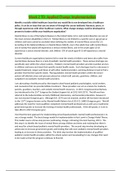
Week 2 TD: Applied Change Implementation Identify a socially visible healthcare issue that you would like to see developed into a healthcare policy. It can be an issue that you are aware of through the course textbook, literature, peers, or through experiences with other healthcare systems. What change strategy could be developed to present to leaders within your healthcare organization? Mental illness is one of the highest diseases in the United States (U.S.) and mental disorders are one of the most common disabilities in the U.S. Mental illness is not limited to a specific race or age group so children and teens cannot be excluded when defining the statistic of mental illness across the U.S. According to the National Alliance on Mental Illness (NAMI), one in five adults lives with mental illness, one in twenty-five adults will experience a serious mental illness, one in five youth aged 13-18 experiences a severe mental disorder, and children 13% of youth aged 8-15 will experience a mental disorder. Current healthcare organizations/systems fail to meet the needs of children and teens who suffer from mental illness because there is a lack of pediatric mental health providers. These serious shortages are specifically seen within the school systems. Pediatric mental health providers provide essential services to children and teens and meet their specific mental health needs. Such shortages lead to a decrease in needed treatment, longer wait times at with other medical providers, and long-distance travel to find a provider that fits their specific needs. Placing pediatric mental health providers within the school system will alleviate stress and pressure placed on school staff, parents, guardians, children, and outpatient non-pediatric mental health providers. I am advocating a healthcare policy that targets school-based pediatric psychologists, social workers, and counselors that can provide/initiate treatment. These providers can act as a liaison for students, parents, guardians, teachers, and outside mental health resources. In 2015, Congresswoman Barbara Lee introduced to the 114th Congress the Student Support Act of 2015 (H.R.2375). The bill was then referred to the Subcommittee on Early Childhood, Elementary, and Secondary Education, however it was not enacted (C). Although H.R. 2374 was not enacted, another bill has been introduced to the 114th Congress known as the Mental Health Reform Act of 2015 (S. 2680) (C). This bill addresses the need for more qualified, competent mental health professionals as well as to reauthorize government grants to increase the training of mental health professionals. If this bill passes, it is set to take affect in 2021 (C). I feel that the best approach for implementing school-based pediatric mental health professionals is to use a change model. The best change model for implementation is Kurt Lewin’s Change Model Theory. This model covers a three-step process (unfreezing, change, refreezing) (Current Nursing, 2011). The first step is to identify the issue of mental illness among children and teens and realizing that there is and need for school-based pediatric mental health providers. The second step involves developing an action plan to increase government grants and funding that will cover pediatric mental health providers leading to an increase in these providers. The third step involves the implementation of qualified pediatric mental health providers within the school system and reevaluating for any changes that need to be made so that the program continues to flourish. Stakeholders for this change are students, teachers, parents, guardians, school-based mental health providers, outpatient mental health providers, mental health coalitions, and policymakers at all levels of government. I am dedicated to see this occur so that community awareness is raised regarding mental illness. Mental illness needs to be seen more like a serious issue than a stigma and an elephant in the room no one wants to address. References: C. (n.d.). H.R.2375 – Student Support Act. Retrieved from C. (n.d.). S.2680 – Mental Health Reform Act of 2016. Retrieved from National Alliance for Mental Illness. (n.d.). Mental health by numbers. Retrieved from Office of Disease Prevention and Health Promotion. (2019). Menta health. Retrieved from
Written for
- Institution
-
Chamberlain College Nursing
- Course
-
NR 554 (NR554)
Document information
- Uploaded on
- February 4, 2021
- Number of pages
- 2
- Written in
- 2020/2021
- Type
- Case
- Professor(s)
- Professor
- Grade
- A+
Subjects
- nr554 week 2 discussion
-
applied change implementation
-
week 2 td applied change implementation identify a socially visible healthcare issue that you would like to see developed into a healthcare poli

Also available in package deal