Module 16 oxygenation - Study guides, Class notes & Summaries

Looking for the best study guides, study notes and summaries about Module 16 oxygenation? On this page you'll find 120 study documents about Module 16 oxygenation.

Page 4 out of 120 results

Sort by:
 Portage Learning BIOD 152 A&P 2 Final Exam
  • Exam (elaborations)

    Portage Learning BIOD 152 A&P 2 Final Exam

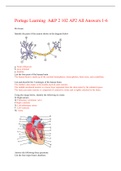
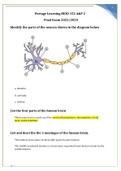
  • Portage Learning BIOD 152 A&P 2 Final Exam 2023/2024 Identify the parts of the neuron shown in the diagram below a. dendrite b. cell body c. nucleus List the four parts of the human brain The human brain is made up of the cerebral hemispheres, diencephalon, brain stem, andcerebellum. List and describe the 3 meninges of the human brain. The leathery dura mater is the double-layered outer meninx. The middle arachnoid meninx is a loose layer separated from the dura...
  • examsetters
    $11.49 More Info
NUR2115- Fundamentals of Professional Nursing  Final Exam
  • Exam (elaborations)

    NUR2115- Fundamentals of Professional Nursing Final Exam

  • NUR2115- Fundamentals of Professional Nursing Final Exam All Modules Review various nursing diagnoses related to specific patient problems · Oxygenation · Ineffective Airway Clearance: fatigue, COPD. Thick, yellow secretions · Impaired Gas Exchange: smokers, asbestos workers. Cyanosis altered blood gases · Ineffective Breathing Pattern: anxiety. Hyperventilating, tachypneic. · Infection · Risk for Infection: chronic illness (diabetes), alteration in skin integrity. S/S of infecti...
  • Docmercy
    $10.49 More Info
NUR 2063 Pathophysiology Final Exam Study Guide Modules 1-10,100% CORRECT
  • Exam (elaborations)

    NUR 2063 Pathophysiology Final Exam Study Guide Modules 1-10,100% CORRECT

  • NUR 2063 Pathophysiology Final Exam Study Guide Modules1-10 Module 1 Chapter 2 I. General Adaptation Syndrome and Allostasis a. Alarm Stage: Fight-or-Flight response due to stressful stimuli. b. Resistance Stage: Nervous & Endocrine systems returning the body to homeostasis c. Exhaustion Stage: Point where bofy can no longer return to homeostasis Chapter 24 II. Body Fluid Homeostasis: Pertains to water within the b...
  • ElonMusk
    $17.99 More Info
NUR 2633 MATERNAL NEWBORN EXAM 1 STUDY GUIDE PART 2
  • Exam (elaborations)

    NUR 2633 MATERNAL NEWBORN EXAM 1 STUDY GUIDE PART 2

  • Maternal Child Exam 1 (module 1 & 2) • Family types o Nuclear (male partner, female partner, their children) o Extended (family unit plus other family member in the same household) o Married-blended (post death/divorce o Commune (group of men, women, and children living together) o Cohabitation (unmarried man and woman living together) o No-parent (children living independent, in foster care, or with close relative) • Family Systems Theory o Changes that occur in one member affect t...
  • Kingamor
    $10.50 More Info
Portage Learning  A&P 2 102 AP2 All Answers 1-6
  • Exam (elaborations)

    Portage Learning A&P 2 102 AP2 All Answers 1-6

  • Portage Learning A&P 2 102 AP2 All Answers 1-6 Pre Exam Identify the parts of the neuron shown in the diagram below g. Node of Ranvier h. axon terminal a. dendrite List the four parts of the human brain The human brain is made up of the cerebral hemispheres, diencephalon, brain stem, and cerebellum. List and describe the 3 meninges of the human brain. The leathery dura mater is the double-layered outer meninx. The middle arachnoid meninx is a loose layer separated from the ...
  • newacademicssolutions
    $15.99 More Info
ATLS Case Scenario CDEM Self Study Modules Approach to Trauma
  • Exam (elaborations)

    ATLS Case Scenario CDEM Self Study Modules Approach to Trauma

  • ATLS Case Scenario CDEM Self Study Modules Approach to Trauma APPROVED BY: DEM Curriculum Home The Approach To... Specific Diseases DIEM Cases Downloads ML's Blog The Approach to Trauma WRITTEN BY: NICHOLAS E. KMAN, MD THE OHIO STATE UNIVERSITY EDITED BY: DAVID MANTHEY, MD WAKE FOREST MEDICAL SCHOOL Trauma is the leading cause of death in the first four decades of life in most developed countries. To this end, there are more than 5 million trauma-related deaths each year worldwide....
  • BRIGHTSTUDYTUTOR
    $24.54 More Info
ATLS Case Scenario CDEM Self Study Modules Approach to Trauma
  • Exam (elaborations)

    ATLS Case Scenario CDEM Self Study Modules Approach to Trauma

  • ATLS Case Scenario CDEM Self Study Modules Approach to Trauma APPROVED BY: DEM Curriculum Home The Approach To... Specific Diseases DIEM Cases Downloads ML's Blog The Approach to Trauma WRITTEN BY: NICHOLAS E. KMAN, MD THE OHIO STATE UNIVERSITY EDITED BY: DAVID MANTHEY, MD WAKE FOREST MEDICAL SCHOOL Trauma is the leading cause of death in the first four decades of life in most developed countries. To this end, there are more than 5 million trauma-related deaths each year worldwide....
  • BRIGHTSTUDYTUTOR
    $18.97 More Info
Portage Learning  A&P 2 102 AP2 All Answers 1-6
  • Exam (elaborations)

    Portage Learning A&P 2 102 AP2 All Answers 1-6

  • Portage Learning A&P 2 102 AP2 All Answers 1-6 Pre Exam Identify the parts of the neuron shown in the diagram below g. Node of Ranvier h. axon terminal a. dendrite List the four parts of the human brain The human brain is made up of the cerebral hemispheres, diencephalon, brain stem, and cerebellum. List and describe the 3 meninges of the human brain. The leathery dura mater is the double-layered outer meninx. The middle arachnoid meninx is a loose layer separated from the ...
  • EuniceAcademics
    $15.99 More Info
NUR_2115 Exam Guide.
  • Summary

    NUR_2115 Exam Guide.

  • NUR_2115 Exam Guide. All Modules Review various nursing diagnoses related to specific patient problems · Oxygenation · Ineffective Airway Clearance: fatigue, COPD. Thick, yellow secretions · Impaired Gas Exchange: smokers, asbestos workers. Cyanosis altered blood gases · Ineffective Breathing Pattern: anxiety. Hyperventilating, tachypneic. · Infection · Risk for Infection: chronic illness (diabetes), alteration in skin integrity. S/S of infectious process, drainage or secretion...
  • D0ctorMackenzie
    $4.49 More Info
Module 5 Pharmacology Reasoning Bradycardia Suggested Answer Guidelines
  • Exam (elaborations)

    Module 5 Pharmacology Reasoning Bradycardia Suggested Answer Guidelines

  • Module 5 Pharmacology Reasoning Bradycardia Suggested Answer Guidelines Marilyn Fitch, 78 years old Medication Categories: Concepts/Content: Antidysrhythmics Assessment ACE Inhibitors Drug-drug interactions Beta Blockers Evaluation of desired outcomes Statins Monitoring for adverse effects Oral Anticoagulants Emergency treatment of dysrhythmias Diuretics Client education Electrolytes Psychosocial support NCLEX Client Need Categories Percentage of Items from Each Category/Sub...
  • ExperTutor
    $14.49 More Info
Fear of missing out? Then don’t!
Do you wonder why so many students wear nice clothes, have money to spare and enjoy tons of free time? Well, they sell on Stuvia! Imagine your study notes being downloaded a dozen times for $15 each. Every. Single. Day.