Escrito por estudiantes que aprobaron Inmediatamente disponible después del pago Leer en línea o como PDF ¿Documento equivocado? Cámbialo gratis 4,6 TrustPilot
logo-home
Examen

CHEM 120 Unit 2 Lab: OL Lab 3: Periodic Table of Elements

Puntuación
-
Vendido
-
Páginas
2
Grado
A+
Subido en
23-04-2022
Escrito en
2021/2022

CHEM 120 Unit 2 Lab: OL Lab 3: Periodic Table of Elements Learning Objectives: Describe the structure and organization of the periodic table Classify elements of a family based on their location in the periodic table Distinguish metals from other element classes based on typical characteristics Use the flame color test to identify metals based on their position in the periodic table Explain valence electrons and oxidation state of a main group element to its position in the periodic table Describe the main trends among groups and periods for atomic properties Explain the causes on the atomic level for the main trends among groups and periods concerning atomic radii, ionization energy and electronegativity Introduction Light up the elements! In this simulation, you will learn all the fundamental ins and outs of the periodic table. Find out which elements have metallic characteristics, perform a flame test, and explore trends in atomic properties among the main groups and periods. A broken table The periodic table is an amazing tool for getting an overview of all the elements in existence, even the elements that only exist when we create them ourselves. But the table in this virtual lab is broken; some of the elements have fallen out, and it’s your mission to figure out where they belong by investigating their characteristics and properties. Flame color test and atomic properties To sort the first few elements in the table you can observe their flame colors. You may need to use your knowledge about element classes as well to get the full understanding. There are surprisingly many atomic properties for which trends can be observed via the periodic table. Moving on to the virtual holo-table, you will investigate these trends and deduct how they behave when you move within and between periods and groups of the table. You will need this knowledge to assign the most tricky fallen-out elements. Become the teacher At the end of the simulation, a special visitor will be coming by the lab, and she needs you to help her understand the basics of the periodic table. Part 1: Complete Labster Lab: Periodic Table of Elements: Get the table organized in time! Part 2: Report and Reflection Purpose: Describe in complete sentences and in your own words, the purpose of this experiment. Observations: Record three observations from the simulation. Answer the questions below: For each of the following elements, give another element in the same family. (2 points) In your own words, describe the terms below: Reflection: Consider what you learned from this simulation. Reflect on three to four key concepts that you learned in this lab exercise. How could the lessons learned in this virtual lab relate to a real world situation in the community/world or your future career? Be specific in your answer (this should require 5-10 sentences). CHEM 120 Unit 2 Lab: OL Lab 4; Ionic and Covalent Bonds Learning Objectives Describe the formation of ionic and covalent bonds Identify anions and cations Apply the octet rule Describe ionic lattice structure Draw Lewis dot structures Explain the formation of single, double, and triple bonds Distinguish between ionic compounds and covalent compounds Introduction Have you ever wondered how atoms are held together? In this simulation, you will learn the basics about atomic bonding in ionic and covalent compounds, and how to distinguish those compounds experimentally. With all this knowledge, you will help your friend analyze two mysterious substances he received from an alchemist. By testing their specific physical properties, you’ll be able to identify the nature of the substances. Finally, you will learn how ions form lattice structures and how this influences the property of a compound. Test solubility and conductivity Atoms can interact in many different ways, creating new compounds with unique properties. In the first mission of the Ionic and Covalent Bonds simulation, your task is to choose appropriate laboratory equipment to test the solubility and conductivity of the two substances. You will explore how these properties differ in ionic and covalent compounds. Draw Lewis dot structures In the second part of the Ionic and Covalent Bonds simulation, you will learn about the octet rule and how to apply this to building Lewis dot structures in a virtual drawing activity. You will see that there are many ways that covalent bonds can be formed, depending on the compound and electron configuration. You will also learn how to identify lone pair electron in a covalent bond. Determine melting points In the last mission, your task is to determine the melting point of the two substances by using a melting point apparatus. You will explore how your results are connected to the ability of ions to form a lattice structure. Part 1: Complete Labster Lab Ionic and Covalent Bonds Part 2: Report and Reflection Purpose: Describe in complete sentences and in your own words, the purpose of this experiment. Observations: Record three observations from the simulation. Answer the questions below: In your own words, explain the terms below: For each of the below, predict the expected ion each could become by giving the charges. For each of the molecules below, determine what molecular shape you would expect. Reflection: Consider what you learned from this simulation. Reflect on three to four key concepts that you learned in this lab exercise. How could the lessons learned in this virtual lab relate to a real world situation in the community/world or your future career? Be specific in your answer (this should require 5-10 sentences). Show Less

Mostrar más Leer menos
Institución
Grado

Vista previa del contenido

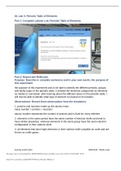
OL Lab 3: Periodic Table of Elements
Part 1: Complete Labster Lab: Periodic Table of Elements


Part 2: Report and Reflection
Purpose: Describe in complete sentences and in your own words, the purpose of
this experiment.
the purpose of this experiment was to be able to identify the different periods, groups,
and family types of the periodic table. it showed the elements categorized as elements
as metals or nonmetals. after learning about the different areas on the periodic table, I
will now be able to identify what type of element it is based on its location.
Observations: Record three observations from the simulation.
1. protons and neutrons make up the atomic mass.
mass number = protons + neutrons
atomic number represents the number of protons and is fixed for every element
2. elements in the same period have the same number of electron shells and tend to
have similar properties. whereas elements in the same group have the same electron
configuration in their valence shell.
3. all elements that have eight electrons in their valence shell complete an octet and are
known as noble gases.


Sumiya Jonét Culler CHEM120 - Week 2 Lab
This study source was downloaded by 100000845689434 from CourseHero.com on 04-23-2022 12:50:46 GMT -05:00


https://www.coursehero.com/file/68083782/Week-2-Periodic-Tabledocx/

Escuela, estudio y materia

Institución
Grado

Información del documento

Subido en
23 de abril de 2022
Número de páginas
2
Escrito en
2021/2022
Tipo
Examen
Contiene
Preguntas y respuestas

Temas

10,05 €
Accede al documento completo:

¿Documento equivocado? Cámbialo gratis Dentro de los 14 días posteriores a la compra y antes de descargarlo, puedes elegir otro documento. Puedes gastar el importe de nuevo.
Escrito por estudiantes que aprobaron
Inmediatamente disponible después del pago
Leer en línea o como PDF


Documento también disponible en un lote

Conoce al vendedor

Seller avatar
Los indicadores de reputación están sujetos a la cantidad de artículos vendidos por una tarifa y las reseñas que ha recibido por esos documentos. Hay tres niveles: Bronce, Plata y Oro. Cuanto mayor reputación, más podrás confiar en la calidad del trabajo del vendedor.
EliteStudyDocs Rasmussen College
Seguir Necesitas iniciar sesión para seguir a otros usuarios o asignaturas
Vendido
3530
Miembro desde
5 año
Número de seguidores
2869
Documentos
8978
Última venta
1 día hace
High Quality Exams, Study guides, Reviews, Notes, Case Studies

Welcome to EliteStudyDocs, your ultimate destination for high-quality, verified study materials trusted by students, educators, and professionals across the globe. I specialize in providing A+ graded exam files, practice questions, complete study guides, and certification prep tailored to a wide range of academic and professional fields. Whether you're preparing for nursing licensure (NCLEX, ATI, HESI, ANCC, AANP), healthcare certifications (ACLS, BLS, PALS, PMHNP, AGNP), standardized tests (TEAS, HESI, PAX, NLN), or university-specific exams (WGU, Portage Learning, Chamberlain, and more), our documents are 100% correct, up-to-date and reviewed for accuracy. What makes my documents stand out: ✔ Latest 2026/2027 Updates ✔ Verified Questions & Correct Answers ✔ Clean, Professional Exam Format ✔ Designed for High Grades (A/A+) P/S: CHECK OUT THE PACKAGE DEALS

Lee mas Leer menos
4,0

696 reseñas

5
382
4
127
3
77
2
39
1
71

Recientemente visto por ti

Por qué los estudiantes eligen Stuvia

Creado por compañeros estudiantes, verificado por reseñas

Calidad en la que puedes confiar: escrito por estudiantes que aprobaron y evaluado por otros que han usado estos resúmenes.

¿No estás satisfecho? Elige otro documento

¡No te preocupes! Puedes elegir directamente otro documento que se ajuste mejor a lo que buscas.

Paga como quieras, empieza a estudiar al instante

Sin suscripción, sin compromisos. Paga como estés acostumbrado con tarjeta de crédito y descarga tu documento PDF inmediatamente.

Student with book image

“Comprado, descargado y aprobado. Así de fácil puede ser.”

Alisha Student

Preguntas frecuentes